
 E-Paper



Shambhu stir leaves Zirakpur battling daily traffic nightmare
As per police data, now over 50,000 vehicles pass through Dappar toll plaza daily, as compared to 38,000 vehicles before the blockade at Shambhu; 10,000 additional vehicles, including trucks and buses, are taking side roads, bypassing Dappar toll plaza towards Lehli, Ramgarh, Yamuna Nagar in addition to other diversions which remain choked especially during morning and evening hours


For 10 long months, the Shambhu barrier has remained a stubborn roadblock. The once smooth journey on the Delhi-Haryana-Punjab highway has turned into a chaotic ordeal. The resulting diversion of vehicles has led to an unprecedented congestion on Zirakpur-Dera Bassi road, making daily commutes a herculean task.
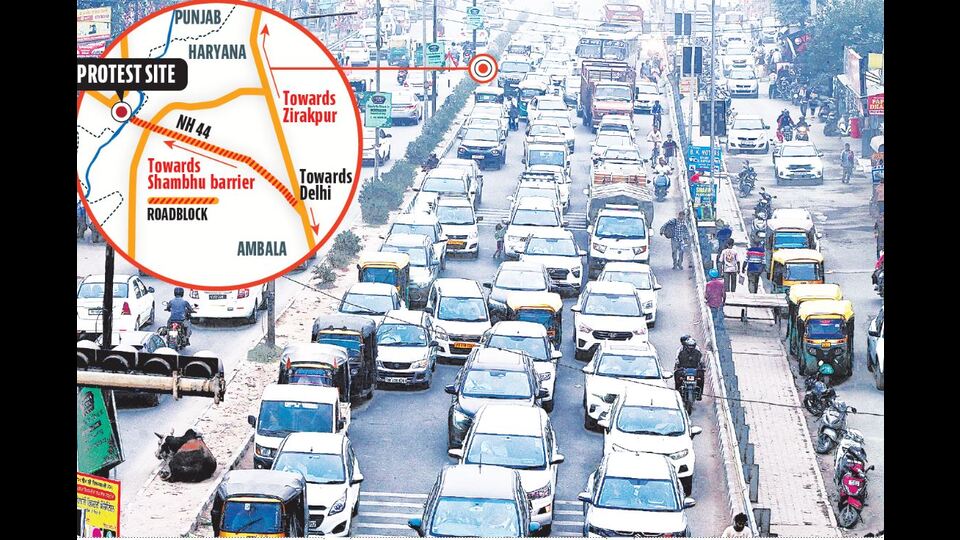
Haryana government had blocked the Ambala-Chandigarh national highway (NH)-152 on February 11 in the wake of the farmers’ “Delhi Chalo” march on February 13. Haryana Police also have installed cement blocks on the highway near the Shambhu barrier to stop farmers from reaching Delhi.
Since then, commuters heading to the capital are a hassled lot as traffic from Punjab got diverted towards Zirakpur, Dappar toll and Jharmari barrier, delaying their trips by over two hours. Similarly, those coming from Delhi cannot pass through the Shambhu barrier to enter Punjab from Ambala and rather have to travel extra kilometres and suffer in serpentine queues.
Vehicles travelling from Ambala side to Rajpura, Mandi Gobindgarh, Ludhiana and so on, have to take a detour through either Chandigarh or Mohali, increasing travel distance and time many fold. All this has overburdened the already busy Zirakpur-Dera Bassi road.
As per police data, now over 50,000 vehicles pass through Dappar toll plaza daily, as compared to 38,000 vehicles before the blockade at Shambhu. Moreover, 10,000 additional vehicles, including trucks and buses, are taking side roads, bypassing Dappar toll plaza towards Lehli, Ramgarh, Yamuna Nagar in addition to other diversions which remain choked especially during morning and evening hours.
As the long traffic jams have become a source of sheer harassment for helpless commuters, their travel times have increased by several hours.
“Earlier I used to reach Delhi in four hours using Landran Road, connecting Rajpura-Delhi highway. Now it takes at least six hours to reach Delhi from the Zirakpur-Dera Bassi road, which has become a traffic bottleneck. The long traffic jams there are frustrating. Even when the Shambhu barrier is already blocked, farmers frequently block the Zirakpur-Dappar road, further increasing our miseries. Protesters, these days, don’t bother about harassment caused to people. The situation is also heavy on our pockets as we now spend extra on fuel due to the detour,” Kharar resident Ashish Sharma said.
While 56 accidents were reported in Zirakpur last year, 59 mishaps have already been reported in Zirakpur as of mid-November since the Shambhu barrier blockade from February 13. Moreover, as compared to 53 accidents reported last year in Lalru, 55 cases have already been reported.
“With an increase of traffic load on the Zirakpur-Dappar stretch, accidents have also increased. Earlier as 38,000 vehicles used to pass through Dappar toll plaza, more than double the vehicles used to pass through Ambala-Rajpura toll plaza. Now, while a portion of traffic has shifted towards Zirakpur, Lalru, Dera Bassi, Dappar, Yamuna Nagar; vehicles have also got diverted from Patiala. The Ambala-Rajpura highway was the main highway connecting Ludhiana, Jalandhar, Amritsar, and Delhi. So now the burden has doubled on other roads,” a traffic police officer said. Earlier this year, facing inconvenience, residents of villages near the Shambhu barrier had requested the farmer unions, who have been staging protests there, to vacate the national highway.
Residents of Zirakpur and Dera Bassi said they were forced to make a detour for their day-to-day works due to the ongoing protest. Local residents stated they depend on Ambala city for their various day-to-day activities, such as schooling of their wards, medical treatment, household purchase and supply of agricultural produce. Therefore, connectivity with Ambala city is like a lifeline for them.
As of now, residents of nearby villages have to reach Ambala through unmetalled roads. At some point, villagers have to even travel through makeshift bridges over the Ghaggar river to reach Ambala.
SP (traffic) Harinder Singh Mann, however, said traffic police remain deployed at the congested Zirakpur-Dera Bassi road to manage traffic flow and ensure that commuters aren’t harassed.
“The traffic has definitely increased here but our cops remain on their toes to clear it timely,” SP Mann said.


