
 E-Paper



Terror shadow in Haryana: Faridabad arms haul exposes policing lapses
‘Social media-centric’ Haryana Police need to act on ground by re-evaluating internal security strategy, improving intelligence coordination with central agencies, and strengthening surveillance on inter-state routes, say former top cops.


The seizure of nearly 2,900kg of explosive and inflammable materials, assault rifles, pistols and improvised device making components during raids in Faridabad by the Jammu and Kashmir and Haryana Police on Monday has put the spotlight on how the state is emerging as a safe haven for terror operatives.
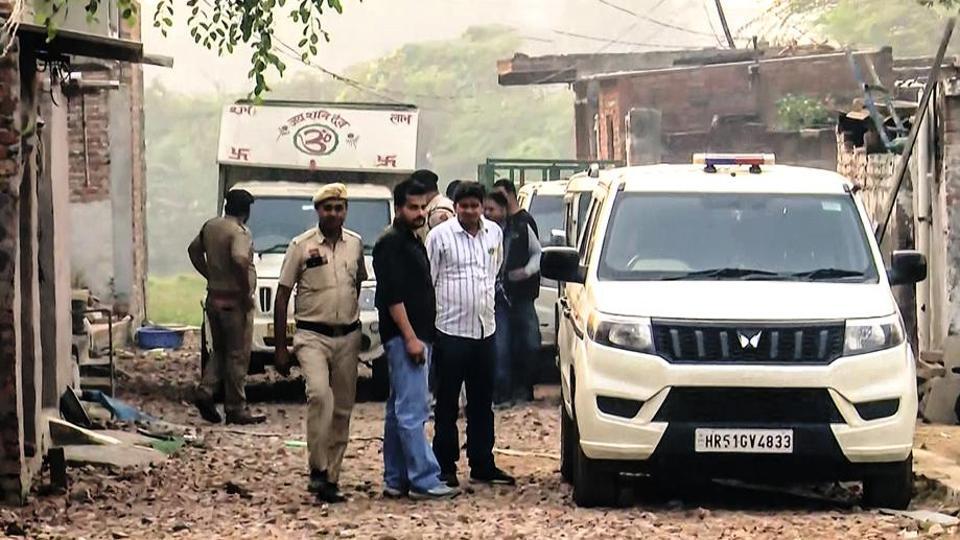
The joint operation that led to the arrest of seven people, including doctors, linked to terror outfits operating from Pakistan, is a wakeup call for the Haryana Police, says former Uttar Pradesh (UP) director general of police (DGP) Prakash Singh.
Endorsing his views, a former DGP of Haryana, requesting anonymity, said this episode underscores the growing footprint of terror networks in the state and brings to the fore the failure of “a social media-centric Haryana Police” to detect and disrupt such activities in time.
This is not the first instance of terror and terror-linked recoveries in Haryana. Improvised explosive devices (IED) had set off blasts on the Indo-Pak peace train, Samjhauta Express, on February 18, 2007. Sixty-eight people were killed after the IEDs and inflammable material triggered blasts and fire in two compartments near Panipat.
In mid-2022, the Haryana Police arrested four suspected terrorists near Karnal, allegedly linked to Pakistan-based handlers. A large quantity of explosives, including IEDs, was seized from their possession.
Wake-up call for state police
Terming the seizure of explosives and inflammable material from Faridabad a “wake-up call”, former UP DGP Prakash Singh said that Haryana Police can no longer afford to remain complacent about terror threats.
“In this era of the internet, there are no territorial or geographical limits to terror activities. The ‘khel of terror’ is becoming very dangerous,” he said, stressing the need for heightened vigilance and proactive policing and thorough sensitisation of the police force in Haryana.
“The rank and file have to be sensitised that just because the state has been free from terrorism, it doesn’t mean it will remain so always,” he said, cautioning against complacency and any sense of security based on the state’s past record.
Emphasising the urgency of the situation, he said, “It is a wake-up call for Haryana Police. Adequate measures must be taken urgently to overcome the sense of complacency and the impression that Haryana is out of the radar of terror activities.”
He said that the evolving nature of terrorism is alarming as now even “highly educated people” are being drawn towards terror activities.
NCR transit corridor
According to a former Haryana DGP, the state’s proximity to the National Capital Region (NCR) and its extensive road network make it a convenient transit corridor for terror operatives moving between northern states.
“The state’s relatively low-profile policing along inter-state borders in UP, Rajasthan and Punjab has often been exploited by sleeper cells and couriers to transport arms, funds, and operatives under the radar,” said the former DGP, pointing out that Faridabad case is a part of worrying pattern.
“It calls for a serious re-evaluation of Haryana’s internal security strategy, greater intelligence coordination with central agencies, and stronger surveillance on inter-state routes. Any complacency now risks turning the state into a logistical hub for terror networks operating across northern India,” he said.
Terror trail of 2022
In March 2022, Ambala police had seized three hand-grenades and an improvised explosive device (IED) from along the Ambala-Chandigarh highway on the Haryana-Punjab border. Later in May, the Karnal police arrested Gurpreet Singh, alias Gopi, his brother Amandeep Singh and Parminder Singh, all three from Ferozepur, and Bhupinder Singh from Ludhiana.
The terror suspects travelling in a Toyota Innova SUV were on their way to Adilabad in Telangana to deliver a consignment of explosives, including a country-made weapon, 31 cartridges, six mobile phones and three containers carrying 7.5kg of explosives from them. Police also seized ₹1.3 lakh in cash.
The IEDs were packed in three small iron containers, each weighing 2.5 kg. Each box contained a timer, a detonator, an explosive and power. Timer, detonator and explosive were connected; however, they were not connected with power.
Following their arrest, it came to light that Gopi, his brother and one other accused Akashdeep, alias Akash, were behind the Ambala explosive recovery of March.
According to the case files, the explosives were received from Pakistan through drones and delivered at the village of Akashdeep’s maternal grandmother, situated near the international border in Ferozepur of Punjab.
-kMNB-U1021018938041uE-250x250%40HT-Web.jpg)


