
 E-Paper



The year-round care that makes Chandigarh Rose Festival bloom
Hindustan Times takes a look inside the meticulous work that goes behind readying the garden for the annual floral spectacle


A symphony of colour awaits in Chandigarh as February approaches. The Zakir Hussain Rose Garden, home to the annual Rose Festival, is a testament to the year-round dedication required to cultivate such exquisite blooms. The three-day festival promises a floral spectacle for thousands, but the garden’s beauty is the result of constant care.
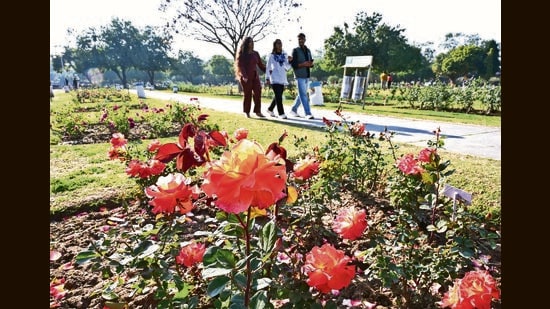
Spread across 40 acres, the Zakir Hussain Rose Garden is the largest of its kind in Asia, and has 829 varieties and nearly 50,000 rose plants in 1,400 beds that include hybrid tea, floribundus, polyanthus, miniatures, and climbers of both indigenous and exotic varieties. Named after India’s former president Zakir Husain and created in 1967 under the guidance of Mohinder Singh Randhawa, Chandigarh’s first chief commissioner, the garden has a legacy of rich heritage.
The roses, originally imported from various parts of India and abroad, also include varieties, named after famous world personalities like Queen Elizabeth, Lady Diana, Dr V Giri, John F Kennedy and others. A section of roses also has funny names: Fragrant Lady, Careless Love, Kiss of Fire, Only You, Eiffel Tower; while some sections are named after countries and states: Oklahoma, Delhi Princess, American Heritage, among others.
Since it has been tagged as a “Heritage Garden”, no new flower variety can be added, and flowers can’t be used for commercial purposes.
A rose is a woody perennial of the genus rosa, within the family rosaceae. Flowers vary in size and shape and are usually large and showy, ranging from whites through yellows and reds. Rose is universally acclaimed as the “Queen of flowers”.
In October every year, around 50 gardeners and horticulture experts from the Chandigarh municipal corporation (MC) begin the critical process of pruning and cutting rose stems, to begin the process of blooming new roses.
First, all flower stems are pruned and treated with Blitox medicine to prevent fungal infections, followed by hoeing and a crucial 15-day period of sunlight exposure before being nourished with cow dung manure and regular watering.
Former executive engineer of UT horticulture department Harjit Singh Dhillon said, “The Rose Festival started with 1,600 varieties of roses in 1967 with most of them from Bangalore and Calcutta. But with years, some of the varieties had died. In 2008, the UT administration had added around 450 new varieties which now continue to be part of the total varieties.”
“Roses require fertile clay loam and loam soil. Soil should be deep, having good water holding capacity with good drainage. Roses are generally planted in cooler seasons, preferably from the end of September to October but it can be extended up to November.
After planting, frequent irrigation, removal of root suckers and manuring is done. The month of October is the ideal time for pruning of roses to secure healthy and clean canes and production of quality blooms,” explained the gardeners, adding that the monsoon months bring high humidity, making roses vulnerable to fungal infections- like black spot and powdery mildew. Regular spraying of fungicides and neem oil-based solutions helps control these diseases, they added.
If any rose variety or plant dies, MC officials cultivate it in their nursery in Sector 23 before replanting it in time for the Rose Festival.
The flowering occurs in three stages: the first bloom in November, the second in January, and the third in March, when most roses reach full bloom. Interestingly, at any given time, only 60% of the varieties are in bloom, as different roses have varied flowering cycles. Even during the Rose Festival too, as per experts, only 60% of the roses bloom and one can never see 100% varieties in bloom on any single day.
The Chandigarh Rose Festival is an integral part of the cultural calendar of the city and is held every year in February. This year, the 53rd edition of the festival will be held from February 21 to February 23, and is being organised by the Chandigarh municipal corporation. Before 2011, the garden was maintained by the UT administration, which also used to organise the festival.
Right before the Rose Festival, workers are busy making last-minute final touches to ensure that everything is perfect for visitors. They meticulously fix QR codes on each rose variety, allowing visitors to scan and learn about the flower’s history and significance.
Gardeners carry out final rounds of pruning to keep the blooms in good condition, while final arrangements are also made for organising cultural performances. From setting up vibrant decorations to ensuring smooth logistics, the corporation leaves no stone unturned in preparing for one of the city’s most anticipated floral extravaganzas, which include attractions like joyrides, and contests of varying nature, such as the Rose Prince and the Rose Princess.


