
 E-Paper



Traditional paddy sowing divided in four phases in Punjab
The four-phase traditional paddy sowing method in Punjab will begin from June 18 and will end on June 24

 Prefer HTon Google


: For the first time in Punjab, the conventional method of sowing paddy saplings in puddled fields has been staggered into four phases beginning June 18 in the upcoming kharif season by dividing the state’s 23 districts into four zones, in an effort to lessen the burden on the use of power and conserve the subsoil water.
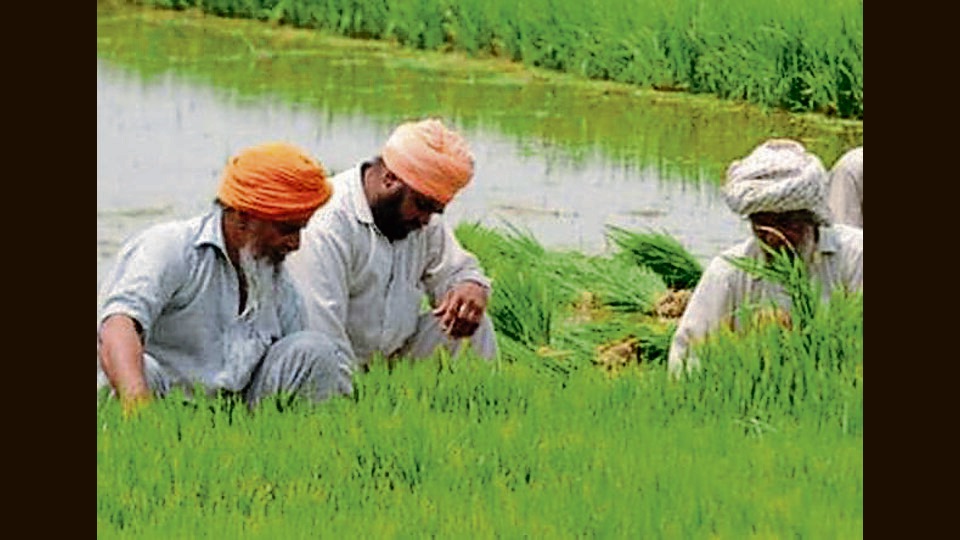
The last phase of paddy sowing is after six days on June 24.
“By staggering transplantation, we tend to conserve the subsoil water as with the delay, sowing will coincide with the monsoons and in the bargain, power will also be saved and also hope to avoid sudden burden on the power distribution system,” said secretary agriculture Dilraj Singh.
Paddy sowing in Punjab by direct seeded rice (DSR) method in the upcoming kharif season will start from May 20 and is expected to be over by May 31. Setting up of nurseries for preparing saplings for transplanting paddy will not be allowed before May 18, the department announced.
A notification by the state government declaring the new sowing/transplantation schedule is expected to be issued on Friday.
The first phase, which has districts Sangrur, Barnala, Malerkotla, Ludhiana, Patiala and Fatehgarh Sahib, paddy transplantation will begin from June 18.
The transplantation in Bathinda, Mansa, Faridkot, Fazilka, Ferozepur and Moga will be from June 20.
For Ropar, Mohali, Nawanshahr, Jalandhar and Kapurthala, the paddy transplantation is from July 22.
Gurdaspur, Pathankot, Hoshiarpur, Amritsar, Tarn Taran and Muktsar will see transplantation from June 24.
Earlier, the state department had proposed to start paddy sowing with the conventional method from June 20, proposing to prepone it by a week from the sowing date (June 13) during previous three seasons (2019,2020 and 2021).
This season, the state agriculture department has set a target of 30 lakh acres under the DSR method of paddy cultivation, out of a total area of 75 lakh acres under paddy cultivation, of which at least 5 lakh acres is expected under the premium aromatic basmati variety of paddy.
“By adopting the DSR method, atleast 30% of the total water used in growing paddy with the conventional method is saved,” said an officer of the state agriculture department.
Incentive for DSR cultivators pegged at Rs. 450 crore
The state government has announced a per acre incentive of Rs. 1,500 for the paddy cultivated with DSR method. In the upcoming season, the agriculture department hopes to double the area under the DSR method; last season’s 15 lakh acre to 30 lakh in the upcoming season.
The total cost of incentive has been pegged at Rs. 450 crores and the state government has asked the finance department to make arrangement for the funds.
The agriculture department plans to use ‘anaj portal’ which the food and civil supplies department uses to verify their crop quantity, to also verify the farmers who have adopted the DSR method and eligible for the incentive.
Lesser burden on PSPCL by staggering paddy sowing
Top officials in the Punjab state power corporation limited (PSPCL) revealed that by staggering the paddy cultivation, the burden on PSPCL will be eased as the previous system of starting cultivation in entire Punjab on a single day pushes the peak load to 15,500 megawatt. However, if it is staggered by a week, the transplantation in the districts that comes in the first phase will be almost over when the district in fourth cluster gets the turn.
There are over 14 lakh tubewells in the state and as per the practice, till the last season, the power supply to the agri-tubewells were divided in three shifts with each getting power supply for 8-hours at a stretch. Each stretch requires 4,500 to 5,000 megawatts. That means, if all tubewells are to be operated in one go, 15,000 megawatts power is required.
“This time, the power requirement is unpredictably very high owing to the heat wave that has set in early, as in April month, peak demand touched 6,800 megawatts,” said a senior functionary on request of anonymity.


