
 E-Paper



Wildbuzz | Turning one’s back to the world
This artwork of Mansi Drall, a MFA (Graphic) 2nd year student at the Kurukshetra University (KU), was on display at the Punjab Kala Bhawan, Chandigarh, as part of the 29th Annual Art Exhibition of the Punjab Lalit Kala Akademi in collaboration with the KU’s department of fine arts


As Pablo Picasso remarked, “The purpose of art is washing the dust of daily life off our souls.”
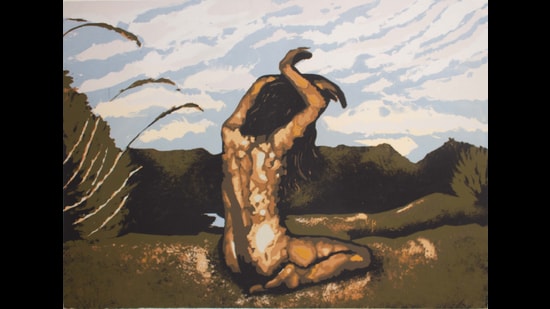
The maddening crowds of urban life sadden the sensitive soul. The connect with nature is lost in the noise and pollution of cramped existence. The soul longs for a flight from the infernal chaos, reconnect with untouched wilderness and breath pure moments of solitude.
‘Deep Breath’ is an artwork executed in the serigraphy technique. It provoked thoughtful observation, induced a diffused comparison to the ‘rishi-munis’ life of contemplation in the mountains and tempted the mind to travel afar from the glare of an art exhibition hall to a gaze at cosmic infinity.
This artwork of Mansi Drall, a MFA (Graphic) 2nd year student at the Kurukshetra University (KU), was on display at the Punjab Kala Bhawan, Chandigarh, as part of the 29th Annual Art Exhibition of the Punjab Lalit Kala Akademi in collaboration with the KU’s department of fine arts.
“In ‘Deep Breath’, I pose the figure with the back turned to the world. I am conveying that all of us need a moment of time when we can seek renunciation from busy life and engage in a dialogue of solitude or with someone with whom we can engage in a heart-to-heart talk and relieve the burdens we carry in our souls. This artwork carries a significance for women who are multi-tasking --- as students, career aspirants, wives, homemakers, mothers --- just as seasons change or a tree passes through different phases. It is critical for women’s well-being to shed the yoke of their enormous and varied responsibilities and seek shelter in nature and solitude where they can be truly free,” Drall told this writer.
The import of Drall’s artwork was aptly summed up in the message that Akademi president Gurdeep Dhiman penned for the exhibition: “Art is not a mere act of creation; it is a force that shapes civilisation, a voice that echoes beyond time. It is both a sanctuary and a battlefield --- a space where the soul wrestles with truth and beauty, seeking to reveal the unseen. To be an artist is to be fearless, to question, to reimagine, and to leave an imprint that outlives the fleeting moment.”

The tree with a Midas touch
As an artist whose passion is to paint trees in their myriad forms and wind-inspired dances, Pardeep Singh stumbled upon a veritable treasure trove when he took a nature ramble into the jungles of the Shivalik foothills. The diversity of trees and other manifestations of flora was bewildering. The Semul was on its way out with ‘cup-full of nectar’ flowers while the Palash dazzled with passionate, fiery-red, claw-like petals that seemed to tear at the hearts of lovers.
However, what really captivated Singh’s aesthetic sensibilities was a tree abundant with pale-gold fruits. It frequents the courses of seasonal rivulets that drain from the foothills. “The fruity spectacle was surreal. The fruits appeared as if they were artificial and had been stuck to the branches like Christmas tree decorations. The fruits were globular and appeared as if they had been lent an artificial ceramic-glaze finish. The structure of the tree itself was enigmatic, with a curvature to its spine and bent over at the top end. It was exceptional, I had not seen anything so aesthetic in trees. It somewhat resembled trees with a peculiar curvature in Chinese landscape paintings. I brought some fruits home and kept them on my desk as a muse but they soon turned a rotting black!” Singh told this writer.
The fruits were too attractive to be palatable to humans though they could yield extracts for medicinal applications. The tree was identified by botanists as a species of the genus Diospyros, family Ebenaceae. Globally, 607 species of Diospyros have been reported. They are deciduous trees and display marked morphological variations among individual specimens.
Species of this genus found in Punjab, such as D montana and D chloroxylon, are known in the vernacular as ‘kinu, kendu and kanju’. Otherwise, Diospyros trees are commonly known as persimmons or ebonies.
vjswild2@gmail.com


