
 E-Paper



Wildbuzz: Chance of the century
The buttonquail’s secretive voyages to Punjab around the monsoons for breeding in fresh grasslands have been noted by 19th century British ornithologists but records have been rather sparse over the centuries


The role that chance plays in the affairs of mortals finds a dramatic resonance in the interface between humans and birds. This was underscored by the rescue of a timid little bird running around in a Jalandhar garage. It turned out that the rescued bird, the yellow-legged buttonquail, was a historical rarity for Punjab. It had not been spotted in the region for over a century.
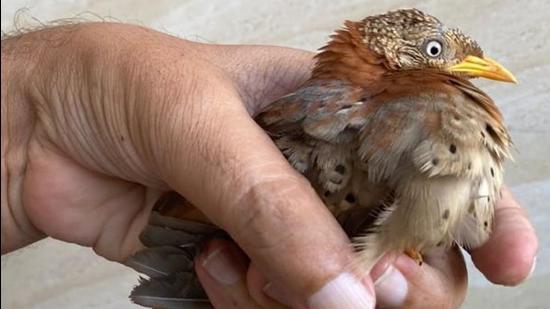
None of us would have been the wiser of this bird’s contemporary presence in Punjab had the buttonquail not got herself into an awkward spot, of all the myriad places in sprawling Jalandhar, in a house whose neighbour, Sanjiv Khanna, happens to be not only a seasoned birder but also one proficient in the rescue of distressed birds.
The buttonquail’s secretive voyages to Punjab around the monsoons for breeding in fresh grasslands have been noted by 19th century British ornithologists but records have been rather sparse over the centuries. This is partly because this diminutive bird, which is the size of a house sparrow, blends amazingly into scrubland or grass and prefers to migrate at night.
In other words, a proverbial undercover agent having mastered the art of hiding in plain sight! Neither is this bird much sought after or tracked down by the roving lenses of the ever-increasing tribe of Punjab bird photographers, otherwise its presence would have been recorded more frequently. Glaring city lights tend to disorient its nocturnal navigation and some befuddled buttonquails end up as fugitives in houses across India leading to astonishment (like a paratrooper landing in the proverbial lap of the householder sipping his morning tea!) and feverish updates to the buttonquail’s distribution maps.
“Some modern field guides on the sub-continent’s birds had all but written off the buttonquail’s presence in Punjab as no sighting had been reported for around a century. Before Khanna’s rescue, the last authentic record (with reference to the area encompassed by present-day Punjab) had come from Hugh Whistler, the policeman-ornithologist, who shot a male buttonquail near Ludhiana way back on July 11, 1917! Whistler had noted that the buttonquail shot by him was the only record from Punjab till then! All said and done, the chance rescue from Jalandhar proves that British ornithologists rightly included Punjab in the summer distribution range of this buttonquail,” said Mohali-based professor Gurpartap Singh, a birder, who has a hawk’s eye for avian identification and backs it with a zealous devotion to historical detail and tireless thumbing of ornithological literature.
Enjoying a quaint zoological nomenclature, Turnix tanki tanki, the buttonquail is not an endangered species. As Khanna’s discovery indicates, it may not be so rare in terms of numbers. But it has certainly been very smart in eluding the Punjabi eye for over 100 years! Let me get Khanna to narrate the delightful tale of his discovery.
“I received an early morning call on June 23 from Satwinder Multani, who lives next door. She called to say that the common myna chick, which she had asked me to replace in its nest two days ago, had fallen again and had taken refuge inside her car garage. She wanted me to restore the chick to its nest again. For all her noble intentions, the pugnacious mama and papa mynas had in the first instance relentlessly pecked at the good Satwinder’s head! I rushed to the spot with the objective to again reinstate the chick in its nest. However, I found that the so-called myna chick was actually a very small bird running in the garage and trying to hide. My birder’s eye seized upon it as a quail-like bird. Its small size had probably led Satwinder to mistake it as the same myna chick, which we had restored to the nest two days back. It was hard to catch the quail and she had a small injury on her head. I brought the bird to my rescue shelter, Aashray. After applying medicine to the injury, I fed her grains and water. After taking feed, the bird was eager for freedom. I released the bird and much to my surprise it took a high flight and disappeared. As a rescuer of an estimated 1,300 birds since 1994, I was very happy to have saved and recorded a very rarely seen species of the Punjab,” Khanna, an engineer by profession, told this writer.
The rescued buttonquail was a female, distinguished by a gorgeous orange-rufous buff collar. The female is the prettier in this species, reversing the differences of plumage in birds where males tend to be the preening queens and more justified in seeking self-gratification from the proverbial mirror on the wall. There is a very good reason for this reversal of beauty as it is the female buttonquail who philanders and wows suitors with her dazzling orange, rust and rufous colours so that she can “sow her wild oats” in a string of seduced males. This inverse version of the Don Juan legend is also slightly larger than the male. The female’s advertising call includes a series of low-pitched hoots, gradually increasing in volume and sounding in the end notes virtually like human moans.
“The female is polyandrous, evidently not promiscuous but practising successive polyandry. She battles with rival hens for the possession of a cock and does the courting. After the eggs are laid, she loses interest and goes in search of a new mate. The cock settles down to incubate them (12-16 days) and later rears the chicks all by himself,” is how legendary birdman, Salim Ali, described the buttonquail’s breeding practises.
vjswild1@gmail.com


