
 E-Paper



Wildbuzz: Delight in a cupwing
A birder manages to capture an elusive bird in his lens; the Indian bullfrog makes a formidable predator


Imagine a feathered ball weighing about two ‘tolas’ of gold, stalking moist montane undergrowth and flipping fallen leaves for insects with a deftness worthy of a gambler flicking cards at a casino. A bird reluctant to fly like a ‘bater’ (quail) and virtually tailless! That’s the scaly-breasted cupwing for you, a delightful avian of the Chakki Modh and Jangeshu hills of Solan district. The bird’s lure has spawned a desperate quip among birders of the tricity and from afar such as Delhi, Mumbai and Kolkata: “Hey, have you managed to spot the elusive cupwing?”
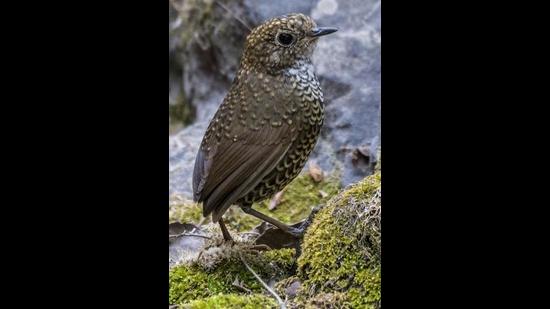
The cupwing enjoys the reputation of abiding by the motto: discretion is certainly the better part of viewing valour, the kind of dictum that once veiled medieval princesses from public gaze. As it is a ground-dwelling avian, extreme timidity and the camouflage afforded by its dark warm brown plumage ensure better chances of surviving roving hawks and ground predators. It is the kind of creature that may well jump at its own shadow!
Among those who managed to photograph the cupwing in a rare moment in the open and free of bushy clutter was Jatinder Vijh, a Chandigarh birder who possesses an exceptional eye for avian behaviour. “I did not see the cupwing initially but heard a faint rustle among fallen leaves. On cautious investigation, I spotted the cupwing. I observed that the cupwing preferred to trot up a moderate incline and then come down while foraging. It is a rare bird, whose presence is all the more difficult to detect because of its furtive habits. We could spot this beauty only after a tedious effort at scouring the area. But success again proved the premise: ‘If you seek the bird, the bird also seeks you.’ I would say the cupwing is one of the seven little wonders of our part of the birding world!” Vijh, a retired joint general manager from HMT, told this writer.
The brave bully
The digital domain is overflowing with images that capture the predatory actions of charismatic species such as tigers and falcons. But a formidable predator, which resembles a powerful, squatting sumo wrestler ready to lunge in ambush mode, dwells right under our upturned noses. This is the Indian bullfrog, among the largest found in the sub-continent and can sport a length of 160 mm! Most of us are either ignorant about the bullfrog’s power or treat it with disgust as a particularly repulsive, flabby, slimy and slothful creature.
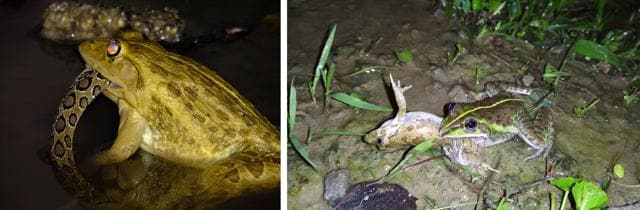
Bullfrogs are not wholly ‘ugly’. During monsoons, male bullfrogs sport blue balloons and their skin colour turns a vibrant yellow to attract females just as male purple sunbirds assume darkly iridescent hues and sport golden pectoral tufts in response to the warming moods of spring.
The above is more an aside to the bullfrog’s gentler, loving instincts. Here is wildlife scientist SB Mishra documenting what it does for a daily living: “The bullfrog feeds on unusual prey, like invertebrates, small mammals, snakes and birds. Plant matter and several odd objects like human hair, cattle dung and grass are also recorded from its stomach.” Bullfrog tadpoles are even known to relish tadpoles of other species or cannibalise their own!
In the Wildbuzz column, I have earlier on showcased the stories of a remarkable bullfrog predating on a Russell’s viper and of another pugnacious specimen which waged a 10-minute-long, blood-spewing struggle with a rat snake before managing to kick the snake in the face and escape from the jaws of death!
Bullfrogs are among the 258 species of frogs found across the globe that predate on other frogs. A recent photo-documentation of a bullfrog’s predation attempt on a rice paddy frog in Bangladesh will further add to Wildbuzz readers’ awareness of this awesome predator.


