
 E-Paper



Wildbuzz | Raptor enigmas in artworks
The identification of raptors in the field or from photographs can present complex challenges

 Prefer HTon Google


The identification of raptors in the field or from photographs can present complex challenges. To do so from fading artworks of a medieval provenance is an even more confounding task. In these columns of January 11, 2026, I dwelt on the Harvard Art Museums (Cambridge, MA, United States) promptly correcting the identity of the raptor in a Mughal artwork of c.1650 (Object Number 2009.202.217 in the Museums’ Collections) featuring Emperor Shah Jahan and Raja Prithvi Singh of Chamba after I emailed the curator that it was not a sparrowhawk but a Shaheen falcon that had been depicted on the Raja’s right wrist.
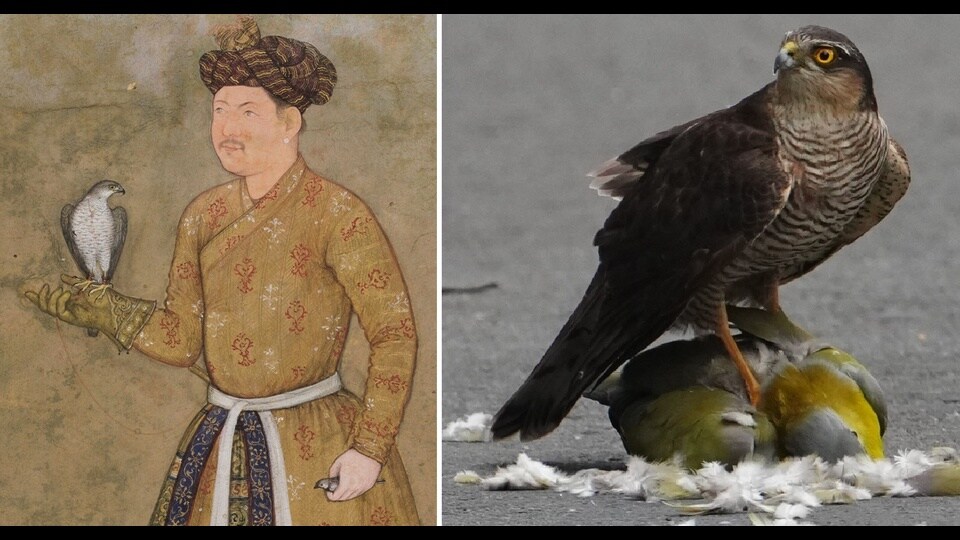
Following that, the Museums’ Norma Jean Calderwood Curator of Islamic and Later Indian Art, Dr Aysin Yoltar-Yildirim, referred to another raptor to settle her niggling doubts. It was a Mughal artwork from c.1610-1620 (Object Number 1999.293) depicting a raptor labelled as a “Sparrowhawk”. In her email to me, the curator requested: “I wanted to notify you of another Mughal painting from our collection, where I think a sparrowhawk is correctly identified. Please let me know what you think.” The background to the doubt was that in the realm of raptor identifications, a female Eurasian sparrowhawk and a male Northern/Eurasian goshawk are persistently mistaken for each other, as they are such close lookalikes.
The artwork in question bore the title, ‘Khan Alam, Mughal Emperor Jahangir’s Falconer and His Ambassador to Iran, with a Sparrowhawk’. The painting was credited by the Museums to the artist, Govardhan, and carried its caption: “Alam was Jahangir’s ambassador to Iran as well as his chief falconer. Here, he stands outdoors with a sparrowhawk perched on his gloved right hand. Red jesses connect the bird of prey to Alam’s sash. In his left hand, Alam clutches onto a small bird, which serves as bagged game, previously caught prey that is either served to the raptor or used in its training.”
Upon examination and in consultation with Prof Gurpartap Singh and falconers of global repute, Sarfrazuddin Malik and Kamran Khan Yousufzai, we established the raptor as proximate for a female Eurasian sparrowhawk, even if allowance be made for artistic fancy/inaccuracy and a deference to royal exaltation. The Museums had been right on this artwork’s raptor identity and I duly notified the curator.
Sparrowhawks in the sub-continent’s court culture and their identification features: (i) they were named ‘Basha’ for female and ‘Bashin’ for male in the sub-continent’s vernacular (ii) female hawks and falcons were preferred in falconry as they were bigger in size while the smaller males were viewed with a decent bit of disdain by royalty (iii) features in Object Number 1999.293 that are pointers to a sparrowhawk depiction include: thin legs, small head and beak, and smaller overall size as compared to a goshawk (iv) the gender of the sparrowhawk in Object Number 1999.293 is proximate for a female, especially the yellowish eyes, pale lores and overall greyish-whitish pale look — male adult sparrowhawks have rufous colouring on cheeks, sides of the neck and barring on underparts, and dark slate-grey upperparts (v) in Emperor Akbar’s court, 100 female sparrowhawks were maintained with other raptors for hunting and as royal symbols.
vjswild2@gmail.com


