
 E-Paper



Wildbuzz | The disrobed beauties of winter
At last week’s exhibition, Nature’s Bliss, staged at the Government Museum and Art Gallery, Kapoor curated bare trees with captivating titles that lent the disregarded souls of winter a radiance and positive aura


Winter strips trees of their “clothes”, and leaves them naked not as Greek goddesses but as still bodies bathed and prepared for the pyres. Caught in between autumn when every leaf becomes a flower and the floral redolence ushered in by spring, trees turn into skeletons inhabiting a weary, grey countryside.
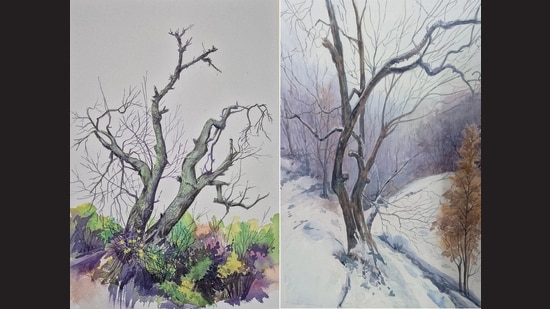
Trees are acknowledged as symbols of resilience in the wake of “General Winter’s” relentless march. But who could find beauty in an “ugly duckling” - as to eyes accustomed to an abundance of verdant trees - but an artist of Prem Kapoor’s endowments and persuasion.
At last week’s exhibition, Nature’s Bliss, staged at the Government Museum and Art Gallery, Kapoor curated bare trees with captivating titles that lent the disregarded souls of winter a radiance and positive aura. “I am still beautiful”, “Winter’s kiss” and “Winter’s wonderland” were among his other artworks executed in the deft, light touch of watercolours. Kapoor had reverted to watercolours to pass time and revel in the solitude of Covid lockdowns but the outcomes happily materialised a few years later into the public forum afforded by an exhibition.
As art critic and assistant professor, Ravinder Sharma aptly put it: “For Kapoor, watercolour is more than a medium; it is a language of emotion, a reflection of his journey and a celebration of life....whose passion (is) to explore new horizons of creativity.”
The portrayal with brush and subtle colours lends to the tapering branches the aura of a magnified diagram of live nerve endings. Delving into winter landscapes with brooding, bare trees conjured on his canvases, Kapoor told this writer: “I was fascinated with the form of the bare branches. The painting, “I am still beautiful”, was inspired by a particular tree of Chandigarh in winter. There is green foliage in the form of bushes around the lower part of the tree but I did not want the verdant bushes to dominate my work - I have highlighted the beautiful bareness of the tree’s limbs.”
Kapoor’s aesthetics have touched diverse lives. He worked in the Punjab health and family welfare department from 1971 to 2005. His creative bent of mind was put to good use as it brought forth posters, pamphlets, exhibitions and advertising materials to raise public awareness on vital issues of health.
The power of flowers in war
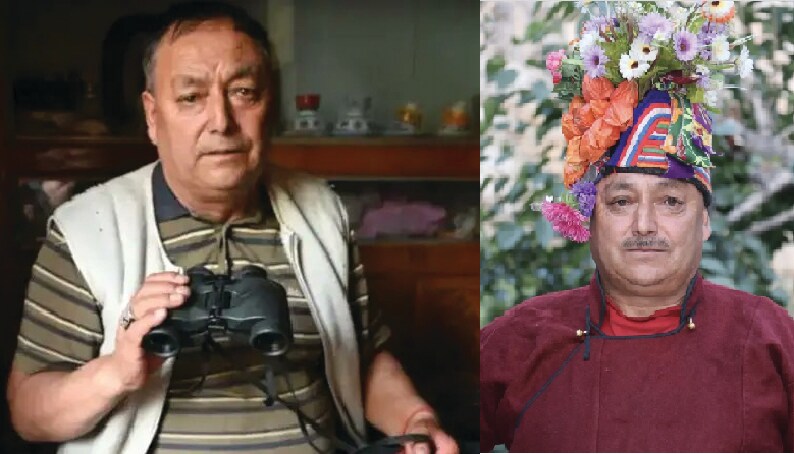
Tashi Namgyal, 58, the Brokpa tribal from the Indus Valley village of Garkhun and an unsung war hero who detected Pakistan Army intrusions in the Batalik sector of Kargil in August 1997 and on May 2, 1999, passed away on December 19. The enduring image that flashed in the obituaries was of Namgyal’s cultural uniqueness: sporting an enchanting ensemble of flowers on his “tepi” (headdress) above a rich-maroon tunic.
The pride and naturalness with which Brokpa men wear floral headdresses makes it a rare community where masculine values do not smirk at these supposedly feminine graces. Brokpas don tepis not just on festive occasions but while working in fields, as a routine, and in war. They worship nature and nurture a fanatical attachment to purity, whether it be mountains, streams, trees, flowers or ibexes, which are worshipped as the “livestock of the mountain spirits”. Anthropologists maintain that Brokpas were not “descendants of Alexander’s armies or pure Aryans” as these tribals like to imagine themselves, but pastoralist migrants from the Central Asian steppe.
The Brokpas evoke the fluid description of “walking floral bouquets”. Flowers are considered auspicious, and as symbols of love, prosperity and dispute resolution in this miniscule community. Brokpa physiognomy is distinguished by high cheekbones, light, almond-shaped eyes, straight noses and fair skins that lend a European illusion.
Flowering shrubs are cultivated in abundance along agricultural fields. The long-lasting sunset-coloured flowers of the Shoklo or Monthu-tha berry are prominent in tepis, though, other dazzling flowers are also used. Multi-coloured ribbons, ancient coins, seashells and bird feathers bejewel tepis. The headdress is not merely decorative - each of its elements enjoys cultural and medical significance and are sourced from mother earth’s bounties.
Flower worship rooted in the Brokpas’ ancient culture evidently paid rich dividends. During the Kargil War, the tepis served as a distinct identity marker for Brokpas heroically traversing the frontlines of criss-crossing shrapnel/bullets. “We were volunteer war porters carrying food, ammo and supplies to high altitudes. Due to a mistake in the maps given to us, we were told to take the war loads to a map position marked Jubar, which was actually Banju Top on ground. The Army did not expect us there and did not recognise us as we were climbing. They were about to open fire when they glimpsed our floral headdresses and realised it cannot be the enemy,” Namgyal had told this writer at Ganasok (Batalik LoC) on July 8, 2019.
vjswild2@gmail.com


