
 E-Paper



YK Alagh, people’s political economist
His demise coincides with the decreasing relevance of interpretive formulations to the advantage of the people living on the margins. He was the first to measure poverty as starvation rather than income. He specialised in industry, agriculture, media, co-operatives and contributed to policy planning.


Economist and policy expert YK Alagh passed away at the age of 83 after a brief illness on December 6.
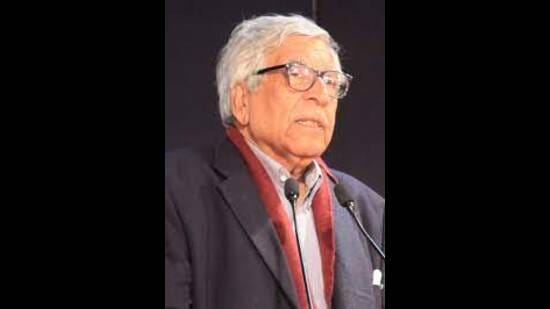
Born in Chakwal, now in Pakistan Punjab, on February 14, 1939, and married to Rakshaben from Gujarat, he settled down in Ahmedabad. He was fluent in Punjabi and Gujarati. A former vice-chancellor of Jawaharlal Nehru University (JNU), he taught economics at universities in India and the University of Pennsylvania, US.
Professor Alagh not only taught economics but practised it, too. He was a political economist and remained a member of Parliament, a minister of planning and programme implementation, science and technology and power from 1996-98. His major contribution was in the field of agriculture and rural development.
AN INSTITUTION BUILDER
Supportive of young researchers, he was an institution builder. As JNU vice-chancellor, he built students’ stakes in running the affairs of the university. Once, students went on dharna against him so he sat with them, initiated a dialogue and resolved the contentious issues. He supported young activists working on the demand side of justice and nurtured those who joined public policy forums from the supply side.
His demise coincides with the decreasing relevance of interpretive formulations to the advantage of the people living on the margins. He was the first to measure poverty as starvation rather than income. This approach was conceived by the Alagh Committee in 1979.
He was also chairperson of the WTO Committee, of which I was also one of the members, set up in 1998 by the Government of Punjab, and its recommendations were incorporated at the national level.
Professor Alagh specialised in multiple disciplines, such as industry, agriculture, media, co-operatives and contributed to policy planning.
He was my mentor and a friend also. He was a founder member of the Institute for Development and Communication (IDC), Chandigarh, and chairperson of the IDC Society since 1993. He had a great sense of humour. He once said no other economist had mastered the art of practical politics as Manmohan Singh, and people took it as “good economics”.
OBJECTIVE VISION
There are many things for which professor Alagh will be remembered, but his commitment to evidence-based policy prescription was remarkable. He took his academics, and quantitative methodologies to collect and analyse data seriously.
He believed that objective data are integral to our future vision. Notwithstanding the fact that data objective or otherwise, have to be located in the path of development. Its interpretation depends largely for whom and for what purpose it’s being used.
The lesson learnt from these explorations was, how far the narrative built by data was in conversation with a common citizen’s life story, as our GDP is rising so are the inequalities. What kind of policy research shall resolve this dilemma? Professor Alagh has left it for all of us to figure out. He was a liberal and democratic person and had a majestic style to carry forward the dialogue.
He wrote a widely read regular column in The Indian Express on issues related to public policy. His writing style was such that even complex issues were simply analysed for the common person.
In conversations, he fondly and respectfully referred to his wife as Rakshaben and mentioned the excellent work done by his son Munish and daughter Tavishi. May his memories give us courage during these challenging times and his family peace and solace.
The writer is director, Institute for Development and Communication (IDC), Chandigarh


