E-Paper



A detailed history of the Ghazipur landfill
From a desolate low lying area to the tallest garbage mound in the country, the Ghazipur landfill site near the Delhi-UP border, which has been on fire since Monday, has been prone to disaster

 Prefer HTon Google


New Delhi: The Ghazipur landfill site near the Delhi-Uttar Pradesh (UP) border has remained on fire for over four days marking the first major fire incident on the garbage mound this year. With the rising temperatures, the landfill is expected to witness many more such episodes in the coming months.
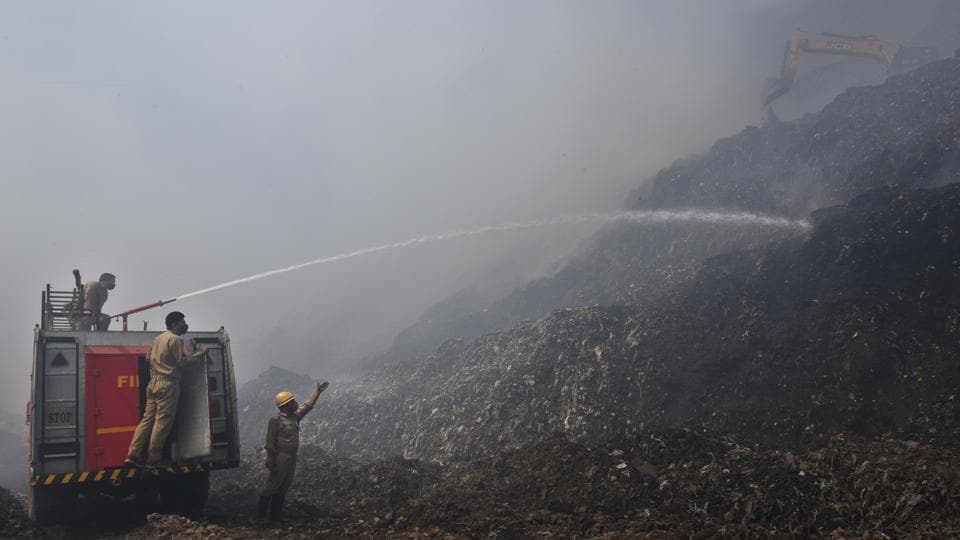
Once a low-lying desolate site on the outskirts of the city, the location was completely unrecognisable a few decades ago. Mohammad Zadar, now 80, runs a hardware store in Mulla colony on the road located directly opposite the Ghazipur landfill site. On instances of fire breaking out, his store and other houses in the lane are the first to be impacted. However, things were not always this way.
Zadar, who has been living in the area even before the landfill site came up, says the site was overgrown with weeds, but largely unused for any activities. “When we built our home here in the 1970s, we did not know a landfill will come up in the area. Initially, waste began to be dumped by some trucks and we thought it will be picked up, but over time, it began to grow in size and by the time we locals started to take notice, the area had become a proper dump for Delhi’s waste,” says Zadar.
The Ghazipur landfill site near the Delhi-UP, which has been in an inferno since Monday afternoon, did not always look like the 65m tall dystopian mound of waste as it stands today. The open area was mostly desolate on the outskirts of the city with very few households and a drain flowing next to it.
A 40-year timeline of events:
| 1984 | Ghazipur landfill site commissioned by MCD |
| 1994 | Okhla and Bhalswa landfills are initiated |
| 2000 | Municipal solid waste management rules 2000 — prescribing landfill rules |
| 2002 | Landfill is saturated and overfilled, 20m height crossed |
| Until 2012 | Until 2012, the sites received garbage from NDMC, Old Delhi, and East Delhi, which changed after trifurcation |
| August 2017 | Height of landfill reaches 50m |
| September 2017 | Section of landfill collapses, two dead |
| September-October 2017 | Garbage dumping temporarily halted and diverted to Rani Khera, but dumping resumes after locals protest |
| 2019 | Ghazipur landfill becomes 65m high, with 140 million tonnes of garbage |
| November 2019 | Bio-mining of landfill starts as per NGT orders |
| March 29, 2022 | A section on landfill on fire; 9 lakh tonnes of waste has been bio-mined |
| December 2024 | Revised deadline to clear the landfill site |
The erstwhile Municipal Corporation of Delhi started dumping waste on the location in 1984 earmarking the 70-acre site for waste management of the city.
Arun Kumar, a retired municipal engineer who has worked on landfill management of the city, said that the site was selected as it was away from the human settlements of the city's core and is a low lying area. "No landfill rules existed before the Solid Waste Management Rules came in 2000. The low lying areas in the city were earmarked and used for garbage dumping. Once the surface level was achieved, the dumping site would be closed down. Ghazipur met the criterion," Kumar said.
Sixty-five-year-old Dharamvati, living in the Ghazipur dairy, which is also located within a 1km radius of the landfill site said that, initially, the size of the landfill was too little to take notice of or worry about. "After a couple of years however, people started realising the problem and the stench began to grow, but agencies said nothing could be done about it,” she said.
A senior north corporation official from planning department said that the zonal plans under older Master Plans of the city had 24 prescribed locations to be used as waste management or landfill sites. "The idea was zone-wise decentralized waste management so that garbage can be processed at local level. Sixteen out of these locations such as Sarai Kale Khan, Tagore garden etc have been used and closed down while four are currently active. Four out of these twenty-four sites have still not been used. Unutilised sites are located in Puth khurd, Narela Bawana road, Sultanpur and Tajpur," the official explained. Delhi has seen twenty sanitary landfill sites developed since 1975, out of which all except four (Bhalswa, Okhla, Ghazipur and Narela Bawana) have been closed down. Some of the low lying garbage dumping sites which have been closed down include Sarai Kale Khan, Rohini Phase-3, Haiderpur, Tilak Nagar, Gopalpur among others, MCD reports show.
Deep Chand Mathur, retired director (information) who was with MCD from 1980 to 2011 said that even the current Sarai Kale Khan Millennium Park area on Ring Road behind the Humayun's Tomb complex used to be a landfill area. "It used to stink and groups of scavenging birds could be seen from miles. Once the area got filled, it was later used by DDA to develop the current park in 2004. The common practice was to close the low lying area of landfill once the area was levelled up and move on to the next site. Hence the word used was land-fill," he added. However, a similar practice could not be followed for Ghazipur due to non-allocation of new space. After Ghazipur, Delhi has seen operations of landfills being initiated at Bhalswa and Okhla sites.
Kumar said that initially the Ghazipur landfill site used to cater to waste coming from three regions — Lutyen's area under SDMC, City-Sadar Paharganj zone and trans-Yamuna area, but post-trifurcation, the catchment area was reduced. A senior municipal official said that normally, the maximum permissible height limit for landfills is 15-20 meters and average span of a landfill to be 20-25 years. "Ghazipur site should have ideally been closed down in 2002 when these levels were achieved but in absence of new sites, fresh waste continues to be dumped," official said.
The garbage hill had reached a height of 50m in September 2017, when incessant rains made a section of the mound unstable, leading to a fatal collapse. Over 50 tonnes of garbage came crashing down the 16-storey-high mountain of garbage creating a deadly “avalanche” that swept away a car and three two-wheelers, killing two people and injuring five.
An official explained that in the wake of the accident, fresh dumping of waste was temporarily halted and a hunt for alternative site began. "We were directed to ferry the trash to Rani Khera on the outskirts of the North Delhi, but the locals started protesting leading to a resumption of dumping after a few weeks. Another alternative site in Ghonda Gujran near Sonia Vihar also faced legal challenges due to its close proximity to floodplains," an EDMC official explained.
The Ghazipur landfill site continued to rise by nearly 10m a year with dumping of more than 2,500 tonnes of garbage every day. By May 2019, when the National Green Tribunal (NGT) intervened, the landfill had accumulated over 140 million tonnes of legacy waste reaching a height of 65 meters — just eight metres short of the iconic Qutub Minar. NGT ordered the three municipal corporations to initiate a ₹250 crore project to carry out bio-mining and bio-remediation of landfills in September later that year. Explaining the process, a senior EDMC official said, “The mixed legacy waste is fed into the main trommel through a conveyor belt. The trommel consists of a cylindrical rotating sieve into which air is blown from one end. Heavy stuff like soil and stones fall through the cylindrical sieve while lighter components such as plastic and paper fall at the farthest end. The various components of mixed waste can also be separated in this manner by simply varying the size of sieves in the trommel machines,” the official said.
EDMC Mayor Shyam Sunder Aggarwal said that the corporation has since deployed 26 trommel machines, 18 loaders and 4 bulldozers to clean up the legacy waste. "Out of 140 lakh tonnes accumulated waste, 9 lakh tonnes has already been removed and the number of fire incidents has drastically come down. We plan to completely remove the landfill by December 2022 for which a separate tender for cleaning of 50 lakh tonnes has been issued," he said.
Leader of Opposition, Manoj Tyagi, said that "2,000 tonnes of garbage is being removed, but fresh waste is also being added every day leading to addition of more waste at the site. How will the landfill be ever removed like this?" he asked. Mayor Aggarwal said that corporation needs allocation of a new site for stopping fresh garbage dumping.
Dumping of fresh waste in the over-saturated landfill sites remains a pan-Delhi problem. Delhi generates more than 11,119 tonnes of garbage every day out of which 6,473 tonnes are added to landfills, 4,550 tonnes are sent to three waste to energy plants, while rest is composted.
Ravi Aggarwal, founder and director of Toxics Link said that the landfill sites are at least 30-40 years old and they came up before the regulations. However, Delhi should be working on war-footing to remediate the situation even if it is in hindsight. "The problem has grown on us as the city has witnessed massive expansion. Diverting the fresh waste from reaching landfills should be our first priority and household level segregation can play the key part in this. Moreover, systems to manage methane through controlled combustion, biomining and leachate management can be carried out on the existing mounds," he added.