
 E-Paper



China’s Tycoons Made Fortunes Offshore. Now the Party Is Over.
In a series of new rules and laws, China is reordering the wealth landscape, seeking to better control how money leaves the country.


 Prefer HTon Google


SINGAPORE—For decades, founders and investors in China’s technology firms used tax-haven shell companies to list overseas and keep billions of dollars in offshore centers. The loophole allowed China’s superrich to bypass strict capital controls and avoid government oversight of their wealth.

Now, the party is ending. In a series of new rules and laws, China is reordering the wealth landscape, seeking to better control how money leaves the country, with effects rippling beyond its borders.
Authorities are pressuring companies to abandon foreign structures and incorporate locally. For those still listing in offshore centers such as Hong Kong, Beijing is demanding that the money earned by founders and insiders from share sales flow back to the mainland. Those holding existing offshore assets now face tighter tax scrutiny of their foreign gains.
Chinese authorities “were not applying or enforcing some of their own rules,” said Erica Tay, a Singapore-based economist at Maybank Investment Banking Group. “They’re now starting to put their house in order.”
China’s new rules are unsettling Asian advisers to the rich. The flow of capital from mainland China has grown so large that Hong Kong last year overtook Switzerland as the world’s biggest cross-border wealth hub, with $2.9 trillion in assets, according to Boston Consulting Group.
Beijing’s rules matter in the U.S. too because investment offices run by families in Asia have become big investors in North America, with about half their portfolio there, according to Swiss bank UBS.
China initially allowed offshore structures because they attracted foreign investors to the country’s nascent tech companies, fueling their growth. In the early 2000s, internet leader Tencent and other Chinese companies sold shares using a legal structure that involved a Cayman Islands parent owning the economic value of the business on the Chinese mainland.

When these companies listed on exchanges outside China, the founders, early investors and employees minted fortunes in currencies that were outside China’s capital controls.
Over the next two decades, nearly every major tech company in China used the same loophole to raise capital by listing in Hong Kong or New York, creating offshore fortunes for thousands of founders, employees and early investors. These individuals often also used tax-haven shell companies to hold their stakes. The mainland companies paid profits to the offshore entities, which disbursed dividends to shareholders in foreign currencies.
The entire system flew in the face of Beijing’s longstanding principle that the government should have control over people’s taking money out of the country. Chinese authorities for two decades have capped the amount of money citizens can transfer overseas at $50,000 annually—the type of regulation that the U.S. and other advanced economies generally don’t impose on their citizens.
An initial public offering of shares by a China-affiliated offshore entity “is a simple way to circumvent the capital controls,” said Edmund Leow, a senior partner in Singapore at law firm Dentons Rodyk.
“If I was the authorities, I wouldn’t be happy,” he said. “They’ve now taken action.”
Beijing has outlined new rules in a series of announcements in recent months from the government, central bank, securities regulator and tax authority. The most recent government directive, issued by China’s cabinet known as the State Council, came into effect this month and outlined how companies and individuals can invest overseas.
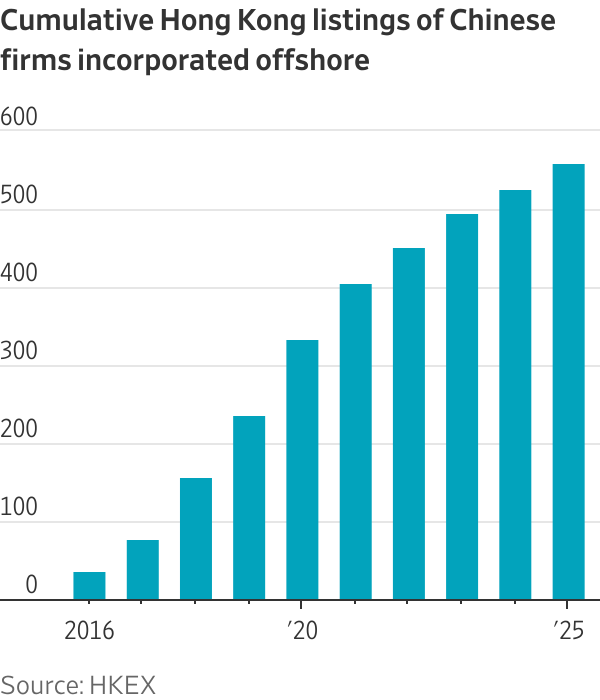
Under Beijing’s new system, Chinese founders can still list their companies on offshore exchanges and then cash out shares. But entrepreneurs have to repatriate the money back to China and pay tax before seeking approval to invest overseas, according to lawyers tracking the changes.
“It’s just now every step is visible,” said Paul Jebely, a partner at law firm Sterlington who lives in Hong Kong and represents wealthy clients.
Hong Kong has been one of the hottest global markets for IPOs, raising money for companies and bringing a bonanza for early investors. Directors in Hong Kong-listed companies sold shares in bulk trades worth $7.6 billion last year, the highest level in five years, according to data firm Dealogic.
Beijing wants to tighten control over capital flows while widening the channels for money to leave the country, according to economists and lawyers. It is encouraging everyone, including wealthy entrepreneurs, to invest overseas via closed-loop systems. These take an investor’s yuan, invest it offshore on Hong Kong exchanges or in funds run by asset managers, then return the proceeds of any sale or other profits in China’s currency. This keeps the life of the investment under government oversight.
Buffeted by the storm is billionaire Leaf Li and his brokerage firm, Futu.
Li was an early employee of Tencent, which is now China’s most valuable listed firm. When Tencent listed in Hong Kong in 2004, he became rich overnight. He later founded Futu in Hong Kong to help people invest in global markets. By the end of the first quarter, clients had put $156 billion at his firm, making it one of Asia’s biggest online brokers and wealth managers.
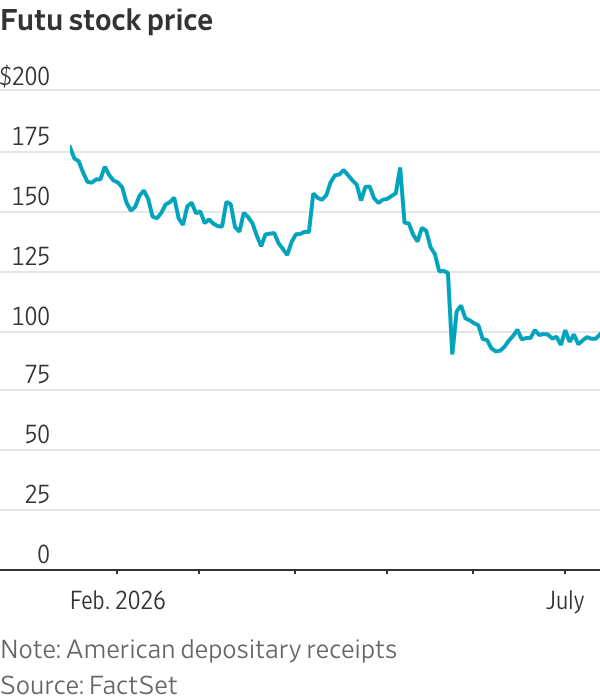
Authorities in May handed Futu a $271 million penalty for what they said was illegal facilitation of cross-border investments, part of a sweep of penalties against similar companies. News of the fine sent Futu’s share price down nearly 30% in a day.
The company has said it is cooperating with Chinese authorities and has told investors that only 17% of its total client assets are from accounts based in mainland China.
Thanks to China’s trade surplus with the rest of the world—which reached $1.2 trillion last year—Chinese companies are earning ample foreign currency. If they brought it all home, that might push up the yuan against the dollar and hurt the competitiveness of Chinese exports. Capital outflows offset that pressure, which is why analysts say Beijing isn’t trying to stop people from investing overseas altogether.
The new policy is also designed to ensure profits earned overseas are taxed, an area that has been poorly policed for decades.
Tax authorities this year have reminded nationals to declare overseas income and noted China’s involvement in the Common Reporting Standard, an information-sharing system among global tax bodies. The new rules issued by the State Council also seek to regulate the transactions of offshore companies owned by Chinese superrich, according to lawyers.
“Even if you make a capital gain outside of China, you have to pay tax now,” said Kevin Woo, a partner at Hong Kong-based law firm Ince.
Write to Rory Jones at Rory.Jones@wsj.com


