
 E-Paper



ASI to launch ₹2.4-crore project to revive Zafar Mahal’s water tank
Work on removal of existing concrete layers of the tank has already begun and restoration is likely to be completed in the five months. It will cost an estimated ₹2.4 crore, said officials.

 Prefer HTon Google


The Archaeological Survey of India (ASI) will soon undertake the revival of the water tank surrounding the Zafar Mahal — a red sandstone water pavilion, built by the last Mughal emperor Bahadur Shah Zafar in 1842. Located inside the Red Fort premises, Zafar Mahal is one of the last monuments built by the Mughals.
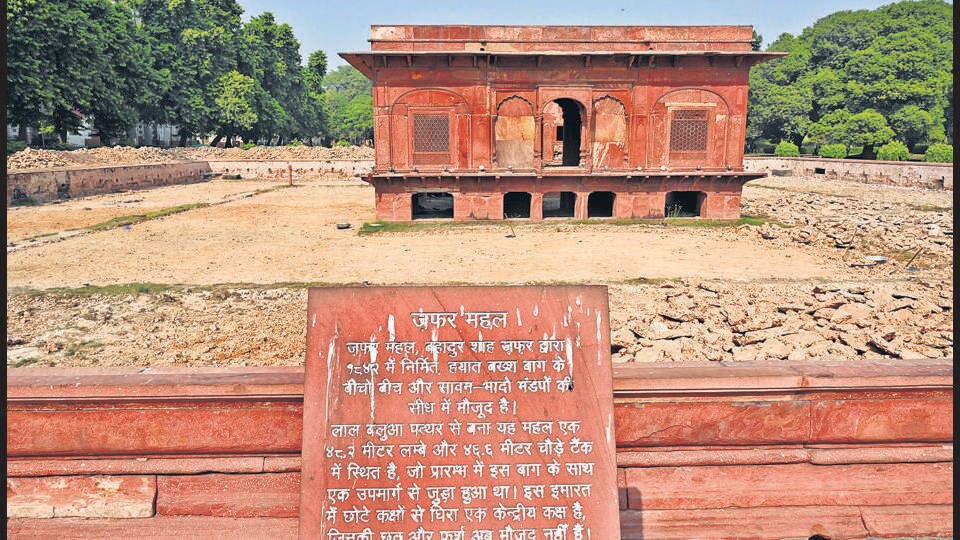
Apart from this, the agency will also begin work to rejuvenate fountains and illuminate the red sandstone pavilion, as well as restore the inner cells on the northern side of the Red Fort, said an ASI official who asked not to be named. Work on removal of existing concrete layers of the tank has already begun and restoration is likely to be completed in the five months. It will cost an estimated ₹2.4 crore.
Constructed as a summer palace, Zafar Mahal was built in the Hayat Baksh Bagh (life giver garden) — built by Shah Jahan during the construction of the Red Fort —and is one of the largest gardens in the fort.
The ASI has invited bids for executing a series of rejuvenation and improvement projects at the World heritage site under which the agency will spend around ₹1 crore on the revival of the water tank and its fountains and ₹1.41 crore on the conservation of the inner cells. The agency is also undertaking repair and refurbishment work in the museums inside the complex, officials said.
According to the ASI report on the project, restoration will be done using traditional methods such as red sandstone slabs, stone aggregates with gum, Belgiri, along with application of non-woven geotextile layer resistant to microorganisms and waterproofing joints. Belgiri — whose scientific name is aegle marmelos — is used in heritage restoration as an organic additive in traditional lime mortar and plaster. It acts as a natural binder and admixture, increasing durability.
Today, Zafar Mahal paints a sorry picture with sections with exposed bricks, missing red-sandstone, and cracks in the façade. In 2020, parts of the pavilion had also collapsed. A year later, in 2021, HT had reported that restoration work had been carried out. “At the time, we had restored the fountains around Rang Mahal but the work in the section along Zafar Mahal was not done. Once the water tank is restored and illumination work is complete, it will act as another key attraction for the tourists,” official added. Rang Mahal, also built by Shah Jahan , served as one of the largest and most ornate imperial apartments in the complex.
In his book, ‘Red Fort: Remembering the Magnificent Mughals’ (2019), author Debashish Das writes that, at the centre of the Hayat Baksh Bagh, two pavilions named after the two monsoon months — sawan (the July to August period) and bhadon (August to September period) — stand at the opposite ends of the long canal, equidistant from the central rectangular pool in which stands another pavilion named Zafar Mahal.
The pavilion complex is built in bilateral symmetry on either side of the central axis called “qarina”. A painting by Ghulam Ali Khan, known as the last royal Mughal painter, titled ‘Sketches of Delhee Palace and Delhee, 1854’, commissioned by East India Company officer, Sir Thomas Douglas, shows the newly constructed Zafar Mahal with its unique bridge having an open arch at its centre under which boats could ply.


Stay updated with all top Cities including, Bengaluru, Delhi, Mumbai and more across India. Stay informed on the latest happenings in World News along with Delhi Election 2025 and Delhi Election Result 2025 Live, New Delhi Election Result Live, Kalkaji Election Result Live at Hindustan Times.


