E-Paper



Day after formal event, revellers rush back to Delhi’s favourite public space
One element was missing from this familiar air of festivity associated with the India Gate --- ice cream trolleys and snack vendors were missing from the immediate vicinity of the monument, ostensibly due to security reasons.

 Prefer HTon Google


Families relaxing on the lawns. Kids taking a dip in the fountains. Youngsters busy clicking selfies with the iconic monument as a backdrop. After nearly 20 months, a newly revamped Central Vista Avenue around the India Gate -- the most accessible open public space in Delhi -- has come alive with the sound of joy and laughter.
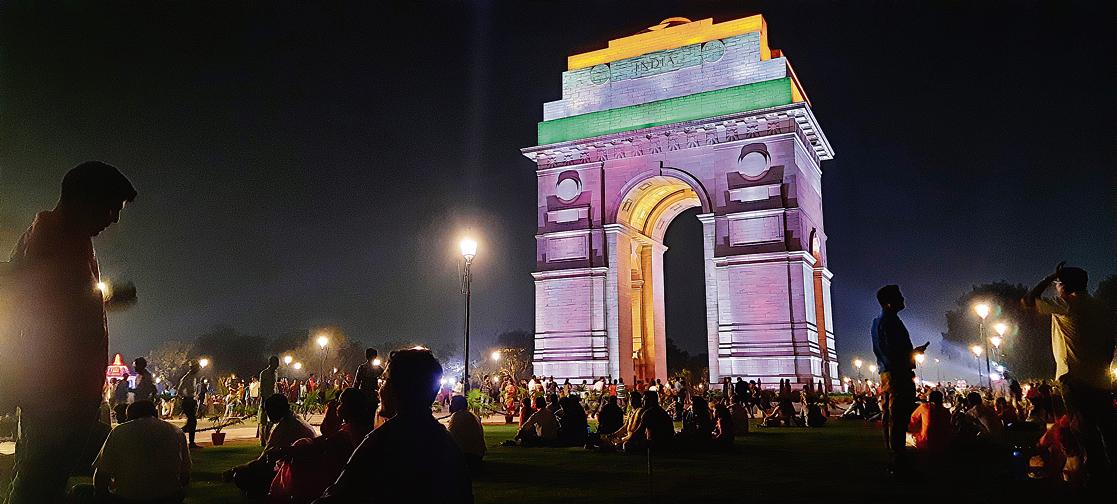
Days ahead of the inauguration of Kartavya Path by Prime Minister Narendra Modi on Thursday, there was a buzz around the city -- many feared the iconic lawns would be out of bounds for visitors. However, these apprehensions were allayed on Friday, with the vast green spread teeming with adults and children on a warm, balmy evening as some cooled off near the fountains and the canals.
One element was missing from this familiar air of festivity associated with the India Gate --- ice cream trolleys and snack vendors were missing from the immediate vicinity of the monument, ostensibly due to security reasons.
Munching on a snack or licking an ice cream bought from a vendor at the India Gate lawns is something experienced by generations to have visited the iconic memorial. However, visitors to the revamped Central Vista Avenue found street vendors missing altogether from the area.
Rauf Ahmed Ali, who had been selling bhelpuri at India Gate for over a decade, said he temporarily relocated to nearby markets during the renovation period, but was hoping to return to his favourite haunt upon India Gate’s reopening. “We got to know in the morning that no entry will be allowed. While some vendors were able to sell in the lawns initially, security personnel quickly told us to leave,” he said.
Under the revamped Central Vista, seven vending zones, including two near India Gate at C-Hexagon, have been developed-- but they were yet to be occupied on the first day. Of the seven vending zones, five will have space for 40 vendors each. There will also be two amenity blocks at India Gate with 16 shops.
A senior CPWD official said, “The vendors were not allowed due to security reasons on the directions of the Delhi Police. We would have tried to accommodate some vendors at the five vending zones, which has space for 200 vendors, if the police had allowed.”
Parul Garg, 32, a resident of Shahdara said that while the Central Vista was aesthetically pleasing, her children were upset over the lack of availability food. “I had promised them ice-cream at India Gate but I was not aware that no vendors will be allowed inside,” Garg rued.
Others, meanwhile, said this was a welcome move, as it will prevent littering inside the lawns. “The entire Central Vista looks beautiful and to maintain it and keep it clean, it is important to keep street vendors outside. If food is allowed inside, litter will constantly have to be picked up by the upkeep staff,” said 53-year-old Angad Singh, a businessman.
However, street photographers were back at India Gate, unceasingly pitching their expertise to visitors, offering to take your photos with a warmly lit monument in the backdrop.
Dinesh Lal, who has been clicking pictures of visitors at India Gate for the last four years, said it was good to be back. “For the last two years, we had been clicking pictures from outside the barricaded area, but people would argue that the photographs are from too far away. Now, we are again able to snap pictures of our customers from inside the lawns and I have already made sales of over ₹2,000 since I arrived in the morning at 9 am,” said the 32-year-old, who says he expects the crowd to grow further on the weekend.
The highlight of Friday’s festivities was a drone show on Netaji Subhas Chandra Bose, but till early evening, multiple troupes showcasing the cultural art forms of various states of India were busy occupying the attention of the crowds. The crowd swelled to such a degree that though the drone show was slated to begin at 8 pm, it was delayed by over half an hour --- at first, security personnel tried their level best to clear a 50-metre radius around India Gate, but to no avail. Finally, a loudspeaker mounted on police jeep was roped in to clear the area.
At 8.38 pm, a loud roar reverberated around India Gate as over 100 drones shot up in the sky to form the tricolour, before transforming into different shapes. The show continued for around 10 minutes during which the drones morphed into shapes resembling Netaji’s statue, broken handcuffs, Jai Hind in Devanagari script--each of which brought chants of ‘Jai Hind’ and ‘Bharat Mata Ki Jai’.
While awe-struck people gazed towards the sky, the accompanying commentary on loudspeakers which narrated the life and struggles of Netaji.
“I came with my children and wife as they were all excited to see what India Gate looks like now. We were also curious to see the drone show and it did not disappoint at all… This should become a permanent attraction at India Gate, similar to laser shows that are held at some monuments around the world,” said Anand Rai, a 38-year-old engineer.
Shantnu Moitra, a student, said he was thrilled to see the drone show. “It was worth the time we spent commuting here from Noida. Everyone should come to see this new space once,” he said.