A thick haze covered the city on Thursday as the air quality index (AQI) remained in the “very poor” category for the fourth consecutive day, just days ahead of Diwali as forecast said of a likely deterioration to ”severe” levels from Friday
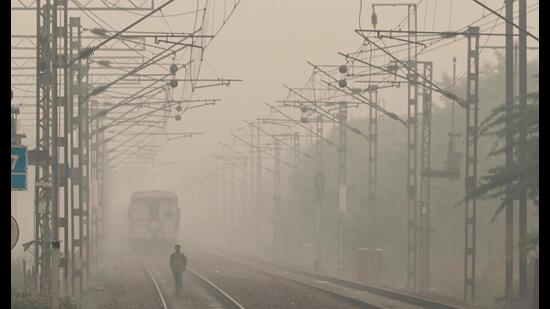
The 24-hour average stood at 369 on Thursday, according to the Central Pollution Control Board (CPCB)’s 4pm bulletin, just 8 points lower than Wednesday’s 377. It was higher than 350 on Tuesday and 324 on Monday.
The CPCB classifies an AQI between 0 and 50 as ‘good’, 51-100 as ‘satisfactory’, 101-200 as ‘moderate’, 201-300 as ‘poor’, 301-400 as ‘very poor’ and 401-500 as ‘severe’.
Also read: Delhi's air continues to worsen as AQI nears 400-mark
Forecast and Monitoring Station Readings
The Air Quality Early Warning System (AQEWS) has forecast that Delhi’s air quality will remain “very poor” on Thursday before deteriorating to the “severe” category from Friday to Sunday. The outlook for the subsequent six days is also likely to remain between the two categories.
On Thursday, of the 59 active air quality monitoring stations in the national capital, 22 recorded “severe” air quality on Thursday at 10pm. Punjabi Bagh reported the highest AQI of 459, followed by Jahangirpuri (457), Rohini (453), IIT Delhi (452) and DTU (443).
{{/usCountry}}On Thursday, of the 59 active air quality monitoring stations in the national capital, 22 recorded “severe” air quality on Thursday at 10pm. Punjabi Bagh reported the highest AQI of 459, followed by Jahangirpuri (457), Rohini (453), IIT Delhi (452) and DTU (443).
{{/usCountry}}The main pollutant was PM2.5.
Also read: No respite for Delhiites as pollution levels surge; AQI at 373, 21 stations in ‘severe’ category
Sources of Pollution
The Decision Support System (DSS) for Air Quality Management in Delhi estimated the contribution of stubble burning to Delhi’s PM2.5 levels at 15.6% on Thursday with a forecast indicating that it would rise to 19.2% on Friday before dropping sharply to 1.6% on Saturday.
Meanwhile, the DSS, under the Ministry of Earth Sciences, estimated that the contribution of transport emissions, meanwhile, is expected to increase from 17.9% on Thursday to 18.3% on Friday and 21.1% by Saturday.
Nasa’s satellite detected 2,251 farm fires in Punjab and Haryana between October 1 and November 4 (2,025 in Punjab and 226 in Haryana), including 246 on November 4. During the corresponding period last season, it detected 2,579 fires.
Also read: Hindustan Times launches pollution dashboard that puts air quality data in context
However, HT had previously reported that Nasa’s satellite passes at about 1.30pm, and most burning now happens later in the day, so its count is far below the real number.
Frequently Asked Questions
What was Delhi’s average AQI on Thursday?
What AQI category was forecast for Delhi from Friday to Sunday?
Which monitoring station recorded the highest AQI on Thursday?
How many farm fires did Nasa’s satellite detect in Punjab and Haryana between October 1 and November 4?
Stay updated with all top Cities including, Bengaluru, Delhi, Mumbai and more across India. Stay informed on the latest happenings in World News along with Delhi Election 2025 and Delhi Election Result 2025 Live, New Delhi Election Result Live, Kalkaji Election Result Live at Hindustan Times.
Stay updated with all top Cities including, Bengaluru, Delhi, Mumbai and more across India. Stay informed on the latest happenings in World News along with Delhi Election 2025 and Delhi Election Result 2025 Live, New Delhi Election Result Live, Kalkaji Election Result Live at Hindustan Times.