
 E-Paper



Delhi faces pollution threat from Gurugram firecracker sales
While the sale of green crackers is allowed in Gurugram, lax enforcement by authorities has now compounded the problem

 Prefer HTon Google


Cross-border smuggling and doorstep delivery of firecrackers, including traditional ones, is set to exacerbate pollution woes in the Capital, according to a spot check by HT at shops selling fireworks in Gurugram, even as Delhi authorities moved to cut out the problem by issuing a blanket ban on all firecrackers, including green crackers.
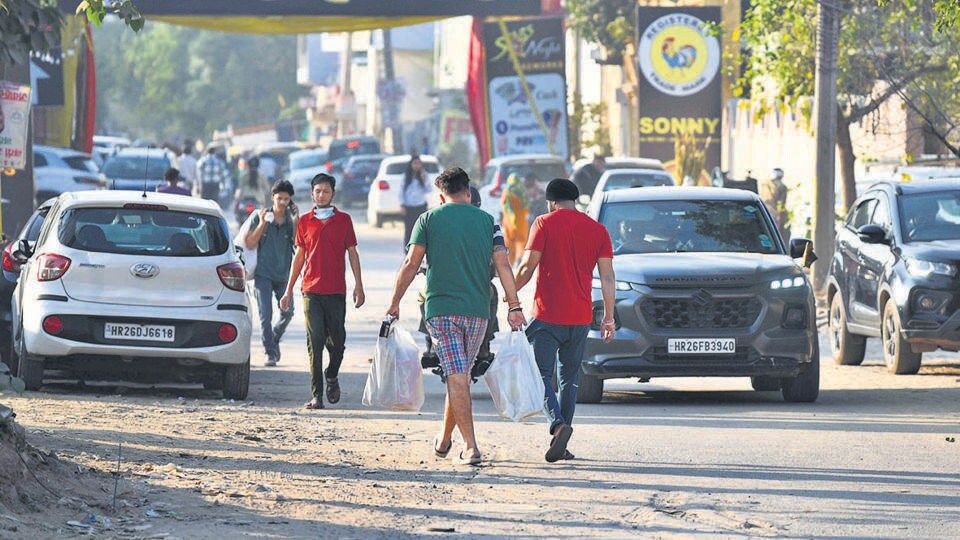
While the sale of green crackers is allowed in Gurugram, lax enforcement by authorities has now compounded the problem, as HT found traders selling traditional firecrackers — often under false pretences, by sticking green labels on the boxes — to customers.
To be sure, the sale of green crackers is allowed in Gurugram but they can only be burst between 8pm and 10pm on Diwali and Gurupurab, and from 11.55pm on Christmas Eve to 12.30am on Christmas, according to the local administration.
Delhi Police said that while it may not be feasible to check every Delhi-bound car at every border, they are conducting random checks and have activated informers to check on the smuggling of firecrackers into the Capital.
Ashok Kumar, a wholesale firecracker trader in Gadoli, said that compared to the past few years, sales have doubled in the run-up to Diwali. “Daily sales have reached up to ₹4 lakh. Since the ban in Delhi, customers are coming here for their firecrackers. Delhi used to have a big wholesale market in Sadar Bazar, but with the restrictions, Gurugram has become their new destination,” he said.
Kumar attributed the surge in footfall primarily to customers from Delhi, estimating nearly 60% of buyers to be non-local. He said that the demand for firecrackers with loud noise and colourful displays remains high, and customers are often unconcerned about whether firecrackers are green or traditional ones. “People just want firecrackers that make a lot of noise. They don’t care about the green logo,” Kumar said.
Arjun Yadav, another firecracker trader in Gadoli, said he is offering to deliver firecrackers to customers in nearby districts and the national capital. “We have hired delivery boys who travel by train, bus, and private vehicles to deliver firecrackers to those placing orders of ₹30,000 and above on an advance payment of ₹5,000,” Yadav said.
Checks at shops in areas farther from the Capital, such as Pataudi, Sohna and Farrukhnagar, revealed that many were offering discounts of up to 25% to woo customers from across the NCR. “The market is seeing a rise like never before. Our sales have more than doubled compared to 2019. People are buying in bulk for Diwali as many parties have been organised in farmhouses,” Ramesh Kumar, a dealer from Sohna, who has been trading in firecrackers for decades, said.
No end in sight
Experts have been calling for a uniform ban on firecrackers across NCR for long to crack down on cross-border sales. Delhi has been enforcing a complete ban on firecrackers since 2020, banning green crackers too — a notification to this effect was issued on October 14 this year.
However, Haryana and Uttar Pradesh are yet to enforce a complete ban, instead allowing green crackers to be sold and burst.
Central Pollution Control Board (CPCB) data since 2015 shows a spike in the air quality index (AQI) post-Diwali in seven of the past eight years, barring 2022, when strong winds on Diwali helped disperse firecracker emissions.
Last year, Delhi’s AQI on Diwali (November 12) was 218 (“poor”), the lowest since AQI data was available. However, the rampant bursting of firecrackers in the evening saw Delhi’s average AQI rise to 358 (“very poor”) the next day.
Bhavreen Kandhari, an environmental activist, said until a central body such as the Commission for Air Quality Management (CAQM) calls for a uniform ban, cross-border sales will continue. “We have bans coming into effect in states at different times, and Uttar Pradesh and Haryana have not been imposing complete bans. People can quite easily go to Gurugram or Noida and get crackers with them. Even in these neighbouring towns, pollution that occurs through these crackers will come towards Delhi,” she said.
Delhi bursting signals worse to come
Delhi residents were also seen bursting firecrackers on Karwa Chauth, on October 20. Although the sale of firecrackers is banned in Delhi, a spot check by HT found shopkeepers discreetly selling the banned goods across the Capital. Traders, locals said, were only selling firecrackers to acquaintances, or people who visited with kids and “seemed genuine customers” to evade authorities.
In Kirti Nagar, west Delhi, a trader sold sky shots, phooljharis and small bombs to a 10-year-old boy a few minutes before he refused to sell firecrackers to the HT team. In Tilak Nagar, a noted and licensed firecracker trader claimed he wasn’t selling firecrackers because of the ban, but a vegetable vendor located next to the shop said that “he was selling to everyone he knows but not to those who come without referrals.”
At two shops in Sadar Bazar, which used to sell firecrackers at throwaway prices, there was no sale. “All vendors were removed... They are now selling to acquaintances from home,” Rajesh Kumar, 46, who sells decorations near the shops said.
In Uttam Nagar, locals told the reporter that firecrackers were being sold at a shop that sells kites.
Increasing cost fails to dampen demand
Gurugram’s deputy commissioner Nishant Kumar Yadav on Monday issued orders reinforcing the ban on traditional firecrackers till January 31, 2025. However, traders were openly flouting the norms, with many saying that selling fireworks for higher prices or sticking green labels on traditional fireworks was worth the risk.
Customers, too, are feeling the pinch of rising prices and are hence, opting for traditional ones as they cost less.
“My standard set of preferred fireworks cost me ₹20,000 usually, but this year, I had to shell out ₹45,000 for the same. Shopkeepers are saying that substitutes for barium are more expensive, but the difference in quality is hardly noticeable. People are opting for traditional crackers because they’re more affordable,” Neeraj Sachdeva, a resident of Delhi’s Lajpat Nagar, said.
Wholesale markets are thriving as customers prefer them over retail outlets, where prices are significantly higher. “At the wholesale market, a box of 10 green ‘anar’ crackers is ₹220, but the retail price is often around ₹370, after discount,” said Kamal Gupta, a wholesale seller in Gadoli.
Demand for firecrackers is here to stay and the sale of traditional firecrackers shows no sign of slowing down, traders said.
(with inputs from Jasjeev Gandhiok, Hemani Bhandari and Karn Pratap Singh)


