
 E-Paper



Delhi forest dept razes illegal houses in Sangam Vihar
Forest officials said that the drive began on Tuesday when two acres of forest land were cleared, and the drive will continue on Thursday

 Prefer HTon Google


Delhi’s forest and wildlife department on Wednesday demolished seven houses built on forest land during an anti-encroachment drive in south Delhi’s Sangam Vihar, forest officials aware of the matter said. The demolished houses were built on 0.5 acres of land that formed part of the southern ridge in Sangam Vihar’s H block, they added.
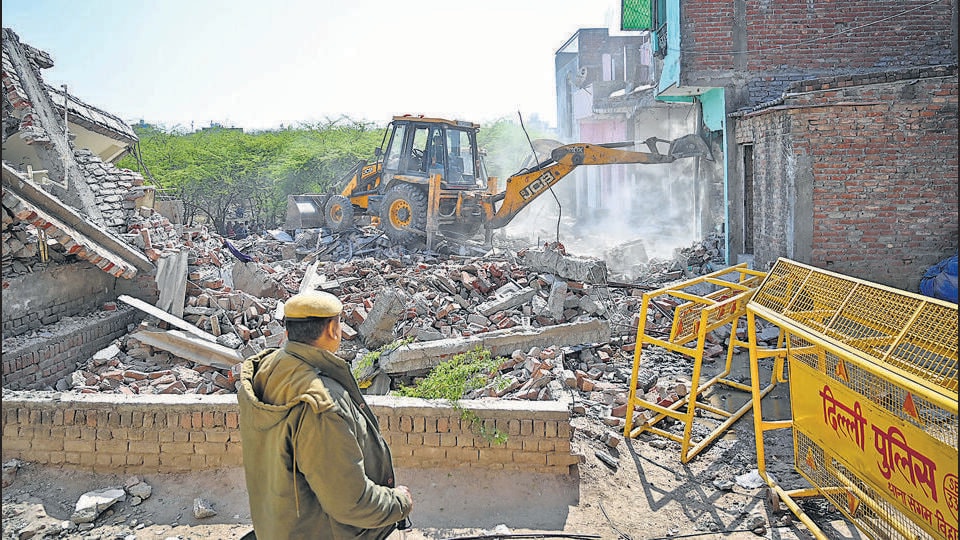
Forest officials said that the drive began on Tuesday when two acres of forest land were cleared in south Delhi’s Tughlakabad, Sangam Vihar, Neb Sarai, and Ayanagar. More than 250 police personnel were involved in the drive, and it will continue on Thursday, forest officials said.
“At least 2.5 acres of forest land have been cleared over the last two days, with the anti-encroachment drive to continue on Thursday to free up even more forest land. This is being done in compliance with a National Green Tribunal (NGT) order to free up the Ridge from any encroachments,” said a senior forest official on condition of anonymity.
A senior forest official said a joint exercise carried out by them and the revenue department till 2018 revealed maps of the southern ridge, which are to be considered forest land. “Existing encroachments on that land are now being removed, as per court orders,” the official said.
Pankaj Kumar, 30, a resident of H block whose house was among the few that were spared, said that some residents were served notices and asked to vacate their plots immediately, but the Khasra numbers mentioned on the notices did not match the Khasra numbers on the ground. Khasra is a number provided to an owner of land that serves as an identity proof.
“My house has not been demolished yet, but a friend’s house down the street has been razed. We are afraid that we could be next though we have not yet received a notice. The forest department says this land belongs to them, but the Khasra numbers mentioned in the notices do not match our actual numbers,” said Kumar, adding that most residents were owners of their land, not tenants.
“We have documents to show we purchased this land. How did no one tell us at the time that this was illegal?” he asked.
Amit Chaudhary, another local whose house is among the many that have been served notices, said the forest department was not listening to their pleas. “I showed them our house’s purchase documents but they said the land belongs to them. People are being asked to vacate immediately,” he said.
The forest department has been carrying out anti-encroachment drives in the southern ridge since 2019 following a 2015 NGT order in the Sonya Ghosh v Govt of NCT Of Delhi and Others case. Ghosh had petitioned for the removal of all illegal encroachments in the Ridge.
The Ridge in Delhi — an extension of the Aravallis — is divided into four unconnected parts. These include the Central Ridge, the Northern Ridge, the South Central Ridge, and the Southern Ridge, the last one being the largest of the four. HT reported in December last year that despite frequent drives, more than 314 hectares (ha) of the southern ridge was yet to be cleared of the encroachments. This was based on forest department data submitted to the NGT-appointed Oversight Committee (OC).
The data had shown encroachments in 19 villages forming a part of the southern ridge. This includes Tughlakabad, Rajpur Khurd, Chattarpur, Dera Mandi, Sangam Vihar, Jaunapur, Ayanagar, Satbari, Saidulajab, Maidangarhi, Neb Sarai, Asola, Bhatti, Rangpuri, Sahurpur, Devli, Rajokri, Ghitorni, Mahipalpur, and Pul Prahladpur.
Of the 314.7 hectares still under encroachment, the highest — 44.1 ha fell in Asola, adjacent to the Asola Bhatti Wildlife Sanctuary. This was followed by 38.1 ha in Bhatti village, 37.8 ha in Devli, and 31.6 ha of forest land in Tughlakabad.



