
 E-Paper



Delhi: Ganga water diversion via Eastern Yamuna canal being considered
The additional water will enter the Yamuna upstream of Wazirabad, a 22km stretch through Delhi that contributes to over 76% of the river’s pollution, according to the Yamuna Monitoring Committee

 Prefer HTon Google


As part of the Centre’s Yamuna rejuvenation strategy, Delhi government agencies are exploring a proposal to divert around 500 cusecs of Ganga water to the Yamuna to improve its flow during the non-monsoon season, multiple officials familiar with the matter said on Monday.
The plan, which was discussed at a high-level meeting on May 22chaired by Union home minister Amit Shah, alongside Union urban affairs minister Manohar Lal Khattar, Jal Shakti minister CR Patil, and Delhi chief minister Rekha Gupta, proposes the diversion of water from the Upper Ganga Canal in Roorkee to the Eastern Yamuna Canal via the Deoband feeder branch. From there, it will reach the Yamuna at three points in western Uttar Pradesh — Bhaniawala, Baraut, and Jawli near Loni — through re-engineered defunct stormwater drains that once served as Yamuna tributaries.
The additional water will enter the Yamuna upstream of Wazirabad, a 22km stretch through Delhi that contributes to over 76% of the river’s pollution, according to the Yamuna Monitoring Committee. The water will pass through Delhi and be recovered downstream via the Agra canal, with a critical condition: the Delhi Jal Board (DJB) cannot extract the water for municipal use. Consent from Uttar Pradesh and the Upper Yamuna River Board is also required before implementation, the people cited above said.
Experts, however, pointed out that diverting flows from a river to clean another river may be a short-cut measure that may not be a substitute for long-term sustained efforts, such as fixing drains or adding sewage treatment plants, to restore the Yamuna.
To be sure, this is the first time that such a plan has been formulated to clean up the Yamuna. There has never been a water transfer for the purpose between the barrages involved.
A senior official involved in the plan said the intention is to simulate ecological flow (e-flow) through Delhi’s Yamuna stretch by using available canal infrastructure. “This initiative is meant purely to enhance river health. Using stormwater channels and dry nullahs may help avoid fresh construction,” the official said.
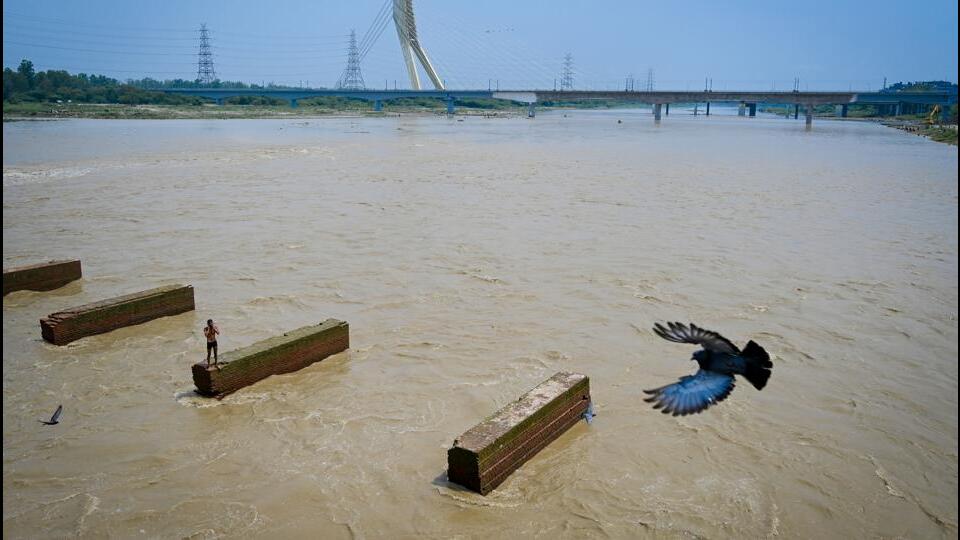
The officials cited above, however, insist the urgency of improving flows is clear from the current state of the river, as it has visibly improved following recent monsoon rainfall in the northern hills. As swollen streams and tributaries feed into the river, the generally inky black waters of the Yamuna are gradually turning into a more natural, muddy flow.
“The increase in flow has flushed out some pollutants. The Yamuna’s black waters have given way to a muddy but cleaner stream,” said an official from the Delhi environment department. “This is evidence that flow is key to reviving the river.”
Typically, each monsoon, excess water is released into the Yamuna via the Hathanikund barrage, increasing both its flow and its water levels, which has a flush-out effect. This can often lead to pollution levels dipping by nearly half.
The Delhi Pollution Control Committee (DPCC) and environmental agencies have pegged e-flow requirements for the Yamuna at 23 cumecs (cubic metres per second), but current levels often dip to around 10 cumecs. Improved flow will help dilute pollutants, including biochemical oxygen demand (BOD) and total suspended solids (TSS), restoring aquatic health.
However, experts have raised red flags. Bhim Singh Rawat, a river activist with the South Asia Network on Dams, Rivers and People (SANDRP), called the plan a “shortcut” and “half-baked solution.”
“This move evades the real problem — untreated sewage and broken river catchments. Firstly, Ganga does not have any surplus water. Like Yamuna, the national river also struggles to maintain minimum flows during lean season. Transferring water from one depleted river to another is not restoration,” he said.
Rawat also questioned the feasibility of using old drains that cut through pollution-prone and encroached agricultural zones in UP. “Ensuring the diverted water actually reaches the Yamuna will be an enormous logistical challenge. And even if it does, the volume is too little to make a significant impact,” he said.
He advocated for the revival of the Shivalik feeder streams and increasing water releases from Hathni Kund barrage, as well as using Western Yamuna Canal water through Drains No. 2 and 8 — all of which are better aligned with natural hydrology.
HT had reported on June 24that the Delhi government is also working on a closed duct system to route treated water from the Coronation Pillar and Yamuna Vihar sewage treatment plants (STPs) to Wazirabad. Meanwhile, water from the Okhla STP will be released via the Abul Fazal drain. Combined, these interventions are expected to inject 1,244 MLD (million litres per day) of treated water into the Yamuna’s lean-season flow.
There was no immediate reaction available from the Uttar Pradesh side.
Still, experts believe that unless untreated sewage is stopped from entering the river between Wazirabad and Okhla, these additional flows may prove ineffective.
Environmental activist Diwan Singh, who has worked on restoring multiple water bodies in Dwarka and Yamuna revival, said: “The primary culprit is untreated sewage and industrial waste falling in Yamuna. We should focus on treating all the waste water and ensuring the flow in the river. Yamuna cannot walk on crutches of some other river system. We should not focus on optics but on natural revival of streams that feed Yamuna, its feeder streams and tributaries.”


Stay updated with all top Cities including, Bengaluru, Delhi, Mumbai and more across India. Stay informed on the latest happenings in World News along with Delhi Election 2025 and Delhi Election Result 2025 Live, New Delhi Election Result Live, Kalkaji Election Result Live at Hindustan Times.


