E-Paper



Delhi: Gurmukhi road signs littered with errors
The New Delhi Municipal Council (NDMC) has been criticized for misspelling road names in Gurmukhi, the Punjabi script, on signage in the city.

 Prefer HTon Google


Akbah Hoad, Catliya Marg, Aaditi Sadaan, Janpadh – did Delhi add new roads to its already busy list? No. The roads remain the same, just misspelled in Gurmukhi (the Punjabi script) on green signage that dot parts of New Delhi.
Hours after Simon Wong, the Singapore high commissioner to India, pointed out on Twitter on October 8 how the Embassy of Singapore had been erroneously spelt as “Singapur” on a sign at Satya Marg, a Twitter user pointed out that this was not the only mistake made by the New Delhi Municipal Council (NDMC).
Harshdeep Rapal, 40, an entrepreneur and avid cyclist, said that as he rode past Lutyens’ Delhi many mornings, he noticed several incorrect Gurmukhi spellings. “I have spotted over a dozen wrongly spelt road signs so far, including at roundabouts. I have complained many times but nothing changes,” he said.
The signage for major roads in Delhi have the names first written in Hindi, followed by English, Gurmukhi, and then Urdu. HT showed photos of several such signs to Professor Ravinder Kumar, dean and head of the department of Punjabi at Delhi University, who corroborated Rapal’s findings.
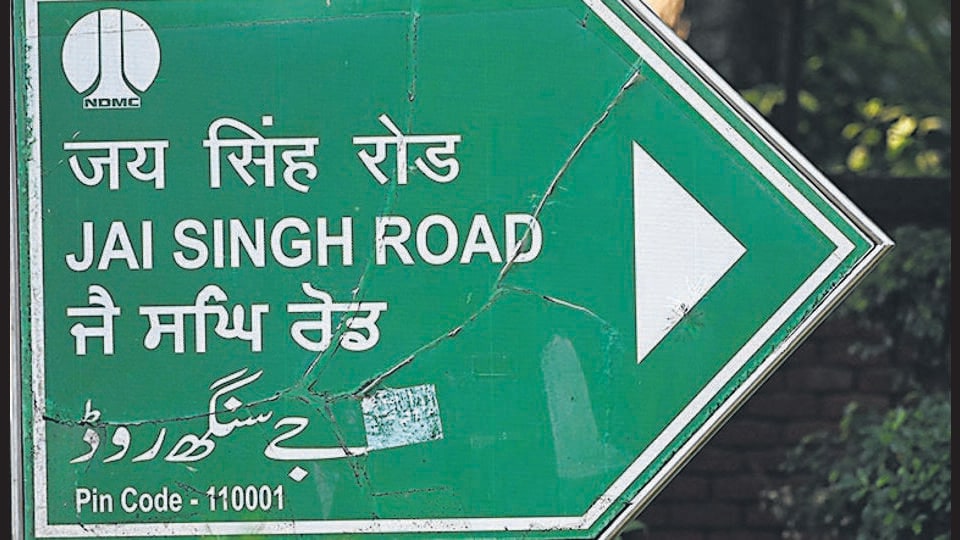
For example, Jai Singh road has been translated in Punjabi to Jai Saghi road; and Janpath, which is one of the main roads in New Delhi running perpendicular to Kartavya Path (earlier Rajpath) has an “h” missing in the transliteration.
Then there is Kautilya Marg – a key road in the diplomatic enclave which connects Sardar Patel Marg at one end to Hotel Samrat at the other – has been given feline origins in its Gurmukhi spelling. It reads Catliya Marg. Not to forget, Aditya Sadan near Ashoka Road has become Aaditi Sadaan.
During a spot check, HT found that mistakes are not limited to these signage alone. In some cases, the same road has been spelled differently in Gurmukhi multiples times, such as Janpath which has been written as “Janpat” near Claridges hotel, “Janpadh” near the National Archives, and the correct one “Janpath” near Kartavya Path. Akbar Road near the C-Hexagon has been misspelt as “Akbah Hoad”.
NDMC manages 42.7 sq km of area in central Delhi.
Satish Upadhyay, vice-chairman of NDMC, told HT, “I am not aware of the issue, I will look into the matter.”
An NDMC official said that the main challenge is the use of various languages – English, Hindi, Punjabi, Urdu. “Many roads are named after places and figures from other countries. Translating them into Urdu, Punjabi and Hindi can be tough,” said the official, and added that errors are fixed when they are pointed out.
The official added that while the English and Hindi names are typed out, and errors are often found during the typing stage due to theauto-correct function on the computer, there are no such corrective mechanisms for Punjabi and Urdu names. “Pictures of existing names on the signage are taken and replicated during the placement of the boards,” the official said.
NDMC officials also claimed that language academies are consulted in the signage-making process to ensure that they are error free.HT reached out the Punjabi Academy but officials did not respond to requests for comment.
Professor Ravinder Kumar, dean and head of the department of Punjabi at Delhi University, reviewedthe signs on several New Delhi roads for HT. He, too, confirmed that some signage in Gurmukhi were either outright wrong or unintelligible.
He confirmed the mistakes at Jai Singh road, and Kautilya Marg, among others. “It is sad that the road owning agencies are so lax in putting up the signage in Punjabi which is a second official language of Delhi,” said Kumar, lamenting that while the Centre wants to promote all 22 official languages of the country by teaching and promoting their usage, the state of the public signage tells a story of neglect.
“These departments should have language experts but many of these posts are lying vacant. Delhi government also runs an official academy for promoting Punjabi language in the city. All these signage should have been vetted by experts before being put up,” said Kumar.
An NDMC official told HT that they had Punjabi and Urdu translators – who retired in 2013 and 2018, respectively. The posts have not been filled since. Despite repeated attempts, NDMC did not respond to queries regarding the vacant posts.
Professor Kumar recommended that due to the scale of the mistakes, a citywide survey by subject experts from the academy should be done to detect and remove anomalies.
HT reached out to Dr Md Yahya Saba, an Urdu lecturer at the Delhi University, to verify the spellings of the same set of signage, and a relatively minor mistake was found in a sign on Kautilya Marg. The current version reads “Kauilya” since the “T” alphabet in Urdu is missing.
In June 2003, Punjabi and Urdu became the second official languages of Delhi with the then-President of India APJ Abdul Kalam giving his assent to the Delhi Official Language Bill, 2000.
The 2003 recommendation for presidential assent was made by deputy Prime Minister LK Advani after a delegation of Punjabis led by BJP leader Madan Lal Khurana met him about this.
The enacted law declared that Punjabi in Gurumukhi script and the Urdu script will be the second official languages of Delhi for various official purposes. This would necessitate publishing the translation of important government rules, regulations and gazette notifications, and important government advertisements in Gurmukhi and Urdu. The gazette notification section 4(C) says that the “signboards of the official buildings, government offices and roads will bear the names in Urdu and Punjabi also.”
Dr S Velmurugan, chief scientist and head of traffic engineering and safety division of Central Road Research Institute (CRRI), said, “Such mistakes can be confusing for native language speakers in the city. Mistakes in public signage is a grave error. In a cosmopolitan city like Delhi, which receives visitors from all over the country, the signage should be error free. People who only understand Punjabi will misunderstand the names of places and that defeats the purpose of the signage,” he added.
About the Singapur-Singapore controversy, an official of the NDMC said, “The Singapur typo may have happened due to error creeping in at the printing stage. The workers at printing stage may have changed it to Singapur while typing it in the system.”
According to this NDMC official, in the case of names involving embassies, these names are usually taken from the embassies themselves instead of using search engines. An NDMC report says that it manages 1,298km roads in Central Delhi, along with 52 rotaries and roundabouts where there are more than 5,343 road signs in place. Officials said that the real number may be higher as each road has multiple signs at various ends and intersections.
(With inputs by Jasjeev Gandhiok)