E-Paper



Delhi's arsenal for pollution fight retooled
On Wednesday, the new Graded Response Action Plan (Grap) for the national capital was released by the Commission for Air Quality Management (CAQM).

 Prefer HTon Google


New Delhi: This winter, restrictions aimed at combating pollution are likely to be proactive, not reactive, if the new Graded Response Action Plan (Grap), released by the Commission for Air Quality Management on Wednesday, works as designed.
Till now, Grap, a list of progressively strict set of restrictions on activities that lead to pollution, were triggered in stages when particular thresholds were crossed for two consecutive days. In the revised plan, these will be activated three days before the air quality is predicted to hit their triggers.
Also Read: In revamped Grap, ban on diesel car when air severe+
To do so, officials aware of the plan said, authorities will rely on forecasts by the Indian Institute of Tropical Meteorology’s (IITM) Early Warning System (EWS) for air pollution in Delhi.
According to officials, the Early Warning System, a forecasting mechanism launched in 2019, will be aided by the Decision Support System (DSS), which was launched in 2021. The DSS considers multiple readings and observations, including pollution data from across northern India, satellite data of aerosols and of farm fires. Forecasts can be made up to 10 days, with accuracy fairly high for up to a week.
The new Grap is also part of what experts said was a comprehensive policy for the National Capital Region (NCR), which will focus on multi-pronged action across different sectors contributing to pollution in the region.
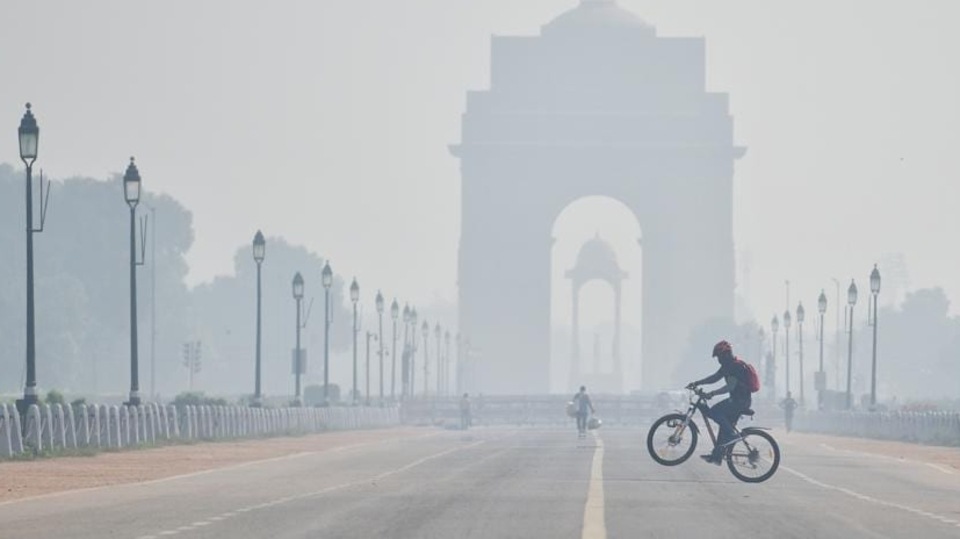
Delhi, and its surrounding regions, are beset by a severe pollution problem every winter
Unlike the previous version, which required PM2.5 or PM10 concentration to reach a particular threshold before each category was enforced, the new one treats AQI, or air quality index, as the trigger. This index comprises eight different pollutants -- particulate matter (PM)10, PM2.5, Ozone (O3), sulphur dioxide (SO2), nitrogen dioxide (NO2), carbon monoxide (CO), lead (Pb) and ammonia (NH3).
Based on these, four new categories have been created -- Stage I or ‘poor’, when AQI is between 201 and 300. Stage II or ‘very poor’, when AQI is between 301 and 400; Stage III or ‘severe’, when AQI is between 401 and 450) and Stage IV or ‘severe plus’, when AQI goes over 450.
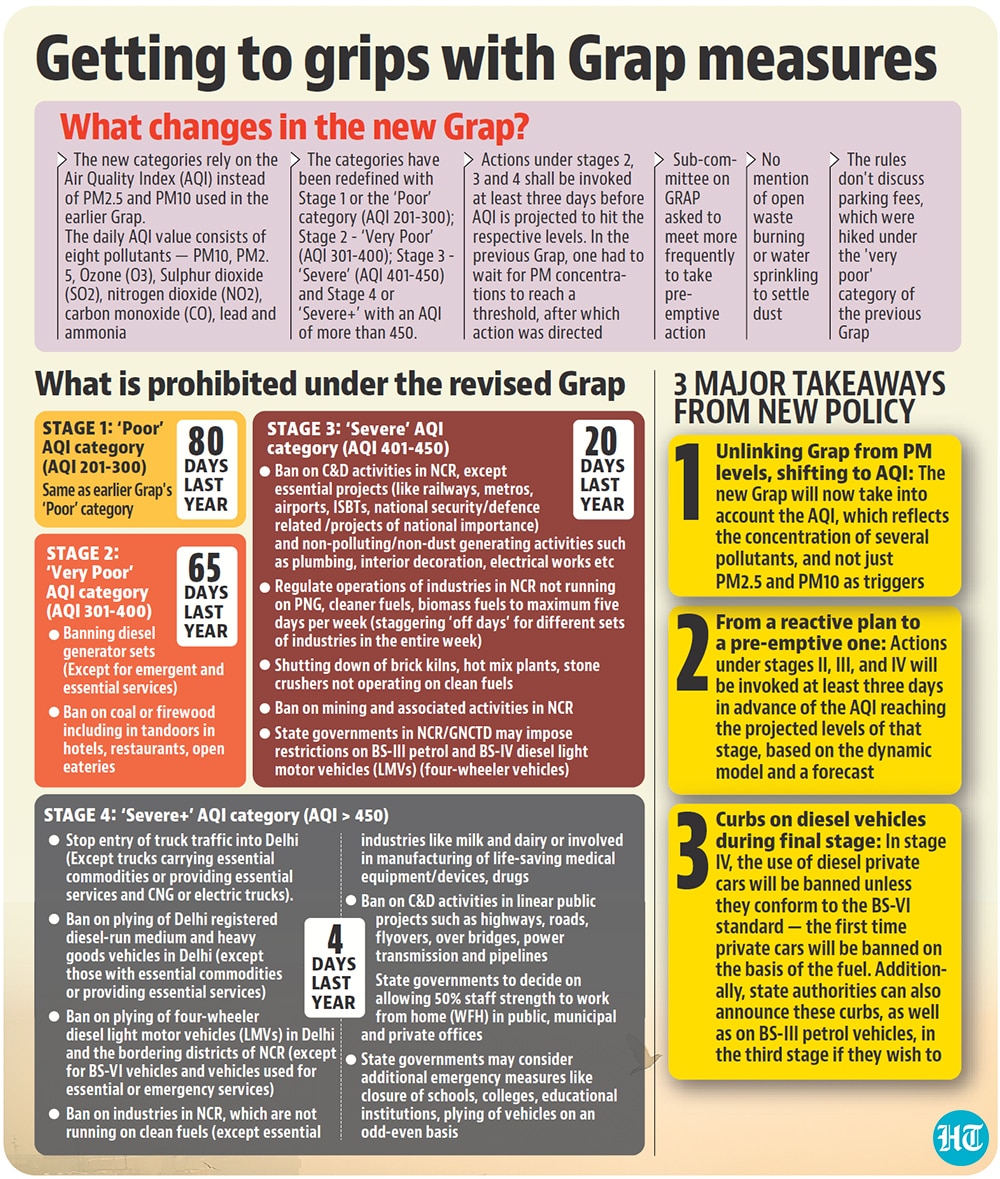
While stage I will not be enforced in advance and measures under it will come into action when the AQI crosses 201, measures in Stage II, Stage III and Stage IV have to be invoked at least three days before AQI is projected to reach the respective thresholds.
“Proposed restrictions are to be progressive from a lower stage to higher stage, so restrictive actions undertaken as per previous stages shall be continued, in addition to the air pollution stage under which the restrictive actions are envisaged to be taken. For example, restrictive actions under the Stage III category, whenever invoked, shall be in addition to those under Stage I and II respectively and so on and so forth,” said the policy.
Anumita Roychowdhury, executive director, research and advocacy at the Centre for Science and Environment (CSE), said the new categories and their measures are designed in such a manner to ensure pollution levels are not able to rise to dangerous levels. “If action is taken in advance, a significant portion of the pollution comes down in advance and the sub-committee on Grap can also enforce additional measures if needed,” she said.
There was a ban on entry of trucks into Delhi as per the existing Grap, but the new one goes a step further, expanding it to diesel run cars as well when the AQI reaches the ‘severe plus’ category. The new policy also bans the use of Delhi-registered, diesel-run medium goods vehicles (MGVs) and heavy goods vehicles (HGVs) within city limits – previously, their entry would be regulated.
In the ‘severe’ category, state governments are also empowered to impose restrictions on BS-III petrol and BS-IV diesel light motor vehicles if required.
The CAQM has also introduced a ban on mining across NCR, a restriction which was missing in the previous Grap, while it allows for hot-mix plants, stone crushers and brick-kilns to function across NCR if they are on cleaner fuels. Earlier, there was a blanket ban on these, irrespective of the type of fuel or technology being used.
A blanket ban on construction, meanwhile, is not likely this time around, with a construction and demolition activity (C&D) embargo now being split up into two categories. In the ‘severe’ category, essential projects such as railways, metros, airports, ISBTs, and those for national security or related to defence as well as non-polluting and non-dust generating measures will be allowed. These are banned only in the severe plus category.
The CAQM has also completely done away with measures under the last Grap that asked for enhancement of parking fees by 3-4 times as part of the ‘very poor’ category and an increase in bus and metro services by augmentation and introduction of differential rates to encourage off-peak travel.
Dr. Mukesh Sharma, professor at the Department of Civil Engineering at IIT, Kanpur and part of the expert group that framed this new policy, said they have increased focus on vehicular pollution, particularly through diesel-sources, to ensure there is a smooth phase-out of such vehicles from the region. “Under the last Grap, only diesel-based trucks were banned, but we have now added heavy goods vehicles, medium goods vehicles and light motor vehicles under the restricted category too. This sends a message that there is a need to phase out these vehicles,” he said.
In NCR regions, diesel vehicles have a registration span of only ten years, compared to 15 for those running on petrol.
Residents slam move to curb diesel cars
Residents said they were surprised by the new measures and called them “drastic” and “knee jerk”. “Has the commission thought how it will be enforced? Also, banning diesel vehicles in severe+ category means all the load will come on public transport. Is our city equipped and what about last mile connectivity. Besides, the government itself still uses a lot of BS-IV vehicles, why hasn’t it removed them yet?,” said Saurabh Gandhi, general secretary of United Residents of Delhi.
Traders and businessmen called the move “shocking”. Sanjeev Mehra of Khan Market traders association said, “It is not surprising but it is a shocking recommendation. This will lead to the ban of lakhs of vehicles which may not only burden people financially, but it will also render many jobless also. The inventory of BS-IV vehicles were cleared under duress by manufacturers