
 E-Paper



Feared gangster Deepak Boxer, who fled to Mexico, captured in joint op
Deepak Boxer had been on the Delhi Police’s radar, and Dhaliwal said officers learned that the gangster may have fled India in January.

 Prefer HTon Google


A coordinated operation involving Indian law enforcement agencies, Interpol, the Office of the Legal Attaché of the US Embassy in New Delhi, and Mexican immigration and law enforcement agencies resulted in the apprehending of Deepak Pahal alias Deepak Boxer, one of Delhi’s most dreaded gangsters, from an airport in Cancun, Mexico.

The Delhi Police, which shared news of the capture, said Boxer, 27, will likely be brought back to the Capital on Wednesday and arrested, and is currently in detention on a flight to the city via Istanbul, Turkey, and added that the exercise was code-named Operation Mexico.
Also read: From sports to underworld: Rise and fall of Deepak ‘Boxer'
“This is the first time that a fugitive is being brought back to India from Mexico,” Delhi Police said in an official release.
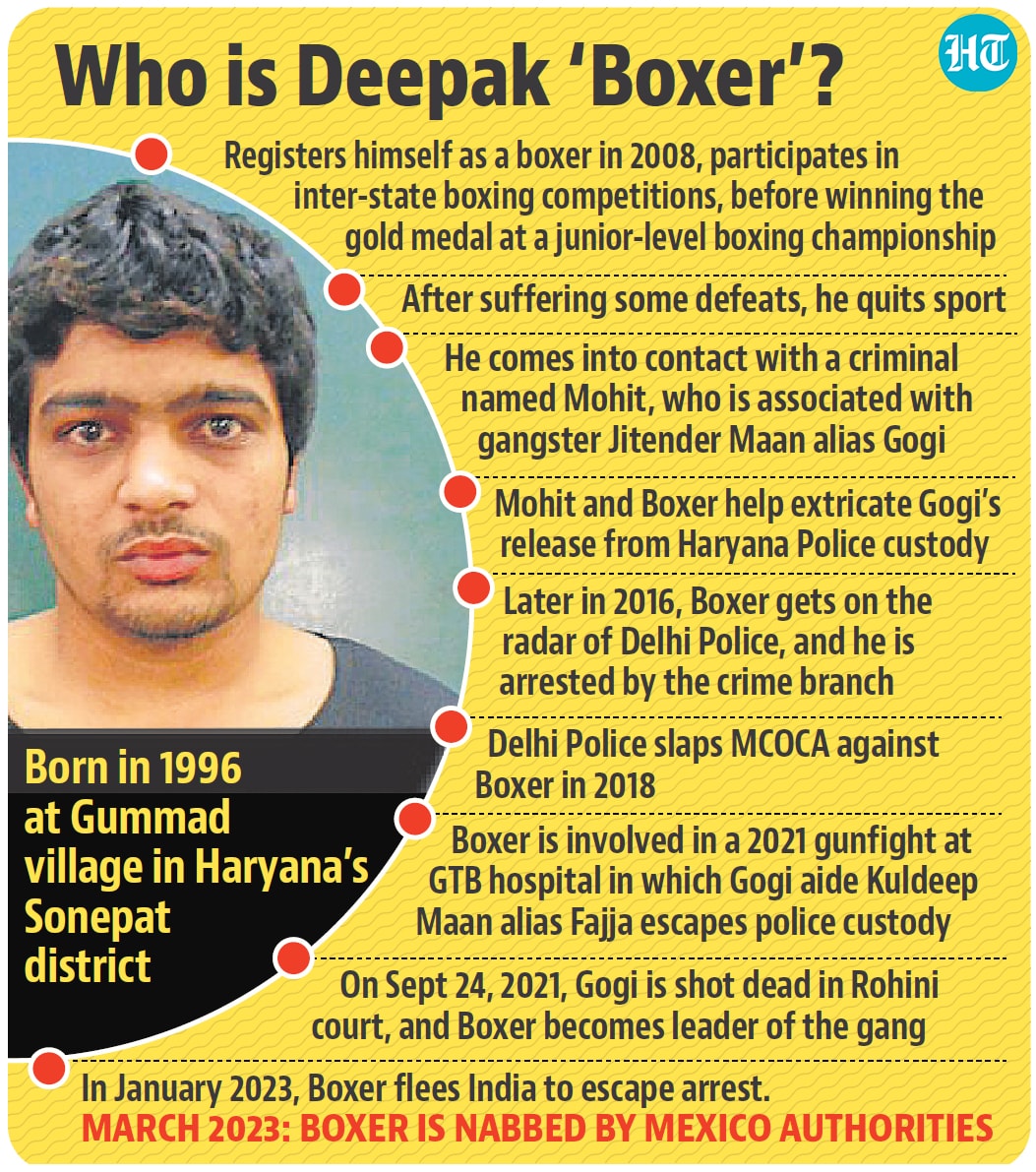
Boxer earned his moniker after making his name as a junior pugilist, winning medals on the inter-state circuit, police said. According to officers, after he failed to make it big in the sport, he switched to a life of crime, which culminated with him becoming the head of the gang which was previously led by slain gangster Jitender Gogi.
Special commissioner of police (special cell) HGS Dhaliwal said that in a meeting in August last year, Union home minister Amit Shah directed Delhi Police’s special cell and crime branch to legally pursue organised criminals and terrorists trying to hide anywhere in the country or abroad and bring them to justice. Thereafter, multiple operations were carried out in Delhi and other states against gangsters such as Lawrence Bishnoi, Kaushal Chaudhary, Lucky Patial and Kapil Sangwan, and it led to arrest of many members of the gangs.
Boxer had been on the Delhi Police’s radar, and Dhaliwal said officers learned that the gangster may have fled India in January. To confirm the inputs, officers interrogated some of Boxer’s key aides arrested in recent months, also questioning his relatives. They learnt that Boxer had fled the country using a fake passport prepared in Bareilly in Uttar Pradesh using the name Ravi Antil.
On March 16, a case was registered by the special cell and Boxer was declared wanted, said Dhaliwal.
After collecting details of the fake passport, special cell sleuths learned that Boxer had fled to Dubai from Kolkata. The sleuths informed the Union home ministry, and it further roped in the ministry of external affairs ministry (MEA).
Thereafter, it was decided that Boxer had to be traced and arrested from any corner of the world, police officers aware of the operation said.
Special commissioner of police (crime) Ravindra Yadav said technical surveillance on Boxer revealed that he had used the “donkey channel” — a term used by criminals to illegally enter countries using touts, agents, traffickers and other helpers.
Around the last week of March, Yadav said, officers learnt that Boxer had reached Mexico via at least six international airports — Dubai, Almaty in Kazakhstan, Istanbul, Paramaribo in Suriname, Port of Spain in Trinidad, Panama City in Panama and El Salvador City in El Salvador. He stayed in each of these places for some days before moving forward. The local agents and traffickers were ensuring his stay and travel, for which nearly ₹40 lakh was paid to the members of the “donkey channel”.
Through the MEA and the Central Bureau of Investigation (CBI), the Delhi Police approached Interpol and consulates in some of the countries Boxer had passed through before reaching Mexico.
“His intention behind reaching Mexico was to reach the US with the help of human traffickers, from there he would continue to run the activities of his organised crime group in Delhi and neighbouring states,” Dhaliwal said.
In the second phase of this operation, Indian authorities and sleuths began sharing information with US authorities and Mexico Police. Acting on this information, Boxer was traced to the beach city of Cancun, said Dhaliwal.
A special cell officer, on condition of anonymity, said that a red corner notice (RCN) was issued against Boxer through the Interpol, and details about his criminal record, his fingerprints, and the fake name and passport he was using were all shared with the US authorities, and the Mexican immigration and law enforcement agencies.
Also read: Security scare at US embassy in London, operations resumed after brief lockdown
Around 10 days ago, officers said, Boxer learned that Indian agencies were on his trail and attempted to flee Cancun, reaching the city’s domestic airport. “However, immigration officials caught him after he was identified as an international fugitive,” the officer said.
After the special cell was informed about Boxer’s detention, a two-member team was dispatched to Mexico to secure Boxer’s deportation and custody. The team reached on April 1 and after following the paperwork, took Boxer’s custody. Boxer was deported to India via Istanbul and is expected to reach Delhi by Wednesday morning, the officer said.
The arrest of Boxer will bring down the curtain on the five-year chase that Delhi Police and other police forces of adjoining states carried out. “Nabbing the dangerous fugitive from Mexico and bringing him to India is a big success,” said Dhaliwal.


