
 E-Paper



Delhiwale: This way to Chhatta Shaikh Mangloo
The Walled City dictionary

 Prefer HTon Google


As part of our ‘Walled City dictionary’ series that is chronicling every Old Delhi locality.
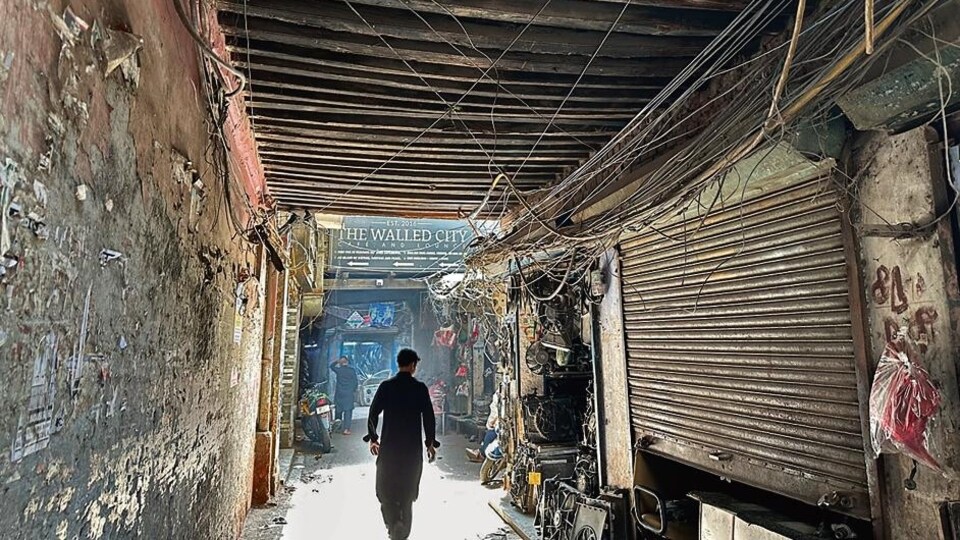
It flows like a nadi (river) from under the shadow of the Jama Masjid. But a citizen walking on the street won’t see anything of the grand mosque. Flanked by multi-stories, Chhatta Shaikh Mangloo teems with crowds. This afternoon, a man is ambling along with a car door; the location of the rest of the vehicle is a mystery. The street is overstuffed with shops stocked with spare car parts. “This is a self-starter, this is a altimotor [altimeter], that is a viper machine, those are inner parts”—-a trader remarks, his grease-stained hand waving at the shop’s clutter of metal knick-knacks.
The spare car parts market popped up in the street a few decades ago. It was formerly lined with havelis, each pickled in its self-contained isolation. Such as the Din Duniya House. That beautiful mansion of terraces, balconies, corridors and staircases was the home of Din Duniya, an Urdu weekly founded in 1921 by the haveli’s patriarch Shokat Ali Fehmi. One of Shaikh Mangloo’s most distinguished residents, he authored 43 books on history and religion, most of which are still in print. The magazine surveyed politics and society. Its publication lay suspended in the turbulent years around the Partition. Later, it evolved into a monthly journal. Shokat Ali died in 1993; his Din Duniya continued to issue out from his haveli.
One afternoon, many seasons ago, the haveli’s courtyard was alive with the whining of two printing machines— one hand-fed, circa 1985, and one automatic, circa 1996. The latest issue of Din Duniya was being printed. Its then editor-printer-publisher, Asif Fehmi—one of the founder’s four sons—was sitting in an adjoining hall. He was writing an editorial, checking proof copies, drinking chai, and editing stories sent by the magazine’s two freelance contributors. At that time, it appeared that Din Duniya would last forever. Now, the printers lie disused since the Covid lockdowns. During the pandemic, the Din Duniya House was renovated by the gentle-mannered Arshad Fehmi, Shokat Ali’s other son. The new building’s sprawling roof offers a breath-stopping view of the Jama Masjid.
Further down the street, past Just For You guesthouse, stands Nawab House—the haveli of late Aziz Shafi, a magistrate remembered by Shaikh Mangloo masses as “judge saab”. The haveli is a significant landmark. It has two chhattas, kind of bridges (see photo), that span over the street at two separate places, giving the street its designation of “Chhatta”. The chhattas connect Nawab House to late Nazam Faiz Ahmad’s haveli that stands on the facing side of the street. The passages were used by the purdah-bound ladies of the two havelis to visit each other.
Facing Nawab House lies a side-alley snaking into a warren of doorways. A locked yard within has the grave of a fakir. He was Shaikh Mangloo.


