E-Paper



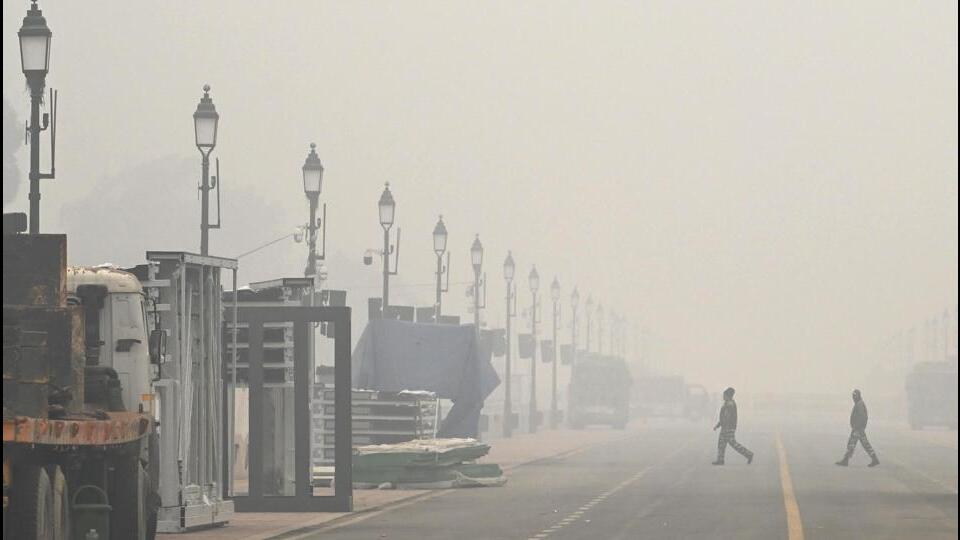
Hazy shade of winter: Dense fog cloaks Delhi, delays flights
IMD forecasts show dense fog is likely on Monday as well, while moderate to dense fog is forecast for Tuesday. From Wednesday onwards, the fog intensity is likely to reduce.

 Prefer HTon Google


The Capital woke up to “very dense” to “dense” fog on Sunday morning, as visibility stayed below 200 metres at Delhi’s Indira Gandhi International (IGI) Airport for nine hours between 2.30am and 11.30am, leading to at least 100 flights getting delayed and two flights being diverted to the Jaipur airport. Trains too were impacted, with at least 42 trains delayed for over 1.5 hours, both to and from the Capital, data shared by northern railways showed.
The first of the two flights diverted on Sunday was an Air India Bengaluru to Delhi flight (AI-804), which was diverted to the Jaipur airport at 10.10am, followed by a Cochin to Delhi Air India flight (AI-466), which was diverted at 10.25am. An airport official said that both flights had to be diverted as CAT-III procedures were in place, but the pilots were not CAT-III compliant and so were not given permission to land.
“In both cases, the pilots did not meet the CAT-III criteria and so were asked to divert to Jaipur. The flights landed in Delhi once the visibility improved,” the official said.

At 3.50am, Delhi airport tweeted that low visibility procedures were in place and while no flights had been impacted, passengers should check with the airline for the latest flight information. “While landings and takeoffs continue at the Delhi airport, flights that are not CAT-III A compliant may get affected. Passengers are requested to contact the airline concerned for updated flight information,” it tweeted.
The airport initiates low visibility procedures (LVP) -- measures aimed at making landing for flights easier-- when visibility dips below 800 metres. During this period, CAT-I procedures are in place, which is the most basic set of precautions to guide pilots in landing. Only flights and pilots that are CAT-II compliant are allowed to land when visibility is less than 550 metres. CAT-III A pilots can land when visibility is between 175 and 300 metres. CAT-III B is the most stringent set of qualifications for a pilot to land a flight, allowing them to land even when visibility is 50 metres.
While flights can still land at the airport when visibility is 50 metres, no flight is allowed to depart unless runway visibility range (RVR) is 125 metres, leading to flight delays. A departure of over 15 minutes from the scheduled time of arrival or departure is classified as a “delay”.
A Met official said fog began forming over Palam around 8.30am and dissipated only by 1pm.
“Visibility fell to 50 metres around 2.30am and stayed below 100 metres till 10am. After that, visibility was around 100 metres till 11.30am, before becoming moderate and dissipating completely by 1pm,” said the official. “This led to some arrivals and departures being delayed during this window as well.”
The India Meteorological Department (IMD) classifies fog as “shallow” when visibility dips below 1,000 metres, as “moderate” when visibility is between 200 and 500 metres and as “dense” when it is below 200 metres. It is “very dense” when visibility is below 50 metres.
IMD forecasts show dense fog is likely on Monday as well, while moderate to dense fog is forecast for Tuesday. From Wednesday onwards, the fog intensity is likely to reduce.