
 E-Paper



'Extension of weekend curbs will depend on Delhi’s graph,' say officials
Chief minister Arvind Kejriwal on Thursday expressed concern over the Covid-19 situation in Delhi and imposed a weekend curfew

 Prefer HTon Google


Stricter curbs may be imposed in Delhi if the number of Covid-19 cases and the positivity rate continue to rise at the pace they are, senior administration officials said on Thursday after chief minister Arvind Kejriwal announced a curfew this weekend and imposed widespread restrictions as the pandemic continued to spiral out of control in Delhi.

“The order issued on Thursday imposes a weekend curfew only from 10pm on Friday to 5am on Monday. Extending the restriction for more weekends or imposing stricter curbs on the lines of Maharashtra will solely depend on Delhi’s Covid-19 curve — the positivity rate in the next few days. So the coming week will be crucial,” said a senior health official.
In Delhi, the latest test positivity rate was 20.22%, the highest in 294 days.
This number has shot up over the past few weeks, well past the 5% threshold as recommended by the World Health Organization (WHO).
Delhi’s positivity rate fell below 5% on December 3. It then dropped to below 1% on December 28, and stayed beneath that number for 82 days.
The city also has over 54,000 active cases now — the highest ever.
The official quoted above said the Delhi government and the Lieutenant Governor (L-G) will review Thursday’s restrictions in the coming week to decide if more stringent curbs are needed, factoring in the impact of the fresh curbs on the Capital’s Covid-19 case trajectory.
A second government official actively involved in Delhi’s Covid management plan said the city administration is closely monitoring the recent curbs announced in Maharashtra, which is witnessing the steepest surge in cases among all states. The Maharashtra government this week announced the imposition of Section 144 across the state till 7am on May 1.
“Cases are increasing at an unprecedented rate, which has forced the government to impose these restrictions. It is expected the restrictions will help slow down the spread of the disease. Otherwise, no amount of additional hospital beds, ICUs and ventilators will be sufficient. The restrictions should help increase mask compliance and adherence to distancing among the masses,” said a second senior official who did not wish to be identified.
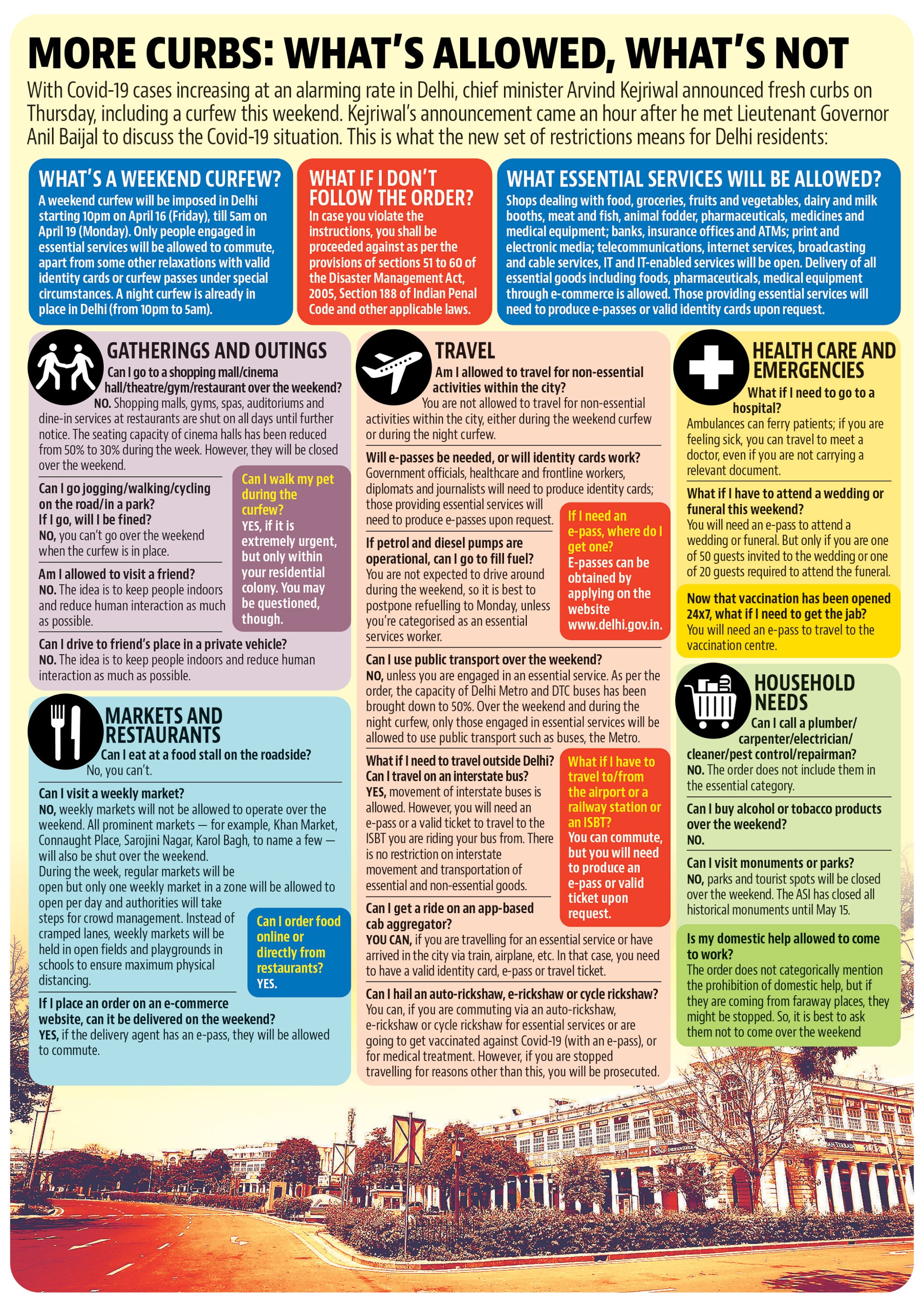
Chief minister Arvind Kejriwal on Thursday expressed concern over the Covid-19 situation in Delhi and imposed a weekend curfew, temporarily shut shopping malls, gyms, spas and entertainment parks, capped the capacity of cinema halls and multiplexes at 30%, barred dining at restaurants, and limited weekly markets to one per day in a single municipal zone. The night curfew, in place till April 30, will continue, the Delhi Disaster Management Authority (DDMA) said in its order.
“On weekdays, people have to earn their livelihood. But on the weekend, people go out for entertainment and other activities, which can be curtailed. Hence, to break the chain of infections, we are imposing a weekend curfew,” said Kejriwal, an hour after a meeting with L-G Anil Baijal on the Capital’s coronavirus situation.
“We will not allow any inconvenience to those involved in essential services like going to hospitals, railway stations or airports as well as weddings. We will issue passes for their movement quickly and without harassment,” Kejriwal added.
Experts, however, said such restrictions should have been imposed in Delhi much earlier, which they said would have bought DDMA time to review the situation.
Dr Lalit Kant, former head of the division of epidemiology and communicable diseases at the Indian Council of Medical Research (ICMR) said, “It is too late. In Delhi, such curbs should have been imposed much earlier — ideally, by mid or end-March, when cases started increasing at a decent pace. That would have given the government more time to review and assess the impact of the curbs and take decisions on future course of actions. Assessment of such restrictions is not feasible in short time windows.”
Dr Jacob John, former head of the clinical virology department at Christian Medical College in Tamil Nadu’s Vellore, said, “The effects of such restrictions are not likely to reflect in Covid-19 numbers in just a week. The government should have imposed such restrictions in Delhi at least three weeks ago. At this stage, the government should develop more strategies to improve mask compliance. It is evident that large-scale transmission is happening in Delhi and such restrictions cannot be imposed for long durations. People will come out and start making social contact again. The government has to ensure that they are all masked. There is no other way to arrest transmission in the long run.”


