
 E-Paper



Four days past deadline, but 250 winter shelters for homeless in Delhi still not ready
Many of the sites remain non-operational and still in early stages of preparation, even as people living in existing permanent shelters brace for harsher nights ahead.

 Prefer HTon Google


Despite a sharp drop in night temperatures, the Delhi government has missed its deadline to open 250 temporary night shelters for the homeless, with work lagging by nearly four days. Many of the sites remain non-operational and still in early stages of preparation, even as people living in existing permanent shelters brace for harsher nights ahead.
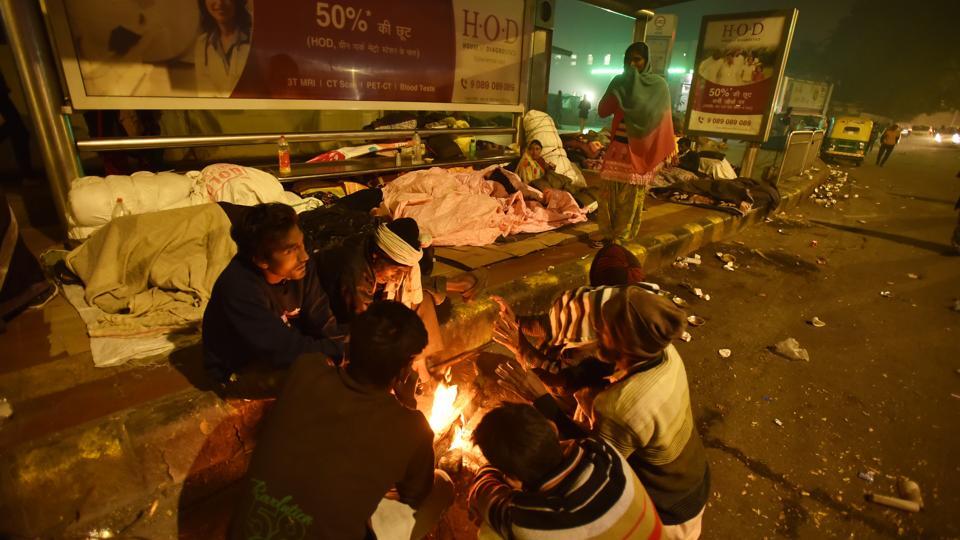
Caretakers at permanent shelters in densely populated areas such as Sarai Kale Khan and Jama Masjid said it would take a few more days before temporary facilities are “fully ready” to house people. Meanwhile, several permanent shelters continue to struggle with basic amenities, from broken toilets and rat-bitten mattresses to the absence of functioning hot-water dispensers.
Earlier this month, the government had announced that 250 temporary shelters would be added to the existing 197 permanent homes, supported by a 24/7 technology-enabled monitoring system for the winter action plan. “The government’s objective is that every homeless person should receive shelter and safety under the winter action plan, which will run from November 15 to March 15,” the chief minister’s office had said in a statement on November 6.
Night-time temperatures in Delhi have fallen noticeably over the past week. At the Safdarjung weather station, the minimum temperature dropped to 11.2°C on Friday, which was 1.1 degrees below normal and slightly lower than Thursday’s 11.2°C. Forecasts suggest the mercury may fall further, potentially oscillating between 9 °C and 11 °C in the coming days.
But a spot check by HT across ten permanent shelters in places such as Jama Masjid, Sarai Kale Khan and Kashmere Gate, where temporary structures were also planned, found that while some sites are in their early stages of preparation, others have not begun work at all, waiting instead for “peak winter” to set in.
“The tender has been awarded just three days ago. We have so far put up 78 temporary shelters in areas such as AIIMS,” said PK Jha, principal director, Delhi Urban Shelter Improvement Board (DUSIB). “Within a week, the target of 250 will be complete.”
Sarai Kale Khan: Tents have no light, water or bedding
Next to Sarai Kale Khan Metro station’s Gate No. 2, a dimly lit permanent shelter has four units for families, one for men, and one for people undergoing medical treatment.There is also a large vacant ground earmarked for five to six temporary shelters. When HT visited, three white tents had been erected, but none of them had lights, drinking water, bedding or mattresses.
The shelter has two hot-water dispensers but both were found pushed into a corner, unused for weeks and covered in dust.
“The tent is ready; a few more will be set up in the coming two or three days, and then blankets and mattresses will also be made available,” said Mohd Chand Hussain, who has worked at the shelter since 2018.
He added that the hot-water dispensers had been removed from public access. “People here are from different religions and castes, and they used to quarrel frequently as they don’t want their water to be touched by others, so ultimately we decided to remove the water dispenser,” he said.
Inside the permanent family units, overcrowding has forced people to sleep inches away from one another, belongings stacked on the floor, clothes hanging from makeshift ropes stretched across the room.
“I came here a few months ago with my son, who is undergoing treatment after his spinal surgery at AIIMS,” said 55-year-old Meena Devi, from Madhya Pradesh. “We got one bed and I decided my son needs it more.” She sleeps on the floor, on a thin worn-out bedsheet. “I asked them for a blanket. They made a note a month ago and said when new blankets come in winter, I will get one.”
Kashmere Gate: Women washroom has no geyser
At another two-storey shelter near Kashmere Gate, the ground floor houses men and the upper floor houses women. But several women said that only the ground-floor washroom, which is meant for men, has a geyser. This forces women to wake up before 6am to bathe, or wait until midday. Drinking water, they said, is also available only on the ground floor.
“If we have to use the geyser, then we have to either go before six or wait till noon. And the drinking water facility is only on the ground floor,” said 26-year-old Madhuri Devi, a caregiver at the shelter for the past year.
Lighting in the women’s washroom is another concern as the toilet is located behind the main building, and accessed through a narrow, dimly lit passage. “There’s no light in the washroom and the doors can’t be locked because of iron rusting,” Madhuri said, adding that these issues are repeatedly flagged during inspections.
Jama Masjid: Rats have infested shelter
At Meena Bazaar near Jama Masjid, the permanent shelters — one each for men and women and two for families — were recently renovated, including an additional layer of tin to prevent rodents from entering. Despite the repairs, HT found rats continue to inhabit the premises, especially in the women’s shelter where nearly all mattresses had been bitten through.
“My mattress has a huge hole from rat bites. We don’t have extra mattresses here, so I have stuffed it with some clothes,” said 22-year-old Chandni Shehnaz, who earlier sold clothes on the streets outside Red Fort and recently found work as a sweeper with a nearby NGO. She said her two-year-old daughter was bitten by rats while sleeping a few months ago.
Nearby, 60-year-old widow Chaman Bano, who has lived in the shelter for nearly a decade, said the blankets provided were coarse “like jute bags” and often infested with bugs. “I sleep only to wake up as early as I can because I have constant itching due to bugs in the blanket,” she said. She works as a ragpicker in the Jama Masjid area and resorts to begging on days she earns nothing.
At both Urdu Park and Meena Bazaar, no preparations had begun for temporary shelters, and the permanent ones continued to struggle with basic infrastructure gaps.
“The 250 temporary shelter homes have not been set up yet, and the existing permanent ones have no space for additional accommodation,” said Sunil Kumar Aledia, a social activist working for the urban homeless. “The temporary shelters aim to accommodate only 2,500 people, whereas the homeless population in Delhi is far higher than that,” he added.


Stay updated with all top Cities including, Bengaluru, Delhi, Mumbai and more across India. Stay informed on the latest happenings in World News along with Delhi Election 2025 and Delhi Election Result 2025 Live, New Delhi Election Result Live, Kalkaji Election Result Live at Hindustan Times.


