
 E-Paper



In Delhi’s Siddhartha Extension, RRTS project evokes concerns
The National Capital Region Transport Corporation is constructing a stabling yard-cum-station at Jangpura as part of its 82-km Delhi-Meerut RRTS corridor.


The concern is clear on the faces of residents of Siddhartha Extension Pocket C, a middle-income neighbourhood in south Delhi. On one side, they are pinned in by the closure of the Ashram flyover, which has caused massive traffic jams across this part of the city. And construction on the new Delhi-Meerut Regional Rapid Transit System (RRTS) is set to worsen the chaos, bisecting this colony and adding to residents’ woes.
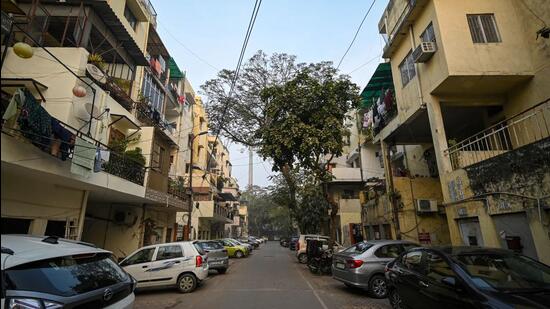
The National Capital Region Transport Corporation (NCRTC) is constructing a stabling yard-cum-station at Jangpura as part of its 82-km Delhi-Meerut RRTS corridor. The elevated corridor connecting Jangpura with Sarai Kale Khan, which is the main transit hub, will pass through Siddhartha Extension Pocket C, which has around 800 flats, and two pillars of the proposed viaduct are set to be constructed in a park located at the centre of the colony, developed in the early 1980s.
Residents want NCRTC to tweak this proposed corridor, as its construction will cause major disturbance and add to noise pollution in the neighbourhood.
Also read: Delhi’s blue cover drops, urban growth to blame, says study
MM Gupta, president of Sidhartha Extension Senior Citizens’ Welfare Forum, said, “How can an elevated train corridor pass through a residential colony? As Jangpura is a stabling yard, there will be train movement throughout the day and even at night. It will only add to the already high noise level and disturb residents.”
Gupta said that residents have been pursuing the matter with NCRTC since 2018, but the corporation is refusing to change the alignment.
However, NCRTC officials said the elevated viaduct will be 24m above the ground level and will not create any obstruction to the residents, affecting only eight flats in the block.
“To avoid inconvenience to the residents of 8 flats (in one block) coming in the shadow of the viaduct, in 2021, NCRTC has offered to temporarily relocate them during the period of construction or offered to purchase the flats, if any residents want to permanently relocate. Subsequently, out of these eight flats, four flats have been purchased by NCRTC as per mutually agreed price from the flat owners. The impact of RRTS will be minimal as it is apparent from the approach of the remaining 4 flats owners, who chose to continue to reside,” said an NCRTC spokesperson.
Residents are unimpressed.
Vimi Goyal, who lives in one of the eight flats which NCRTC says will be affected, said there has been no clarity from the agency about its plan. “One of the piers will come up just outside my house. For the past three years, we have not been able to get any renovation work done due to lack of clarity about the project from NCRTC. We can’t live under a train corridor. We already have so much noise due to the proximity to railway tracks. A high-speed train corridor will only make matters worse.”
Kamlesh Raghuvanshi, president of the Sidhartha Extension Pocket C RWA, said, “They will ruin our park, as pillars will come up on both the ends and heavy machinery will be brought in for construction of the corridor. There are houses on all three sides of the park. How will people live when the construction work of the pillars, which will be constructed less than seven metres away from the houses, will be carried out? Once the corridor is operational, people will get disturbed due to high-speed movement of trains.”
NCRTC officials said that the construction of the corridor will not add to the existing noise levels, adding that the agency has got an assessment done from the Central Road Research Institute (CSIR-CRRI) and also carried out an environmental impact assessment.
The NCRTC spokesperson said, “RRTS is not going to add to the existing noise levels in the said area. As per norms, an environmental impact assessment has been carried out and CSIR-CRRI has carried out noise and vibration level studies. In addition to this, a sun, shadow and wind analysis, and a structural safety audit specific to Siddhartha Extension were also carried out.”
Also read: Why foreign diplomats become wolf warriors in India
The CRRI has made a few recommendations, said the spokesperson, which will be implemented to “ensure that there is no increase in the ambient noise level due to the operations of RRTS”.
The spokesperson also said that no obstruction will be caused to residents as only two pillars will be constructed inside the colony, while the third one will come up outside the boundary wall.
Mohan Lal Ahuja (78), adviser, Sidhartha Extension Senior Citizens’ Welfare Forum, questioned the NCRTC’s claim and said that the pillars are proposed very close to the flats. “NCRTC is constructing a pier outside the colony, and we get disturbed by it. The piers are proposed very close to the blocks. How is it possible that there will be no disturbance caused to residents, especially when the digging work will go on? There will be movement of heavy machineries. We just want NCRTC to change the alignment.”

Stay updated with all top Cities including, Bengaluru, Delhi, Mumbai and more across India. Stay informed on the latest happenings in World News along with Delhi Election 2025 and Delhi Election Result 2025 Live, New Delhi Election Result Live, Kalkaji Election Result Live at Hindustan Times.


