
 E-Paper



Jhumpa Lahiri warns against linguistic nationalism, calls ‘mother tongue’ a myth
Rejecting monolingualism, Lahiri urged writers and readers to learn other languages and engage with translations

 Prefer HTon Google


Pulitzer Prize-winning author Jhumpa Lahiri on Friday issued a sharp warning against the use of language as a nationalist project, arguing that efforts to yoke language to nationhood were historically violent and politically dangerous.
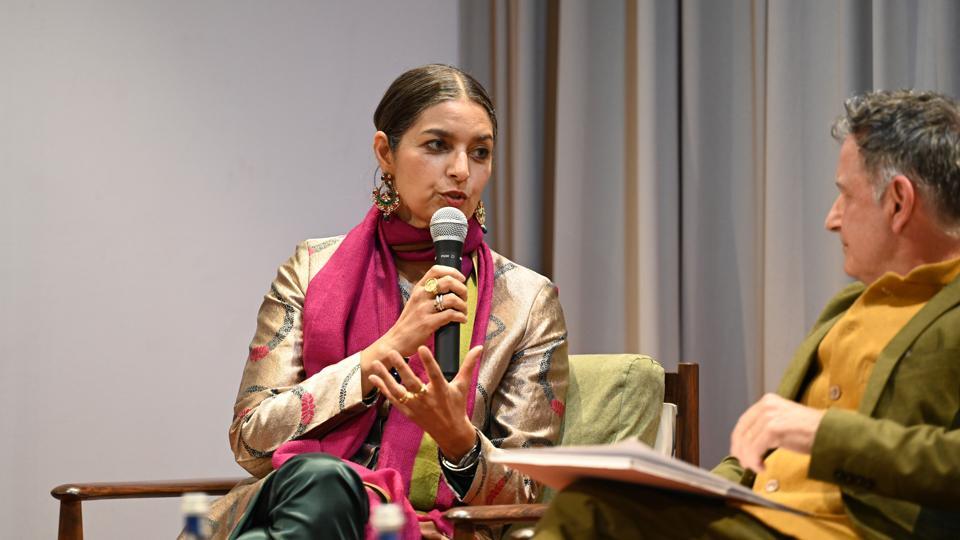
Responding to a question from Hindustan Times on the growing promotion of Hindi and the politics of language in India and South Asia, Lahiri said such projects demanded active resistance.
“Language as a nationalist project is very dangerous,” she said. “We must be vigilant and actively resist these projects of intertwining language and the nation-state. This has only led to tragedy.”
Lahiri was speaking at the Italian Embassy Cultural Centre in New Delhi, where questions of language, migration, translation and belonging dominated the discussion. Her remarks came against the backdrop of renewed debates in India over language policy, education, governance and cultural identity.
Rejecting monolingualism, Lahiri urged writers and readers to push back against the “monolingual centre of gravity”. “If you happen to be in a monolingual reality, fight against it,” she said. “Learn other languages. Cultivate them. Engage with translation.”
At the same time, she warned against the unchecked dominance of English, describing it as a “linguistic tsunami” that facilitates access while eroding linguistic specificity. “It enables certain things,” she said, “but it also diminishes difference.”
A central part of Lahiri’s argument focused on dismantling the idea of the “mother tongue”, which she said was “a myth” shaped by European Romanticism and the rise of the nation-state. “The notion that one language fully represents who you are, that identity is fixed to a single language, is not true,” she said.
Born to Bengali parents in the United Kingdom, Lahiri spoke about the insistence with which her parents held on to Bengali as a way of preserving identity. “They did everything they could to pass down the language,” she said, referring to the social worlds they created, the homes they visited and the people they surrounded themselves with. “It was clear to me how essential language was to their sense of who they were.”
But she also spoke of the distance she herself felt from that inheritance. “The problem begins when there is a space between you and the language that is supposed to fully stand in for your identity,” she said. “Every language I’ve ever known has felt foreign to me.”
That sense of estrangement shaped her later decision to move to Italy and write in Italian — a choice that puzzled many. “People asked me, why are you diminishing the role of English in your life? Aren’t you being untrue to yourself?” she recalled.
For Lahiri, the move was liberating. “It freed me from the idea that belonging was an end point,” she said. “I could consider myself a valid human being with various degrees of ability in different languages. I could move among them, and sometimes the gravitational centre could lean toward one or the other.”
She described writing in Italian as a way of rejecting the pressure to be linguistically loyal. “Once I realised I didn’t need to belong — to a language, a place, an identity — that was the liberation,” she said.
“The quest for belonging is not my quest,” she said. “I don’t need to belong to a place, a language, or an identity.” Instead, she described belonging as mobile and episodic — something she finds in libraries, at her desk, with friends, and by the sea.
Recounting a visit earlier in the day to a library in Delhi, Lahiri said the feeling was immediate. “Put me in a library anywhere in the world and I feel at home,” she said. Pushing back against the idea of libraries as fixed systems of order, she described them instead as spaces of movement. “A library is not a mausoleum,” she said. “Books migrate. If they didn’t, it would just be a parking lot.”
Lahiri also spoke at length about migration and invisibility in her writing on Rome, saying she was drawn to stories of newer immigrant communities from South Asia and North Africa. Several stories in Roman Stories, she said, emerged from conversations with migrant workers she encountered in everyday life. “Listening is where the writing begins,” she said.
Reflecting on her childhood, Lahiri described being shy and introverted, and finding refuge in books rather than in community. “We never talked about the things that hurt,” she said, recalling the embarrassment she once felt speaking Bengali in public. “To talk about it would have made it real.”
Lahiri also returned to the theme of names, recounting how her pet name, Jhumpa, became both her public and literary identity after teachers found her formal name unfamiliar. “It became my writer’s name,” she said. “That irony still strikes me.” She described the experience as “a beautiful metaphor” for hybrid identity, and one that later inspired The Namesake.
On translation, Lahiri described it as a radical and creative act rather than a derivative one, rejecting the idea of linguistic authenticity. “Authenticity is a concept I would like to banish,” she said. “It has caused a lot of damage.” Translation, she argued, is about resemblance rather than sameness — “similar, not identical”.
Lahiri closed by returning to her warning against linguistic nationalism. “No one can tell you that you are not allowed to learn a language,” she said. “That freedom is precisely why we must resist projects that turn language into borders.”

Stay updated with all top Cities including, Bengaluru, Delhi, Mumbai and more across India. Stay informed on the latest happenings in World News along with Delhi Election 2025 and Delhi Election Result 2025 Live, New Delhi Election Result Live, Kalkaji Election Result Live at Hindustan Times.


