E-Paper



‘Unusual’ monsoon to strike Delhi, Mumbai at same time
Experts hypothesise that the annual rains have taken an unusual trajectory this year after a delayed arrival

 Prefer HTon Google


Delhi and Mumbai are likely to be covered by the monsoon in the coming couple of days, the India Meteorological Department (IMD) said on Saturday, with experts hypothesizing that the annual rains have taken an unusual trajectory this year after having entered the country with a significant delay.

The southwest monsoon, as they are called in full, sweeps in from the south and moves in a particular band that typically covers Kerala, Tamil Nadu, Karnataka and Maharashtra first. In terms of regions, the south gets the rains first, followed by the southwest coast. Rains then progress through the central part of the country and sweep the entire country, with the northwest covered at the end.
Also read | Pune gets showers, but monsoon yet to knock at city
This year, however, the onset appears to be lopsided, with more regions in the east being covered by the rains than those that lie further south and west – where the clouds, Indian agriculture’s lifeblood, typically reach sooner.
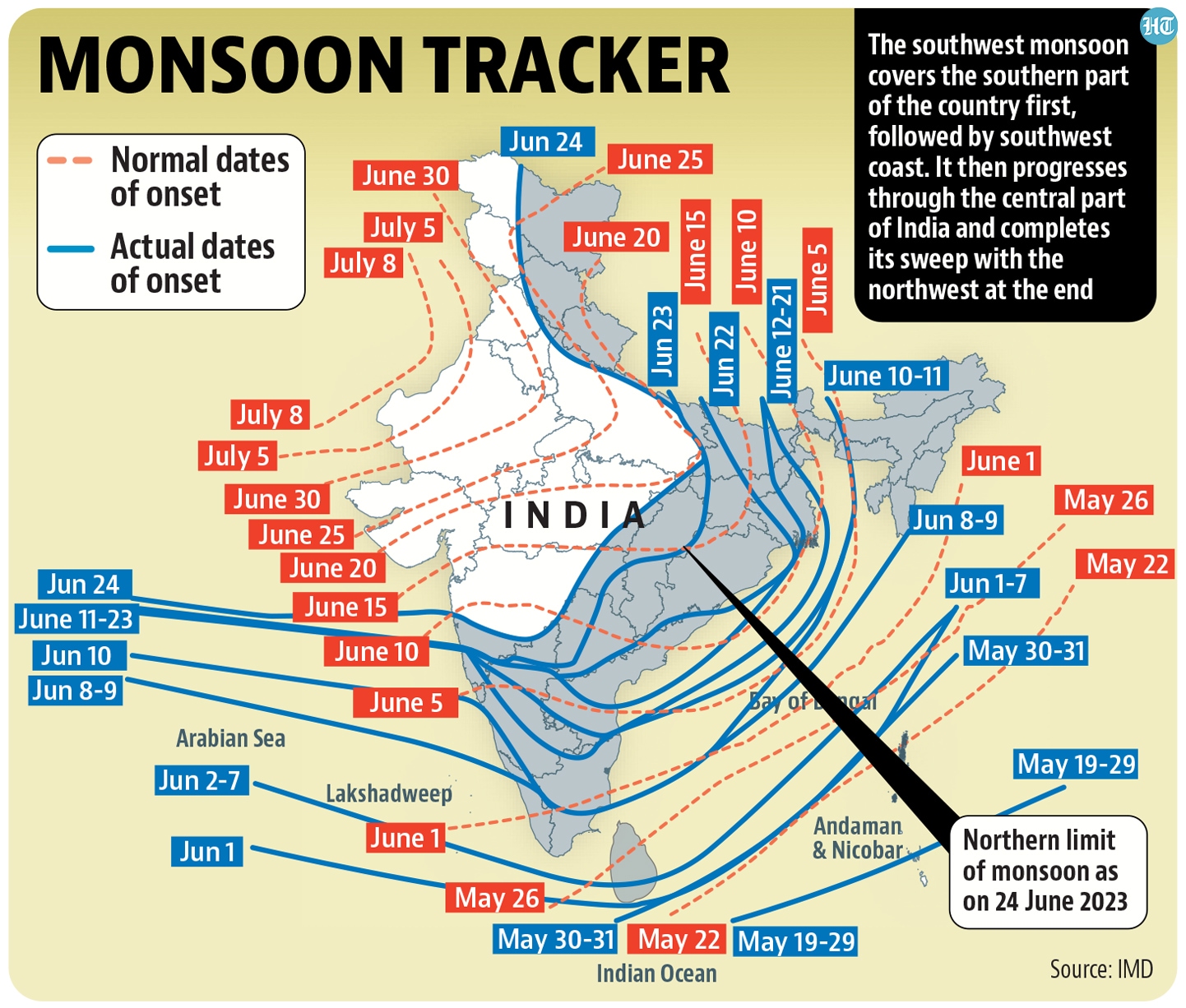
“Conditions are now favourable for further advancement of monsoon over most parts of Maharashtra including Mumbai, Madhya Pradesh, Uttar Pradesh, remaining parts of Bihar, Uttarakhand, Himachal Pradesh, Jammu, Kashmir and Ladakh, some more parts of Haryana including Chandigarh and Delhi, some parts of Gujarat, east Rajasthan and Punjab in the next 48 hours,” Saturday’s monsoon bulletin said.
The bulletin captures the apparent peculiarity: the normal date of onset for monsoon over Mumbai is June 11, and for Delhi, June 27. In other words, the arrival is close to a fortnight late for the financial capital, and a couple of days early for the national capital.
To be sure, however, forecasts by the IMD have often missed the mark in recent years.
Read | Monsoon makeup guide: 7 essential tips to enhance your rainy season beauty
IMD scientist DS Pai explained that much of the aberration is because of the cyclone Biparjoy, which made landfall at the coast of Gujarat on June 15.
“We cannot hope for a set pattern every year because each year the situation is different, so it is normal that we see minor variation. However, this year, due to cyclone Biparjoy, the progression of monsoon over the western coast has been extremely slow since June 11,” Pai explained.
Pai explained that India’s monsoon is fed from two directions: from the Arabian Sea, which funnels rainclouds over the western part of the country, and the Bay of Bengal, from where rains reach the eastern and northeastern parts of the country.
Pai said that Biparjoy, which originated in the Arabian Sea, sapped moisture from the western arc of the monsoon. “The Bay of Bengal branch is active, that is why we are seeing faster progression of monsoon from the other side,” Pai said.
Mahesh Palawat, vice-president (meteorology and climate change) at Skymet Weather—a private weather forecasting service—too said agreed the delay in monsoon onset over Mumbai and neighbouring parts was primarily because of cyclone Biparjpoy.
“The onset over Mumbai and other nearby areas has been extremely late this year. But monsoon onset over Delhi, on the other hand, has more-or-less stuck to its usual arrival date. In the coming days, conditions are favourable for advancement in most parts of the country,” Palawat said.
Some experts also said that typhoons Mawar—the strongest northern hemisphere tropical cyclones on record in the month of May and the strongest tropical cyclone worldwide till now —and Guchol also played a part.
“Onset pattern was heavily affected by typhoons Mawar and Guchol. The change in wind patterns can especially be noticed over Bay of Bengal,” said Raghu Murtugudde visiting professor, IIT-Bombay and emeritus professor, University of Maryland.
Both storms were in the Pacific and Murtugudde explained that these had a bearing in how winds in the Bay of Bengal flowed.
In Delhi, a yellow has now been issued for Monday and Tuesday, with light to moderate showers expected, met officials said.
“Easterly winds are already coming towards Delhi now, bringing moisture and it is likely that moderate rainfall is recorded in most parts of Delhi on Sunday. A trough is also existing from Punjab till Uttar Pradesh, which has been bringing moisture to Delhi NCR over the last few days and that will continue to exist in the coming days too,” said Kuldeep Srivastava, scientist at IMD.