E-Paper



More interchange: Metro stations to improve Delhi’s connectivity
Delhi Metro Rail Corporation (DMRC) officials said the number of triple interchange stations — those that cater to three Metro lines — will now increase to four

 Prefer HTon Google


The Union cabinet’s decision to approve two new Metro lines for the Capital as part of phase 4 expansion of the Delhi Metro will give a boost to connectivity in the city, with the number of interchange stations across the network increasing to 48, officials aware of the matter said on Wednesday.
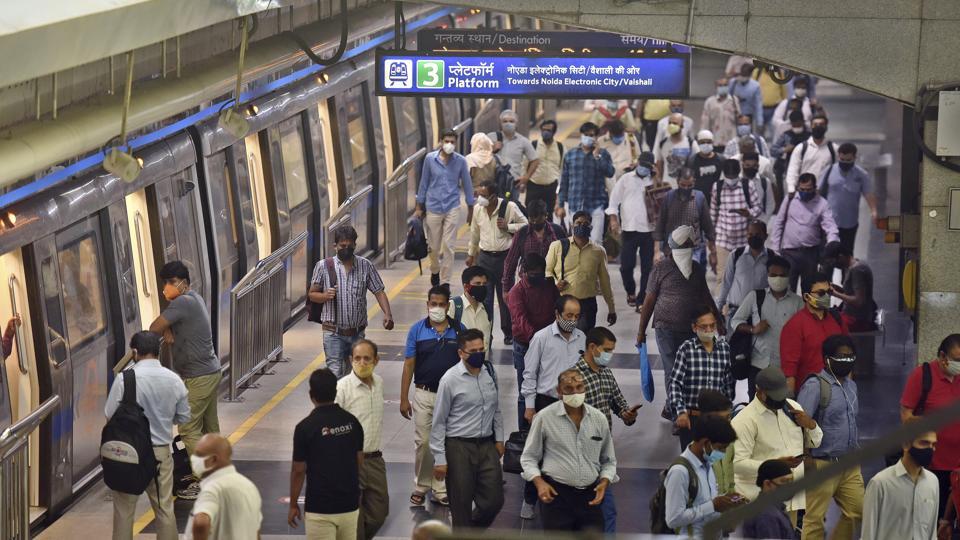
In addition, the Delhi Metro Rail Corporation (DMRC) officials said, the number of triple interchange stations — those that cater to three Metro lines — will now increase to four.
The Delhi Metro currently has a 391km network, with 29 interchange stations. However, as part of the phase 4 expansion, the network is growing by 65km, and the two new corridors announced on Wednesday — Lajpat Nagar to Saket G-Block, which is yet to receive a colour coding, and Inderlok to Indraprastha, which will be an expansion of the Green Line — another 20.7 km will be added to the network.
At present, only one station — Kashmere Gate — is a triple interchange station (Red, Yellow, and Violet lines), while the Azadpur station (Yellow, Pink, and Magenta) is under construction. However, the cabinet’s nod to the two new corridors means that the Lajpat Nagar and New Delhi stations too will become triple interchange stations.
The Lajpat Nagar station currently connects the Pink and Violet lines, and will now link with the new Lajpat Nagar to Saket G-Block corridor. Meanwhile, the New Delhi station, that currently connects the Yellow Line and the Airport Express Line, will now also connect with the expansion of the Green Line.
Read Here | Delhi Metro’s 2 new corridors: Relief from congestion nodes likely
DMRC, in order to decongest the two major interchange stations at Rajiv Chowk and Kashmere Gate, in 2011 had decided to construct a number of new interchange hubs across the city
“This move was to ensure that passengers could conveniently move from one part of the city to another without always coming to Rajiv Chowk or Kashmere Gate. Data till last year shows that the strategy appears to be working,” said an official, on condition of anonymity.
Data shared by DMRC in 2023 had revealed that busy interchange stations such as Kashmere Gate and Rajiv Chowk logged a reduction in footfall after the phase 3 expansion of the Metro network. The reason – people had more interchange stations available to them after the Pink and Magenta Lines were operationalised, allowing people to make shorter journeys.
According to the data, the average footfall at Kashmere Gate dropped by around 12.9% between September 2019 and September 2023, from a monthly footfall of 273,844 in September 2019 to 238,489 in September 2023.
Similarly, at Rajiv Chowk, the average monthly footfall between September 2019 and September 2023 decreased from 247,442 to 202,077 — a drop of around 18.3%.
Giving an example, the official said that commuters who would earlier travel from Noida City Centre to Lajpat Nagar had to earlier travel to Mandi House on the Blue Line, and then change to the Violet Line to travel to their destination. However, the opening of the Pink Line in 2018 meant that they could change trains at Mayur Vihar Phase-1, reducing the travel time by nearly 30 minutes. “We can expect something similar in Phase-4, as journeys will become shorter and the interchanges used earlier may no longer be required now,” said the official.
Dr S Velmurugan, chief scientist and head of traffic engineering and safety division of Central Road Research Institute (CRRI), said that having more interchange stations is beneficial as they reduce travel time, in turn reducing road congestion. “If commuters have a shorter journey, they are more likely to use the Metro. With more interchanges, we can expect journeys to become easier across more parts of Delhi-NCR,” he said.