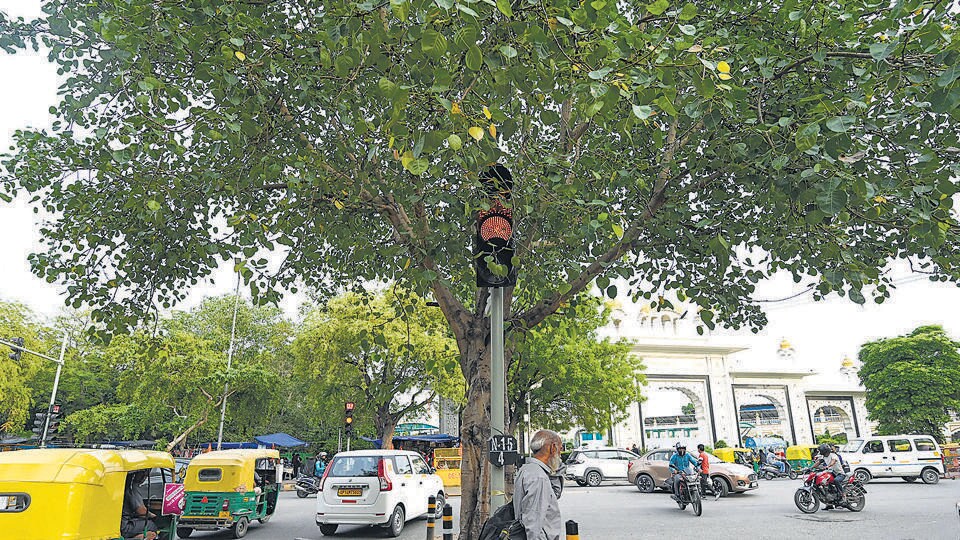
Before the Delhi high court order, the pruning guidelines allowed Delhi’s civic agencies and urban local bodies to carry out pruning of trees and branches with up to 15.7 centimetres of girth without needing to approach a tree officer or the forest department.
Residents simply approached the Municipal Corporation of Delhi (MCD) or their local electricity distribution company (discom) complaining about a possibly dangerous tree or branch that could fall on public property or an electricity pole. The agency would subsequently carry out the pruning.
Also Read | High court sets aside tree pruning guidelines issued by Delhi govt
MK Gupta, president of the GK1 RWA, said that since the high court order, not a single colony tree has been pruned despite the RWA approaching MCD, their discom, and the forest department.
“We flagged trees that may topple with the monsoon approaching and even went to the forest department. A forest officer inspected the area but nothing happened after that. Other civic bodies, meanwhile, were not able to carry out pruning on their own and after nearly two months of back and forth. Saturday’s rain brought down trees on three electricity poles,” said Gupta.
Atul Goyal, president, United Residents Joint Action (URJA), a body of over 2,500 RWAs in Delhi, said they have received complaints from different parts of Delhi on the pruning problem, including Ashok Vihar, Rohini, Karol Bagh, and Janakpuri.
“RWAs, which were earlier quite active and could get trees, particularly dangerous ones, pruned, are now unable to do so. This is an important exercise during the monsoon season when there is a lot of damage after branches break or trees fall,” said Goyal.
RWAs also said that periodical pruning is required for healthy growth of trees.
The Vasant Vihar RWA said it plans to submit a request to prune 7,000 trees in the area, a simple approval for which may take several months.Gurpreet Bindra, president of the RWA, said before the order, the RWA was pruning trees on its own. “Not only do trees fall but they also grow haphazardly, cutting through electricity poles,” he said.
Adding to the problem is the lack of personnel in the forest department. Delhi only has four tree officers — one for each forest division — West, Central, North, and South. The tree officer is generally the deputy conservator of forest (DCF), equivalent to a deputy commissioner of police (DCP), meaning the same officer has multiple responsibilities.
For each tree pruning request, including those by agencies like MCD and the New Delhi Municipal Council (NDMC), one has to apply on the forest department’s portal — https://treeremoval.delhigovt.nic.in.
The number of pruning requests on the portal, which was 10 to 15 per day earlier, has also increased three to four times and goes up to 50 to 60 requests per day. Following each request, the forest department has to carry out an on-ground inspection before granting permission, a tall task for a department that still has over 25% of its posts vacant.
When contacted, a forest official, however, said they were trying to deal with each request within a timeframe of 10 to 14 days.
“More forest guards and rangers are being hired and this will make it easier for on-ground inspections. Once that is done, the permission is granted fairly quickly,” said the official, adding that requests through the portal were the only way to get tree pruning done presently.
A second forest official said under the Delhi Preservation of Trees Act, 1994, an exemption could be sought under Section 8. However, this is only allowed in exceptional circumstances. “Section 8 of the Act says that the tree can be pruned if it is extremely urgent and the permission can be taken later, but the reason needs to be strong enough and normally, this is not being allowed,” said the official.
Civic agencies said the process of applying for permissions through the tree pruning portal requires more time.
“This process requires a site visit by a forest official before permission is granted. Previously, civic agencies, could directly intimate departments like the forest department or the horticulture department and carry out pruning as and when needed,” said a civic agency official aware of the matter.
Bhavreen Kandhari, an environmental activist said that while the new process will take time to smoothen out, Delhi has long required such a defined standard operating procedure (SOP) and more scientifically trained staff to deal with trees.
“The high court order came as the process was not scientific and trees were being hacked away completely. There was a lot of unscrupulous pruning. At the same time, we need to address the problem of manpower shortage that exists not only in the forest department but in civic bodies too, where the ground-level staff is not trained at times to handle or prune trees scientifically,” said Kandhari, referring to the multiple incidents in the recent past from the Defence Colony area, where trees were pruned over the previously allowed 15.7cm.
A Tata Power DDL (TPDDL) spokesperson, which supplies power to north Delhi, said obtaining permission and approval from a tree officer can be a challenging and time-consuming process.
“During the monsoon season, falling tree branches can pose a risk to public safety and assets. Therefore, proactive measures are necessary to mitigate these risks. In the past, the permissible pruning limit was 15.7cm due to pressure from public and land-owning agencies. However, as time passes, branches grow beyond 15.7cm and can cause severe damage with a high velocity of wind and water pressure. To avoid disruption in the power supply caused by damage to the electrical network, we advocate pruning trees beyond 15.7cm,” said the spokesperson, requesting anonymity. .

 E-Paper