
 E-Paper



Revised Delhi budget clears House with ₹2,100-cr boost for capital expenditure
According to documents tabled in the House, the enhancement of over ₹2,100 crore in capital expenditure reflects the Bharatiya Janata Party (BJP)-led government’s stated intent to prioritise long-term asset creation, particularly in transport, education, housing and urban development.

 Prefer HTon Google


The Delhi Assembly on Friday cleared the revised estimate for capital outlay in the city, raising it from ₹28,115 crore in the Budget Estimates (BE) to ₹30,248 crore in the Revised Estimates (RE) for 2025–26, even as the overall size of the budget remains unchanged at ₹1 lakh crore.
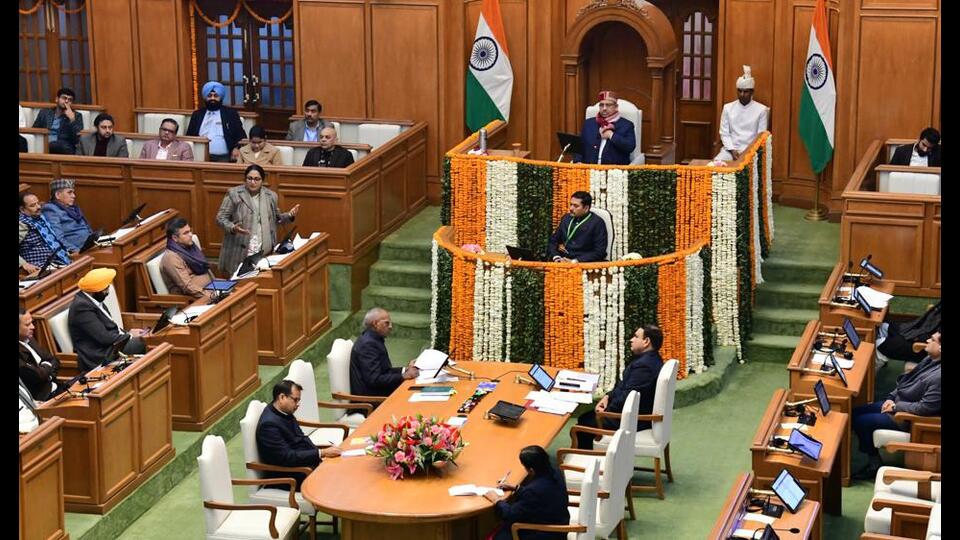
According to documents tabled in the House, the enhancement of over ₹2,100 crore in capital expenditure reflects the Bharatiya Janata Party (BJP)-led government’s stated intent to prioritise long-term asset creation, particularly in transport, education, housing and urban development.
“Capital expenditure is increased from ₹28,115 crore in BE 2025-26 to ₹30,248 crore in RE 2025–26, which is 163% higher than the actual capital expenditure of the previous year,” the government said in its budget documents, underscoring the scale of the increase.
Presented by chief minister Rekha Gupta, who also holds the finance portfolio, the Delhi Appropriation Bill 2026 was passed by voice vote.
“The previous AAP government left Delhi burdened with massive financial and administrative liabilities. Thousands of crores of rupees were pending across departments including electricity, water, health, transport, education, sports and social welfare, often without any proper accounting. Outstanding payments to the Delhi Metro Rail Corporation (DMRC), power distribution companies, the Delhi Jal Board, incomplete hospital projects and schemes launched without budgetary provisions are clear examples. We have now made budgetary provisions for all these development work that should have been started in Delhi years ago,” CM Gupta said.
Among the biggest gainers in the RE is the transport sector, including roads and bridges. Its allocation has been raised from ₹12,952 crore in the BE to ₹16,024 crore in the RE. Transport now accounts for about 16% of the total budget, up from 13% earlier, making it one of the government’s primary focus areas.
A significant portion of this enhanced outlay has gone towards urban mobility projects. The allocation for the Delhi Metro Rail Corporation (DMRC) has been increased by ₹2,117 crore, from ₹2,929.66 crore in the BE to ₹5,046.66 crore in the RE. Officials said the additional funding would help meet equity commitments and support ongoing and future metro projects.
Public transport operations have also received a boost. The allocation for the Delhi Transport Corporation (DTC) has been increased by ₹653 crore, from ₹2,780 crore to ₹3,433 crore — a rise of 23.5%. The government has also nearly doubled the outlay for the strengthening of roads scheme, increasing it from ₹500 crore to ₹996 crore. The additional spending on roads, officials said, is expected to improve road quality and help control dust pollution.
“Taking major steps towards pollution, we have already introduced a fleet of 3500 electric buses that will increase to over 7500 by the end of this year and 10000 by end of 2027. We are also revamping all ISBTs. When we took charge, the losses of DTC were more than the entire budget of the Delhi government today that we have made consistent efforts to reduce,” Gupta said.
Education, meanwhile, continued to command the largest share of the Delhi budget, and its allocation has been further enhanced. The education sector’s budget has gone up from ₹19,291 crore in the BE to ₹20,702 crore in the RE, increasing its share from 19% to about 21%. Within this, higher education infrastructure has seen a sharp rise, with the allocation for the purchase of flats and land for universities increased from ₹500 crore to ₹1,362 crore.
Housing and urban development have also seen higher allocations, rising from ₹10,694 crore in the BE to ₹11,754 crore in the RE. This includes an increase of ₹128 crore for the development of unauthorised colonies, where funds will be used for basic infrastructure such as roads, drainage, water supply and street lighting.
Civic bodies have been allocated additional resources as well. The Municipal Corporation of Delhi (MCD) has received an extra ₹1,031 crore, with its allocation increasing from ₹10,397 crore in the BE to ₹11,428 crore in the RE. The government has said the enhanced funding will help strengthen municipal services, including waste management and sanitation infrastructure.
In the power sector, subsidies to electricity consumers through discoms have been increased by ₹400 crore, from ₹3,600 crore to ₹4,000 crore, to meet higher subsidy requirements. Water and sewerage infrastructure have also been prioritised, with the allocation for loans to the Delhi Jal Board raised by ₹1,000 crore to ₹3,500 crore. The state’s share under the Yamuna Action Plan has been increased by ₹180 crore to accelerate pollution abatement and river rejuvenation efforts.
Several project-specific provisions have been included, including ₹500 crore to clear legacy liabilities related to the Eastern and Western Peripheral Expressways, ₹825 crore for projects under the Special Assistance to States for Capital Investment scheme, and ₹100 crore to complete the long-pending Barapullah Phase-III elevated corridor.
Despite the increase in capital expenditure, revenue spending has been reduced from ₹71,884 crore in the BE to ₹69,752 crore in the RE. Allocation under schemes and programmes has also declined, while the establishment budget has risen marginally.
No new allocation for WCD department
Despite the broad increases, the revised budget made no new allocation for the women and child welfare department. Officials familiar with the matter, who asked not to be identified, said that this is likely to mean that the promised “Mahila Samman” scheme, a key electoral pledge of providing ₹2,500 monthly to eligible women, is likely to not be introduced this fiscal.
A ₹5,100 crore allocation under the Mahila Samridhi Yojana, approved earlier in the year, remains unused. A senior government official, speaking anonymously, indicated the scheme is unlikely to launch before the next budget.
“With about two months left in this financial year, the modalities for the distribution of ₹2500 to economically weaker women is still being worked out and the portal for application is yet to be set up. It is very unlikely that the scheme will be announced before the next budget session,” said a senior Delhi government official.


Stay updated with all top Cities including, Bengaluru, Delhi, Mumbai and more across India. Stay informed on the latest happenings in World News along with Delhi Election 2025 and Delhi Election Result 2025 Live, New Delhi Election Result Live, Kalkaji Election Result Live at Hindustan Times.


