
 E-Paper



Revving Trouble? What India’s two-wheeler boom means for urban mobility
Experts attribute this sudden rise in two-wheeler ownership to poor public transport in Indian cities.

 Prefer HTon Google


India is currently grappling with a dramatic increase in the number of two-wheelers — an oft overlooked element of the road. Over the past two decades, the number of four-wheelers on the country’s roads has seen a marked rise, which is often blamed for the massive snarls that almost all Indian cities now grapple with. However, two-wheelers have flooded the streets at an unprecedented rate, and while this boom has ensured the security of mobility to millions, it has exacerbated urban challenges — from traffic gridlocks and rising emissions, to road safety.
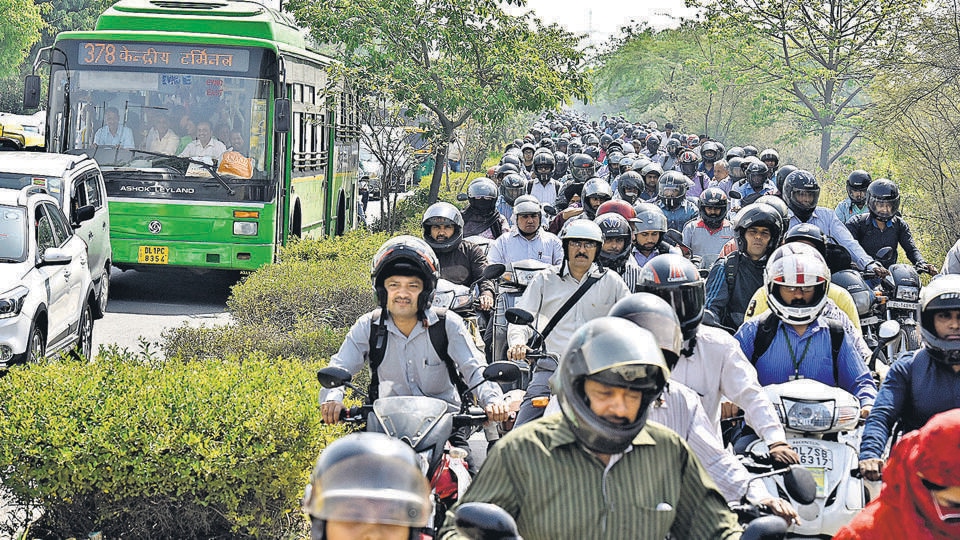
In 2024, Delhi alone added 448,767 two-wheelers, pushing the total number of motorcycles and scooters on the streets of the Capital past 5.7 million, from 5.2 million in 2023, according to official figures.
To be sure, these are just the vehicles registered in the city: Delhi does have hundreds of thousands of two-wheelers registered in neighbouring states. Similarly, Mumbai now has nearly 2.9 million two-wheelers on its roads — up from 1.9 million in 2017. However, the Indian city with the most two-wheelers is arguably Bengaluru, which as on September 30, 2024 had a staggering 7.5 million such vehicles on its streets, up from 6.9 million in 2022.
Failure of public transportation system
Experts attribute this sudden rise in two-wheeler ownership to poor public transport in Indian cities: over the years, motorcycles and scooters have become the preferred choice for the lower-middle class due to their fuel efficiency, even as they are priced out from travelling on Metro trains due to relatively high fare, while buses are often unreliable.
“This two-wheeler boom is a sad commentary on our public transport system. Many people find the Metro fares high and see motorcycles and scooters as a cheaper alternative in terms of cost per kilometre. High fares cannot be justified, after all Metro is meant to serve as an essential public service,” said urban designer Akash Hingorani, the principal architect at Oasis Design.
Shreya Gadepalli, an urban mobility expert, echoed this view, saying that many people find the Metro both physically and financially out of reach.
“Most people use two-wheelers for short trips of 4–5 kilometres, where it’s hard to beat their convenience,” she said, adding that the solution lies in building a more robust bus system. “We need enough buses, and bus stops within a five-minute walking distance for everyone.”
Surge in quick commerce platforms
The surge in quick commerce and food delivery services has also significantly contributed to the proliferation of two-wheelers in India, with many of these companies building extensive fleets of two-wheelers to facilitate rapid food deliveries.
“Quick commerce has certainly driven up the demand for two-wheelers. Not only does quick commerce add to the traffic, the short delivery times promised also pushed delivery staff to drive dangerously,” Gadepalli said.
A report in The Hindu Businessline, citing Swiggy’s IPO papers, stated that the platform supported 457,249 active delivery partners as of June 30, 2024 — up from 350,280 in the same period in 2023.
“Also, bike taxis, while more expensive than public transport, are more affordable than autos and taxis. In the absence of reliable and accessible buses, many, mainly men, are choosing bike taxis for their commute,” Gadepalli said.
Evolution of two-wheelers in India
Introduced during the Colonial period, motorcycles were initially imported from Europe and America as luxury items, catering primarily to the elite and officials. Brands such as Norton, Triumph, and Harley-Davidson dominated the roads, but these vehicles were beyond the reach of the common man.
A few years after Independence, in 1955, Royal Enfield began assembling motorcycles locally, with the iconic Bullet becoming a favourite among the Indian police and military. The 1960s and 70s saw the rise of domestic players such as Ideal Jawa (which produced the Jawa and Yezdi motorcycles) and Bajaj Auto, which initially assembled Italian Vespa scooters.
Soon, scooters emerged as the preferred choice for families, prized for their affordability and utility, making them an essential mode of transport for middle-class households. Motorcycles, meanwhile, were now considered a premium, more expensive product, often seen as aspirational due to their higher performance and “macho” appeal.
The 1980s marked a turning point, with the entry of Japanese manufacturers through joint ventures. Collaborations like Hero Honda (between Hero Cycles and Honda) revolutionised the market with the fuel-efficient CD100, making motorcycles accessible to the masses.
Similarly, TVS-Suzuki and Kinetic Honda introduced models that appealed to urban commuters and young riders. As a result, motorcycles began to outpace scooters as the favoured choice, thanks to their practicality and cost-effectiveness.
Liberalisation in the 1990s opened the doors to global players, driving rapid two-wheeler growth. The Hero Honda Splendor, launched in 1994, became India’s best-selling motorcycle, while indigenous brands like Bajaj Auto and TVS diversified their offerings. Motorcycles became integral to both urban and rural mobility, reflecting India’s economic progress. Last year, India surpassed China to emerge as the world’s largest two-wheeler market, driven by rising incomes and urbanisation.
Congestion and emission
Experts point out that while two-wheelers are smaller than cars and occupy less road and parking space, they contribute significantly to congestion and emissions on the roads.
For example, an International Council on Clean Transportation (ICCT) briefing, brought out in 2021, reported that two-wheelers constituted “more than 80% of total vehicle sales in India in fiscal year (FY) 2020–21. Predominantly powered by internal combustion engines (ICE), they also accounted for 60% of India’s petrol consumption, and for the calendar year 2020, tailpipe carbon dioxide (CO2) emissions from the two-wheeler segment have been estimated at nearly 38 megatonnes. Currently, the two-wheeler segment is not subject to any fuel consumption standards, and fleet average CO2 emissions were 41.2 gCO2/ km in FY 2018–19”.
It concludes that electrification is key to achieving sizable greenhouse gases (GHG) and petroleum consumption reductions.
As part of the PM E-Drive Scheme, the central government is pushing for the widespread adoption of electric vehicles, including approximately 2.47 million e-two-wheelers (e-2Ws). To qualify for this incentive, only e-2Ws equipped with advanced batteries are eligible. The scheme extends its benefits to both commercially registered and privately owned e-2Ws, reflecting a significant move towards sustainable urban mobility.
“I believe providing any subsidy to purchase a car or a two-wheeler effectively undermines public transport. In fact, our study from a few years ago revealed that for the same amount the government offers as a subsidy—around ₹2.5 lakh—to buy a single electric car, one could travel for free on air-conditioned buses in Mumbai for 17 years,” said Gadepalli.
Road safety a concern
WRI India executive programme director (integrated transport) Pawan Mulukutla said while cumulative emissions and congestion caused by two-wheelers are significant concerns, the biggest issue remains crashes involving them.
Two-wheeler deaths rose by nearly 8% in 2022, reaching almost 75,000 and making up 44% of the 168,491 road fatalities in India. Official data also revealed that two-wheelers were involved in about one-fourth of all crash fatalities.
“One of the biggest problems is that bikes, trucks, and cars are all competing for the same road space, and bikers are the most at risk of severe injuries or even losing their lives in the event of a collision,” said Piyush Tewari, founder and CEO of SaveLIFE Foundation, an organisation dedicated to improving road safety, emergency medical care, and urban governance.
“During low visibility, bikers are often not easily visible due to the lack of proper lights or retro-reflective tapes on their vehicles, which increases the chances of fatal accidents,” he said.
Sewa Ram, professor of transport planning at the School of Planning and Architecture (SPA), said while the number of two-wheelers has grown rapidly, its consequences have not been considered. “We should not be encouraging two-wheelers. For one, our road infrastructure, especially interchanges and loops are not designed for two-wheelers. This is a major reason for many road fatalities involving two-wheeler riders,” he said.
While cities in some countries such as the Philippines and Brazil have created exclusive two-wheeler lanes, around 90 cities in China — including Beijing, Guangzhou, and Shenzhen — have introduced outright bans or curbs on motorcycles due to the high fatality rates.
“The surge in the number of two-wheelers is a very complex problem and doesn’t have a one-size-fits-all solution. We need policies that consider all aspects and balance the interests of all stakeholders,” said Mulukutla.


Stay updated with all top Cities including, Bengaluru, Delhi, Mumbai and more across India. Stay informed on the latest happenings in World News along with Delhi Election 2025 and Delhi Election Result 2025 Live, New Delhi Election Result Live, Kalkaji Election Result Live at Hindustan Times.


