
 E-Paper



SOPs issued for Delhi civic bodies on stray relocation after SC order
An area of 70x40 feet has been fixed for keeping 100 dogs; 57x90 feet for 500 dogs, and 221x127 feet for maintaining 1,000 dogs.

 Prefer HTon Google


The Animal welfare Board of India (AWBI) has issued a standard operating procedure (SOP) for municipal authorities to implement the Supreme Court’s November 7 order stating removal of stray dogs from public institutional premises. The SOP includes fixing dimensions of new shelters, conditions of these premises, identifying places from where stray dogs will be picked up, among others.
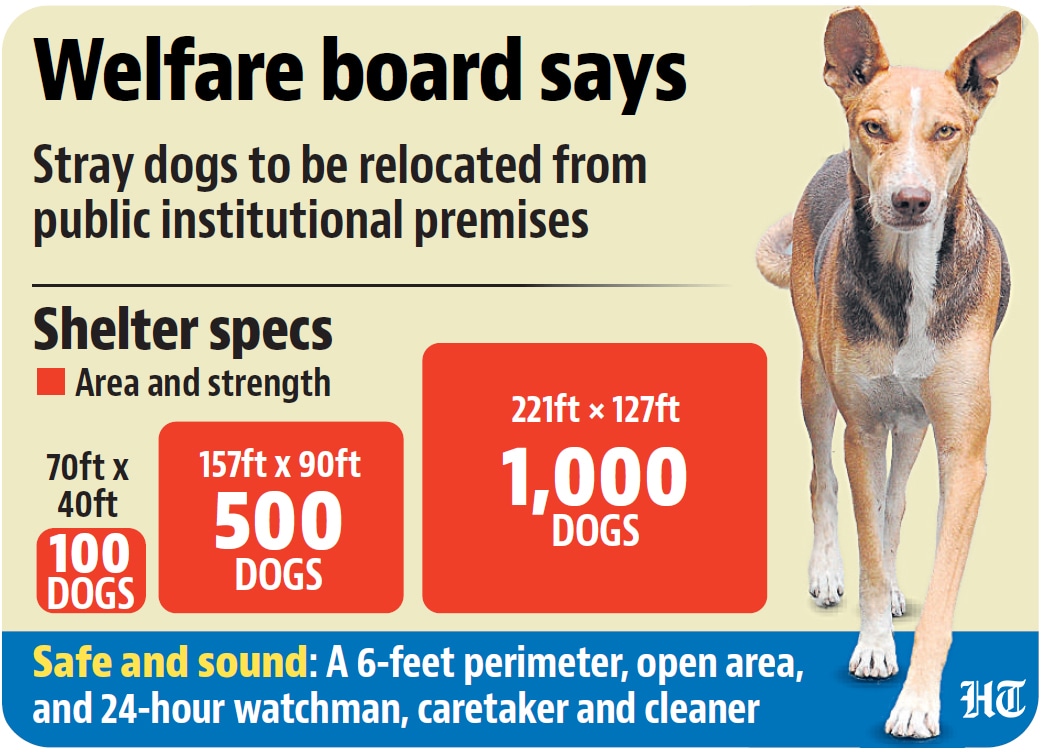
The first step as per the SOP, issued by Dr. Muthukumarasamy B, chairman of AWBI, is to identify the existing shelters and areas where new shelters could be established. An area of 70x40 feet has been fixed for keeping 100 dogs; 57x90 feet for 500 dogs, and 221x127 feet for maintaining 1,000 dogs.
Animal rights activists have flagged that the space would be too small to keep the relocated dogs. “You can’t even keep 20 dogs in this space. Do they want to make shelters like shops? They have failed to implement the vaccination and sterilisations. They did not even wait for the January 13 court hearing. All animal lovers should demand the joint secretary of AWBI to resign,” Manavi Rai, an animal rights activist and rescuer in Delhi, said.
Further, municipal authorities have been asked to identify all government and private educational institutions, hospitals (including district hospitals, primary health centres, and medical colleges), public sports complexes or stadia, bus stand/ depots and railway stations situated within their territorial limits. “It is also advised to identify other public places such as religious places, children’s parks, airports, helipads, seaports, tourist sites and recreational spots. Once the areas are identified by the respective municipal authorities, the concerned management shall ensure that the stray dogs do not ingress in that area,” the directive read.
As per the SOP document, all stray dogs must be taken out from the areas to be sterilised, vaccinated and then kept in a shelter either maintained by the municipal corporations or in coordination with the local animal welfare organisations, gaushalas, pinjra poles or volunteer organisations.
“The institutions with over two acres of land and free space of atleast 6,000 square feet may volunteer for establishing a shelter within their premises, on their own expenditure,” the SOP mentioned.
The order later lays down the conditions for these shelters including fences of 6 feet and more, a watchman for 24 hours, cleaners and caretakers. The feeding frequency for adult dogs has been fixed for 2-3 times a day, depending on age and size.
Also, dogs with 5kg weight should be provided 100-150 gram food in a day, 400-600 gram for 20kg weighing dog and 800-1,200 grams for dogs upto 40kg. It also calls for improvement in waste management, such as establishing closed waste disposal pits for street vendors, daily cleaning of waste materials from all the vending regions around the areas and a helpline for waste disposal also to be established by the municipality.
Activists have called the SOP a failure. Gauri Maulekhi, trustee of People For Animals said, “This proposal fundamentally inverts every proven scientific principle of population management and bite prevention and is destined to backfire. This deficiency is compounded by the demand for infrastructure that doesn’t exist to solve a problem it doesn’t understand, resulting in a policy that is as cruel as it is futile. In fact, the standards proposed would be grossly illegal in any jurisdiction with functioning animal welfare oversight. This is not a solution; it is a blueprint for disaster.”
Dr Asher Jesudoss, member of the executive committee of Delhi Animal Welfare Board, said, “Releasing an SOP of this scale without consulting experts is unacceptable. It shakes public trust in an institution meant to protect animals. The SOP risks severe suffering and the loss of many animal lives and needs to be rolled back at the earliest.”

Stay updated with all top Cities including, Bengaluru, Delhi, Mumbai and more across India. Stay informed on the latest happenings in World News along with Delhi Election 2025 and Delhi Election Result 2025 Live, New Delhi Election Result Live, Kalkaji Election Result Live at Hindustan Times.


