E-Paper



Stubble fires contribute most to push Delhi air in ‘very poor’ zone
Stubble burning is a major cause of pollution in Delhi during winters. Pollution from NCR remains a concern, which adds to 27.9% of PM2.5 concentration in Delhi

 Prefer HTon Google


Farm fires have once again emerged as the single biggest source of pollution to Delhi’s PM2.5 concentration this season, with an estimated contribution of around 16.4% on Sunday, data from the Decision Support System (DSS) under the ministry of earth sciences has shown, worsening air pollution in the Capital with an air quality index (AQI) reading of “very poor” at 313. The last time the AQI read “very poor” this year was on May 17 (336).
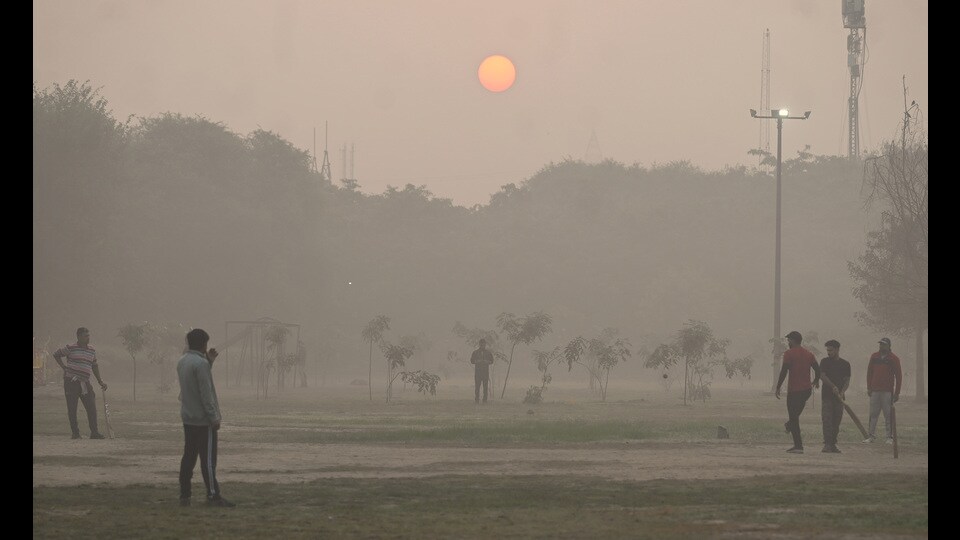
The contribution of farm fires is set to rise to an alarming 30.5% on Monday and 32.8% on Tuesday. Stubble burning was followed by transport emissions from the city as the second source at 15.2%. Stubble burning begins to influence Delhi’s air every winter from October 15 till November 15, peaking in the last week of October and the first week of November. On Saturday, a total of 265 farm fires were reported in Punjab and Haryana—the most in a single day so far this season—according to satellite data from the National Aeronautics and Space Administration (Nasa) accessed by HT. On Friday, there were 206 such fires, the data showed. In the week preceding that, there were an average of 90 such blazes every day.
To be sure, farm fires this season have not yet seen the sort of spike they generally do this time of the year. In October, there have been 2,436 reported farm fires this year in the two states, according to Nasa’s satellite data. This is 75% fewer than the 2012-2022 average of 9,775 such blazes reported in the same time period.
Interestingly, sources from within Delhi contributed to just 27.9% of the total PM 2.5 concentration of Delhi on Sunday, indicating pollution from outside sources was still a worry for the Capital. While this includes biomass burning, it also includes transboundary pollution—coming from the national capital region. Gautam Buddha Nagar contributed 6.6% to Delhi’s PM 2.5 on Sunday, followed by Sonepat (6.07%) and Ghaziabad (4.76%). Around 21.57% of pollution—coming from outside Delhi—was also in the “other sources” category, which includes pollution from beyond NCR.
Within Delhi, the transport sector (15.2%) was followed by emissions from the residential sector (3.32%) and industries (2.43). The contribution of these sectors is largely expected to be similar in the next two days, DSS forecasted.
Forecasts showed the contribution of Delhi’s own sources is expected to be around 29.2% on Monday.
A ministry of earth sciences official, requesting anonymity, said the DSS data was estimate-based and not real-time based, taking into account meteorological factors and a long-term emissions inventory. An emissions inventory is a database that calculates the number of pollutants discharged into the atmosphere during a window such as a month or a year. “Based on the emissions inventory of each source and factors such as the wind direction and other meteorological conditions, DSS estimates the contribution of different sources. But it can only be accurate through a real-time source apportionment model,” said the official.
DSS’ findings are also in line with a source apportionment study carried out by The Energy and Resources Institute (TERI) in 2018, which found the contribution of Delhi’s own sources to its pollution to be just 36% and the remaining 64% to be outside of Delhi.
Experts reiterated that until the entire NCR and the Indo-Gangetic plains were treated as one large air shed, the impact of state-wise policies would be negligible. “Due to the geographical pattern of the Indo-Gangetic Plains and the flow of wind direction which is northwesterly, transboundary pollution is a problem and that requires coordination between states. Pollutants can also travel, so it is important to have policies that tackle sources in the entire region,” said Dipankar Saha, former head of CPCB’s air laboratory.
Sunil Dahiya, analyst at the Centre for Research on Energy and Clean Air (CREA) also echoed similar views. “Stubble burning is a seasonal activity and will be over by the end of November. However, we still see over 50% of Delhi’s pollution coming from the outside. Until we take action around the NCR, Delhi’s air cannot see improvement,” said Dahiya.