E-Paper



Stubble fires rising in Punjab, may impact Delhi after Oct 10
From Sept 15-30, a total of 147 farm fires were recorded, with no fires recorded for nearly a week, when the northern plains were hit with rains. A similar period is expected from October 4 onwards.

 Prefer HTon Google


Farmers have started burning crop stubble across the northern plains, with Sunday recording this year’s highest single-day fire count of 130, data collated from satellite images showed.
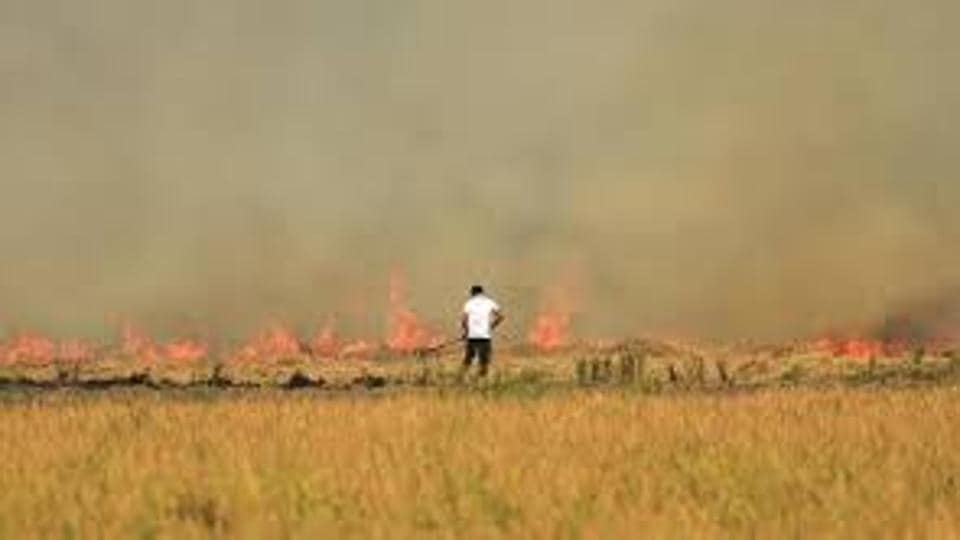
As in the previous years, Punjab is again the primary culprit with the state accounting for 83 fires on October 2 (Sunday); Haryana had seven fires and Uttar Pradesh 36.
Data compiled by the Consortium for Research on Agroecosystem Monitoring and Modelling from Space (CREAMS), a centre under the Indian Agricultural Research Institute (IARI), shows that between September 15 and 30, 147 farm fires were recorded in Punjab. Compared to that, in just the two days of October 1 and 2, the state recorded a total fire count of 128 -- a clear indication that the annual exercise to rid the field of crop stubble has started to pick up.
This does not bode well for Delhi, which every year suffers hazardous levels of air pollution as wind blows the smoke and pollutants towards the capital city. Making matter worse is the fact that the stubble burning season also coincides with unfavourable meteorological conditions in Delhi-NCR (National Capital Region), which keep the pollutants trapped near the surface.
Also read: Punjab assembly gives discussion on stubble burning a miss
CREAMS, which is currently collecting data from all NCR states said this year, each state is following the ISRO protocol -- a standard protocol that has been developed by the Indian Space Research Organisation (ISRO) for monitoring data on farm fires -- and that will help provide uniform data from each state to the Commission for Air Quality Management (CAQM), the agency tasked with managing pollution in Delhi-NCR. Earlier, states were reliant on different Nasa satellites, which meant that each had its own differing counts on farm fires.
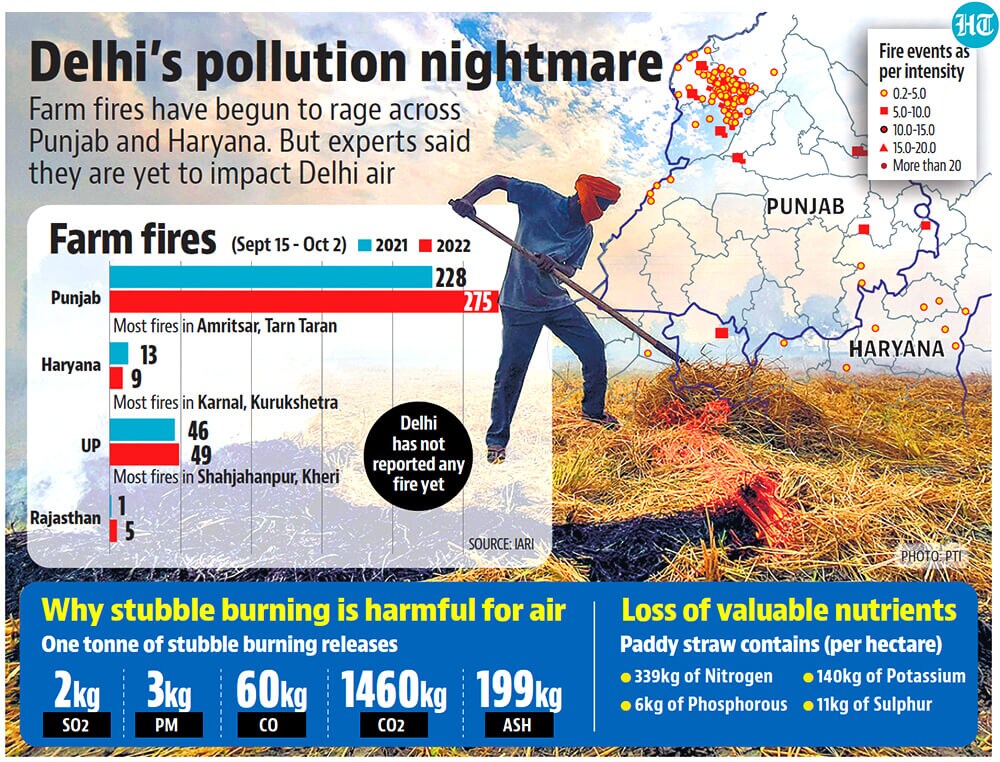
According to CREAMS data, between September 15 and October 2, Punjab saw 275 farm fires, which is slightly higher than the 228 fires in the state during the same period last year. It is, however, lower than the 1,331 fires recorded by Punjab during the same period in 2020.
VK Sehgal, professor and principal scientist at IARI, and a part of CREAMS, said initial trends show a similar fire count to last year, and it appeared to be a considerable improvement over 2020.
He also said the late monsoon rains played a key role this year as well as the last. “We saw a spell from September 24 to 29, when no fire counts were recorded. This was mainly due to rains in Punjab and the fields remained wet for the next few days, so that paddy stubble could not be burnt,” he said.
Weather analysts have forecast a rain spell from October 5-9 across northern India, and Sehgal said it will provide another break from farm fires. “We may again see a spike in the activity from October 10 onwards or a little later than that,” he said.
In Punjab, Amritsar and Tarn Taran have emerged the problem districts, with Amritsar accounting for 230 of the 275 fires so far, while Tarn Taran has recorded 27 of them.
Sehgal said this could primarily be because these districts are also potato producers. “They begin burning paddy fields early, by mid- or late-September, so that they can sow potato by early October,” he said.
While Punjab currently has a higher fire count than last year, Haryana is faring better than last year. So far, only nine fires have been recorded in Haryana between September 15 and October 2, while it was 13 during the same period in 2021 and 123 in 2020.
Uttar Pradesh has recorded 49 fires so far, while it was 46 for the same period last year and 63 in 2020. Delhi is yet to record a single fire incident, while Rajasthan has recorded five fire events until October 2, the data showed.
Pawan Gupta, a Universities Space Research Association (USRA) scientist at Nasa’s Marshall Space Flight Center, who carried out an analysis using the VIIRS SNP 375m satellite, says a clearer trend will emerge only towards the end of October.
“So far, the season in Punjab is similar to that of last year. We had around 250 fires in Punjab from September 1 to October 1 in 2021 and this year’s numbers are about the same. Farm fires returned on October 1 and 2 this year, after a brief break, and a majority of them are either in Amritsar, or across the border in Pakistan,” said Gupta.
Even though the fire count is rising, experts say it has not impacted Delhi’s air quality as yet, despite the winds being northwesterly.
Also read: Centre asks Punjab govt to chalk out detailed plan to control paddy stubble burning
“The fire count is low and the wind speed is also not much at the moment. The fires are expected to start impacting Delhi only after October 10,” said Gufran Beig, founder project director at Safar, a government body, which tracks the contribution of stubble burning to Delhi’s overall PM2.5 (fine inhalable particulate matter in air) concentration.
Krunesh Garg, member secretary, Punjab Pollution Control Board, said efforts on the ground are gradually showing results, but it is will take four or five years for a complete resolution of the problem.
“Crop diversification is not a long-term solution as biomass will be produced by other crops as well. We need both in situ and ex situ solutions and they are already being implemented on the ground at the block and village level. But it will still take four or five years for a complete resolution,” he said, adding that Punjab was faring better this year, despite an increase in the area under paddy cultivation.
During the Kharif season 2022, paddy has been grown across approximately 3.11 million hectares in Punjab, as opposed to 2.96 million hectares in 2021, Garg said.