
 E-Paper



Will Delhi’s excise reform end the theka raj?
A government report on the policy, a copy of which HT has seen, refers to improving the buying experience and includes a rule that will need any liquor shop in the city to be at least 500 square feet in size

 Prefer HTon Google


Deputy chief minister Manish Sisodia likened liquor shops to jails as he announced sweeping changes to the excise policy on Monday that will allow the private sector to fully take over liquor retailing in Delhi. The policy, among other things, envisages new super-premium liquor shops for high-value products.
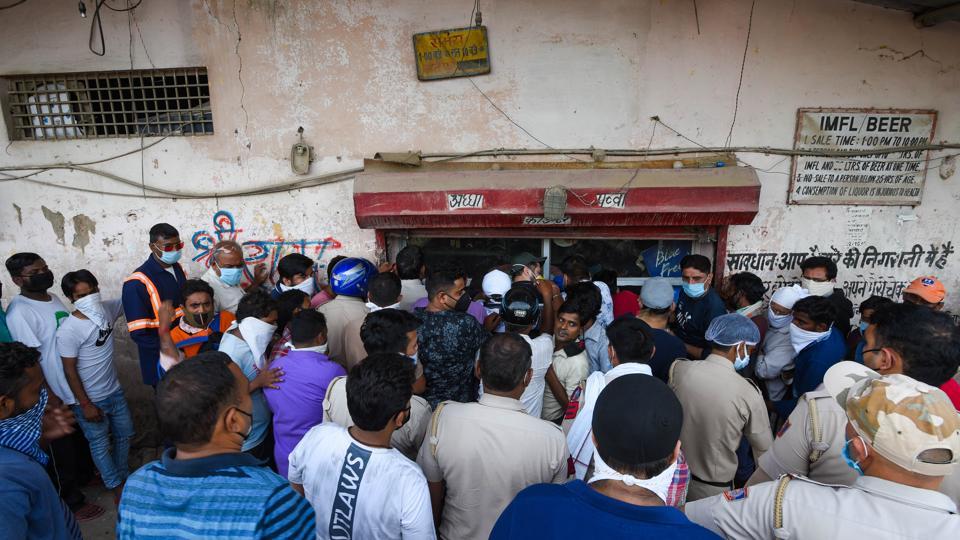
“When you go to a shop, there is a grille and people rush and throw money to buy liquor. There is no dignity. It will no longer be like that.”
A government report on the policy, a copy of which HT has seen, refers to a slew of measures to ensure this. It seeks to improve the buying experience and includes a rule that will need any liquor shop in the city to be at least 500 square feet in size. The shops have to be spacious to allow customers a walk-in experience. The report says the shops cannot have counters facing towards roads. Shop owners will have to ensure that liquor sale and pick-up takes place properly inside the shop premises and there is a proper order outside.
Also Read | Delhi reduces age bar in major liquor reform
“The retail shopping experience for an average customer in Delhi is very pathetic. The scene outside any government vend resembles a zone of a mob craving liquor. The customer has no choice to choose any product and large-scale brand pushing and extra charging happen rampantly. The customers are made to feel like criminals,” the report says.
Brand pushing refers to a practice of suppressing certain brands and pushing others, often at the behest of colluding manufacturers and retailers.
The government seeks to end the current environment around liquor shops which is particularly bad for women.
“The super-premium vends can set up a tasting room within the premise which will have to be an enclosed area, not visible from the rest of the store. This room can only hold training and tasting sessions. The licensee is permitted to have a shop-in-shop concept for exclusive display of various brands in exclusive shelves so that the customers can walk-in into the display for their selection of products,” says the report.
Ankita Kumar, who works with an event management firm, said the new policy if implemented will bring changes to the retail experience of alcohol purchase and also help to gradually reduce the stigma attached. “Currently, the whole environment near a liquor shop is very masculine. I often start doubting if I have come to a place I am not supposed to be in. It is quite unsafe as well. I have been a victim of stalking once when I went to a liquor store in my locality to purchase a few bottles with a friend,” she said.
Vinod Giri, director-general of the Confederation of Indian Alcoholic Beverage Companies, said the rules would mean all the government liquor shops would go and new private ones will be opened instead.
“The government has to ensure that the demand-supply chain is not affected during the transition to full privatisation of the liquor retail sector. The proposed rules also suggest that mostly the big players will be able to get ownership of retail vends even as manufacturers have been strictly asked to stay away from the retail business,” he said.
Officials said keeping big players in retailing will ensure that quality liquor is sold, and the store standards are not compromised with.
The rules seek to end the entire ecosystem that automatically comes up when a liquor shop is opened. “If you see the city’s liquor shops now, invariably they are lined with tiny shops selling snacks, cold drinks, plastic glasses, cigarettes among other things. This leads to crowding of a particular gender [men] around liquor vends and ruins the entire experience, especially for women and even the passer-by,” said an official, requesting anonymity.
“…[there is] an additional condition that the licensee will have to ensure no dry snacks or cooked food outlet gets opened right outside the shop, which encourages people to drink and loiter around,” the official said.
The report says that retail shops can be opened in any of the markets, malls, commercial roads/areas, local shopping complexes, etc as long as the standard rules and regulations of opening a new vend are followed. This includes restrictions on opening vends within a specified distance of schools, religious institutions.
A second official pointed out the entire system of a “theka” will not completely go away.
“These reforms do not mean that country liquor is being banned in Delhi. The government is preparing a separate report on the operational models for the sale of country liquor in the city which will be completed in a few weeks.” The second official said basically, the reforms imply that by and a large majority of the liquor stores in Delhi are set to become bigger and more welcoming in their appeal. “…a few stores selling country liquor shall remain across the city. We hope this will boost not just the liquor and food and beverage industry, but also the excise revenue of the government by ₹1,500-2,000 crore.”
The population-to-vend ratio in Delhi is one of the lowest in the country. Delhi has 849 liquor shops. Yet around 58% of Delhi is either unserved or underserved. Only 8% area of the city is normally served.
“Equitable distribution will ensure less crowding and easy access which will automatically improve customer experience. To make liquor more accessible to people, it is proposed that Delhi will be distributed into 32 pre-defined zones and each zone will have three categories of liquor stores depending on high, medium, and low sales,” the second official said.
Each zone will mandatory have at least two vends in every allocated ward. The remaining will be categorised as freehold, This means that they could be set up in any of the wards under that zone. For clarity, a zone with 27 vends allocated across nine wards will imply that each ward will need to have two vends mandatory. It would make 18 vends as mandatory vends and the remaining nine vends freehold, the report says.
A former excise commissioner, who did not wish to be named, said the proposed rules will potentially overhaul the excise sector of Delhi completely. “…the government’s plans appear to have a holistic approach addressing the loopholes in the liquor business of Delhi. In the past, there were a few attempts by the excise department to exit the retail business, but the government at that time had apprehensions about completely letting go of its control from the sector,” the former commissioner. “Another aspect that is interesting is that the government has allowed liquor retailers and wholesalers to offer discounts. This is something which a few excise commissioners had rooted for in the past, while most others had rejected it saying it would result in revenue losses to the government.”


