E-Paper



Yamuna water level crosses danger mark; river may swell even further
A flood alert is declared in Delhi when the discharge rate from the Hathnikund Barrage crosses the 1 lakh cusecs mark. Cumulatively, more than 17 lakh cusecs of water has been released from Hathinkund barrage on Thursday.

 Prefer HTon Google


Yamuna was flowing above the danger mark at 205.7 metres on Friday a day after large volumes of water was released into the river at the Hathinikund Barrage, located 228 kms upstream in Haryana’s Yamunanagar, even as authorities have started evacuating people living in low lying areas and the floodplain in five districts.
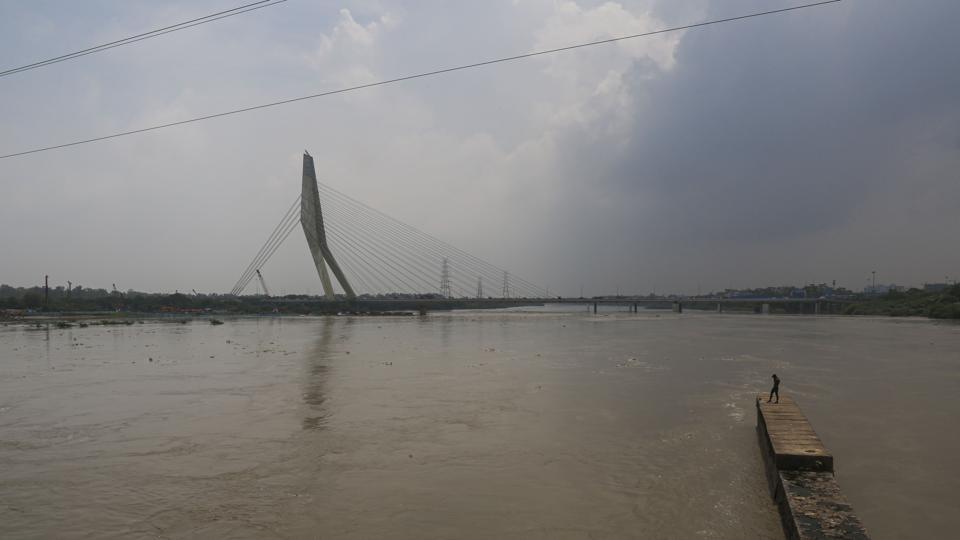
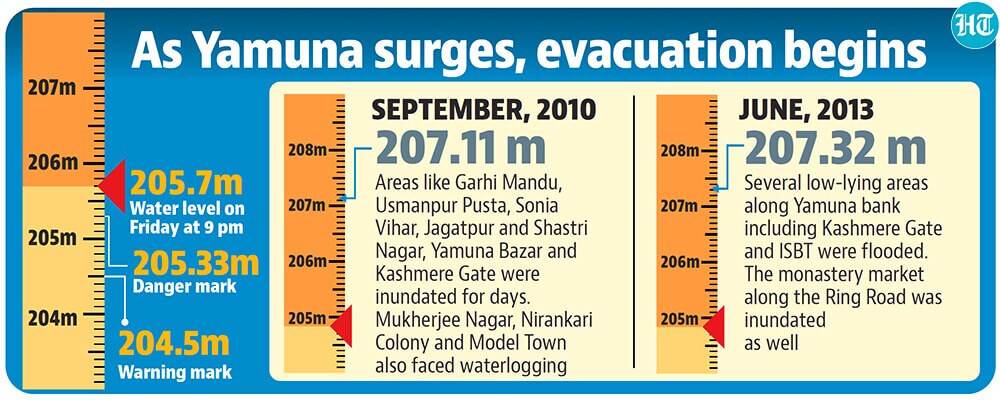
A senior official deployed at the flood control room said that the water level at the old Iron Bridge, which is considered the benchmark for assessing the flood situation in the capital , was at205.7 metres at 9pm on Friday, and it was expected to rise further. “On Thursday, 1 -2 lakh cusecs of water was released at regular intervals from Hathnikund Barrage. Now, around 25,000 cusecs is being released every hour. We are expecting the water level to rise further,” the official said. The water released from the barrage takes 48-72 hours to reach Delhi, the official added.
The city considers 204.5 metre water level at the railway bridge as the warning mark, while 205.33m is considered as the danger level.
The river breached the danger mark at on Friday around 4pm, the flood control room official said.
Lieutenant governor VK Saxena issued an appeal to the people to exercise precaution and not to enter Yamuna. “Due to heavy rainfall in Yamuna’s catchment area, the water released from Hathnikund is expected to reach Delhi on Friday evening. The administration is taking steps to improve security. My appeal to Delhi residents is to not enter Yamuna and exercise caution,” Saxena tweeted.
Delhi recorded its worst flooding in Yamuna on September 6, 1978 when the water level in the river touched 207.49 metres.
A flood alert is declared in Delhi when the discharge rate from the Hathnikund Barrage crosses the 1 lakh cusecs mark. Cumulatively, more than 17 lakh cusecs of water has been released from Hathinkund barrage on hourly basis on Thursday. 1 cusec is one cubic foot of water flow per second. It translates into 28.32 litres of water per second.
The flood forecast sent to the Central Flood Control Room and Northern Railways states that the current indications show that the water level will go up to 206 metres by 2pm on Saturday. Last year, the river had crossed the danger mark of 205.33 metres on July 30, 2021.
Authorities have already initiated protocols to save lives in the five flood-prone districts -- North East, East, North, Central and South East. A sub-divisional magistrate associated with the flood control programme said that the advisory to evacuate people from the low-lying areas has been issued and people have been asked to move to temporary shelters. “In our district, we have deployed 20 boats of which five are on constant patrol. The situation is under control but we have identified community centres where people will be relocated, if water levels continue to rise,” he added.
The flood control department on Thursday advised all sector officers to keep a vigil in their respective areas and take necessary action at vulnerable points by deploying quick reaction teams (QRTs) to warn people residing within river embankments. A total of 34 boats and mobile pumps have also been deployed in anticipation of floods in low-lying areas.
A senior official in the East Delhi district administration said that the district magistrate has ordered that announcements should be made through loudspeakers to urge people to shift to higher areas. “The evacuation will be carried out at larger scale if the water level crosses 206m mark,” official added. It is estimated that around 37,000 people who live in Yamuna flood plains, and a few low-lying area have been earmarked vulnerable. These include areas around Old Iron Bridge, Usmanpur Pushta, Kisan Basti towards ISBT, Kisan Basti towards Seelampur, Garhi Mandu village, MCD toll at Sonia Vihar, Annapurna Mandir, Sabhapur bus terminal and Badarpur Khadar village
In East Delhi, temporary shelters have been formed at Akshadham Pushta, Hathighat Pushta and Ranney Well near DND Flyway
The normal rate of water flow at the Hathnikund Barrage is 352 cusecs, but the discharge increases after heavy rainfall in the catchment areas. In 2019, the flow rate had peaked at 8.28 lakh cusec on August 18-19, and the water level in the Yamuna had hit the 206.60-metre mark.
According to the India Meteorological Department, heavy to very heavy rainfall occurred at a few places in Uttarakhand and Himachal Pradesh on Wednesday. “Widespread rainfall with isolated heavy rain is likely in Himachal Pradesh, Uttarakhand and Haryana on August 14 and 15,” the IMD forecast said.