
 E-Paper



Cities reclaim space under flyovers
Indore pioneered the concept in 2021, when it set up an exclusive sports complex under the Pipliyahana flyover, but many other cities across the country seem to have taken cue

 Prefer HTon Google


A video shared by top Indian industrialist Anand Mahindra on Twitter went viral in March — a group of youngsters playing cricket and basketball in a new sports facility under a flyover in Navi Mumbai. The 2,745 sqm facility under the Sanpada flyover has badminton courts, a skating rink, a box-cricket set-up, and space for yoga, and is already a hit with local residents.
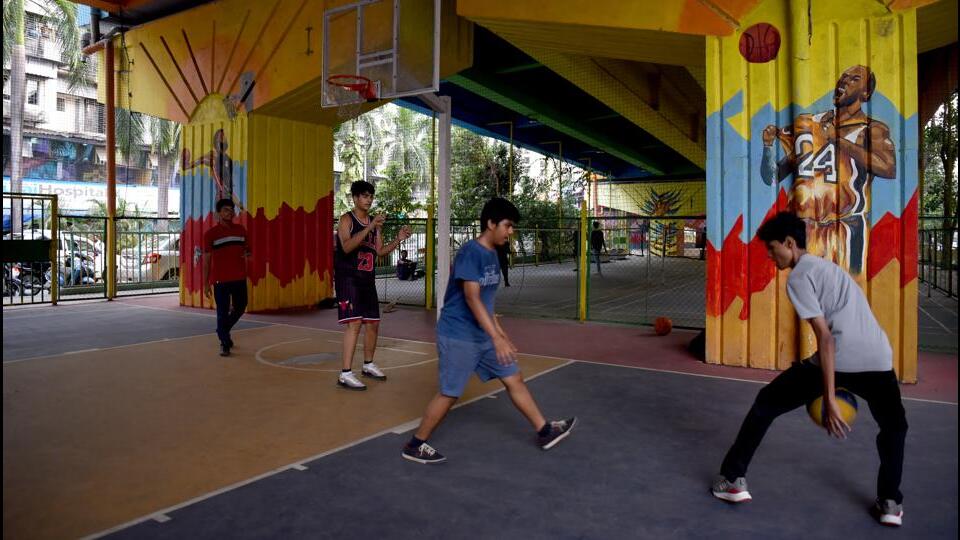
Mahindra shared his video with the message, “Transformational. Let’s do this. In every city”, and his tweet ignited a debate about the merits of the idea, and was retweeted by more than 15,000 people, while the video itself was viewed more than 4.7 million times.
Over the last couple of years, the idea of building sports facilities under flyovers — the empty space variously called leftover spaces, incidental spaces, negative space, or urban voids by urban planners —seems to have caught on.
Indore pioneered the concept in 2021, when it set up an exclusive sports complex under the Pipliyahana flyover, but many other cities across the country seem to have taken cue.
Sanjay Desai, city engineer, Navi Mumbai Municipal Corporation (NMMC), said, “We launched the facility below the Sanpada flyover in October last year, and encouraged by the public’s response, we have decided to create three more such sports facilities under the flyovers.”
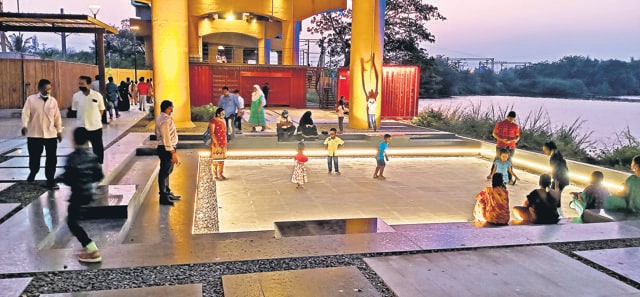
Other cities where this concept has found favour include Chennai, which has created a playfield, a skating ground, a cycling track, a café, and several other facilities under the MRTS bridge opposite Tidel Park. Going a step further, Coimbatore developed a multifunctional space that also has an amphitheatre, an exhibition centre and even a co-working space, redefining spatial typology.
Among National Capital Region cities, the Ghaziabad Municipal Corporation (GMC) developed a sports facility under the Raj Nagar flyover earlier this month, while Delhi’s Public Works Department (PWD) is currently building a sports complex under the Lajpat Nagar flyover.
So what prompted civic bodies from across the country to utilise this “leftover space” for sports facilities?
NMMC’s Desai said, “The Sanpada flyover is in a residential area, where a lot of children used to play on the streets in the absence of sports facilities. So, we thought we could set up a sports complex in the space under the flyover, which had been taken over by squatters… The lack of traffic on the road, along with the length (about 180 metres) and height (about 6.2 metres) of the flyover made it easier for us to develop a sports facility.”
Under the Smart City Mission, Coimbatore has built several facilities under the 700-metre flyover, which overlooks the Valankulam lake. The area, which till three years ago was an unofficial garbage dump, is today one of the most happening public spaces in the city.
“The idea was to create a multipurpose community space under the flyover in the city that does not have many public spaces. I believe there is no limit to what can be created under the flyovers. A city is known by its streets and flyovers are an integral part of the cityscape. With a flyover, you have space and a ready roof over your head, all you need is imagination to build something interesting and useful for the community,” said urban designer and architect Akash Hingorani, who co-founded Oasis Design Inc, the lead design consultant for the Coimbatore project.
NCR authorities join in
The Ghaziabad civic body says that the idea behind building a sports facility under the Raj Nagar flyover was to create “an exciting sporting arena for local youngsters” in a space which was illegally used as parking.
“Currently, we are looking for a private partner to run the facility. There could be a nominal fee to use it in the future. The corporation has used its own funds in this project. But we are now planning to develop other flyover spaces in the public–private partnership model,” said NK Choudhary, GMC’s chief engineer.
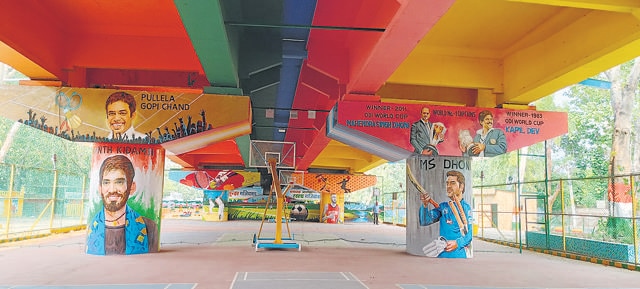
This sports facility was built at a cost of ₹60 lakh and boasts three badminton courts, one basketball court, and a netted batting pitch. The walls and pillars of the complex, which is yet to be formally inaugurated, have paintings of sportspersons, including those of cricket icons Sachin Tendulkar and Virat Kohli.
In Delhi, the PWD plans to develop sports facilities underneath several flyovers, with the one under Lajpat Nagar, which will boast of indoor badminton and squash courts, an open gym, yoga, meditation, and a sitting area, slated for completion in the next few months.“We also plan to develop sports and other facilities under the Karampura and Naraina flyovers. The idea is to remove encroachments from under the flyovers and turn them into vibrant public spaces,” said Vinay Sheel Saxena, executive engineer, PWD.
Delhi has more than 100 flyovers and underpasses, and in its Budget 2023, the Delhi government proposed to build 26 new flyovers, bridges, and underpasses, including three double-decker flyovers. Over the last few years, the Capital has been trying to remove squatters and beautify spaces under its many flyovers. In 2017, for example, the spaces under the Lajpat Nagar and South Extension flyovers were developed into parks with sculptures. However, the project was a failure as the squatters returned within a short space of time.
Experts weigh in
Sewa Ram, professor of transport planning at the School of Planning and Architecture (SPA), Delhi, said using space under a flyover depends on the character of the road, its width, and the density of the traffic. “After all, a flyover is built because the capacity of a certain traffic intersection has been exhausted. The trend of using spaces under the flyover as public spaces is relatively new and has been fuelled by the growing paucity of public spaces in cities. The flyovers were not designed to enable areas underneath them to serve as public spaces,” he said.
Meenakshi Dhote, professor of environmental planning at SPA, said how a city uses the area under the flyover should be the function of the need of the place and the local context. “So, space under a flyover over in a posh neighbourhood can have a small museum and space to display artworks. But I believe local communities should be involved in deciding what should be done with these spaces.”
Oasis Design Inc’s Hingorani said, “In a city like Delhi, which sees extreme weather, spaces under the flyover can be all-weather people’s places. In metros, the land is costly, and no space should be allowed to remain unused and turn into negative space.”
Dhote said, “Encroachments and squatters should not be allowed under flyovers, and future flyovers should be designed keeping in mind the use of the space under it, but without compromising its structural safety.”
The outlier
Not all cities are on board with using leftover space as public spaces
Last week, Bengaluru junked its much-publicised plan of creating a skating rink and basketball court under the flyover at Shivananda Circle after a public outcry. Now, the city plans to develop a public plaza for “people to come, read and relax” under the same flyover.
However, this too has not found favour with residents. “There is no point creating a public space at such a busy traffic interaction, which apart from posing safety risks is not the best of places to relax”, said Krishna Rao, a software engineer in Bengaluru.


