
Sign in

In Gurugram, firecracker traders say business is brisk, booming

Ashok Kumar, who runs Starlight Crackers, said daily sales in the market have gone up to ₹3 lakh, an indication that Gadoli is slowly nudging out Delhi’s Sadar Bazaar, which, until the cracker ban in recent years, reigned as the “cracker market” of the National Capital Region

Published on: Oct 14, 2022, 23:41:59 IST
Share
Share via
  • facebook
  • twitter
  • linkedin
Copy link
  • copy link

Under the garb of selling relatively less polluting “green” firecrackers -- the only kind that is permitted in Haryana -- the wholesale market in Gadoli, about 6km from Gurugram, was doing a brisk business selling regular firecrackers, which are banned across the National Capital Region, a spot check by HT on Friday found.
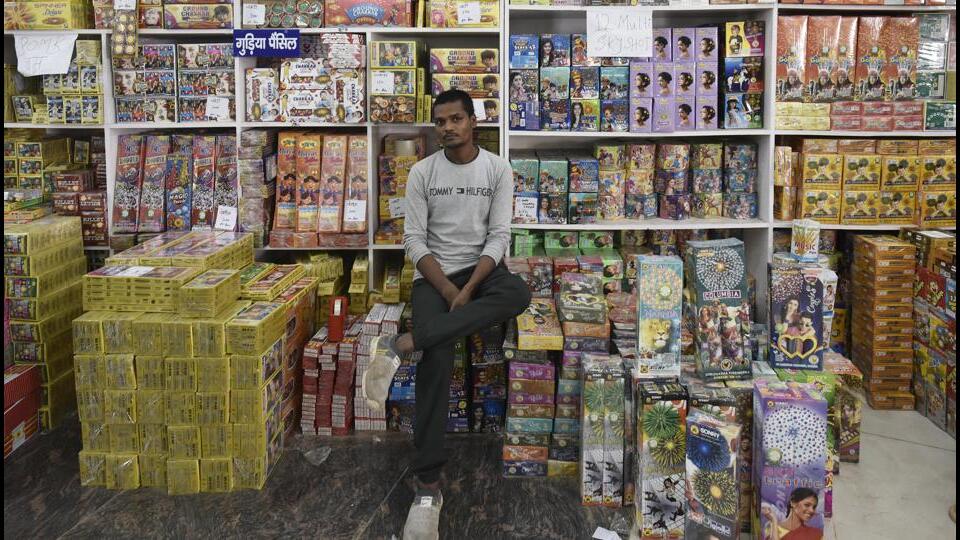
Small shopkeepers from Delhi and Noida are also making bulk purchases of rockets and different kinds of bombs for retail sales in their areas, the shopkeepers said. (Vipin Kumar/HT Photo)

Traders in Gadoli said, despite the Haryana government banning regular crackers this festive season, and Delhi banning firecrackers altogether, their business has doubled as compared to previous years, with people flocking from the Capital and even places such as Meerut and Ghaziabad in Uttar Pradesh.

Ashok Kumar, who runs Starlight Crackers, said daily sales in the market have gone up to ₹3 lakh, an indication that Gadoli is slowly nudging out Delhi’s Sadar Bazaar, which, until the cracker ban in recent years, reigned as the “cracker market” of the National Capital Region.

“People do not even check the logo to see if they are the ‘green’ variety; they are only interested in colours and high decibels -- the louder and more colourful the cracker, the more takers we get,” said Kumar.

Kapil Saini, another shopkeeper, said green crackers are expensive as compared to the traditional ones.

“When we tell customers that, they demand traditional crackers, and we have to keep all varieties so we don’t lose customers. Small-time shopkeepers from rural areas carry ‘green cracker’ stickers with them and paste them on polluting ones to evade police action,” he said.

Small shopkeepers from Delhi and Noida are also making bulk purchases of rockets and different kinds of bombs for retail sales in their areas, the shopkeepers said.

“We have also hired delivery persons who travel by trains, bus and private vehicles to deliver firecrackers to a distance of 150 kilometres but only for those who pay an advance of ₹5,000 and place orders for at least ₹30,000,” said Karamveer Yadav, another shopkeeper.

In Pataudi, Sohna and Farrurkhnagar shopkeepers have set up cracker shops offering 20% discounts.

Ramesh Kumar, a shopkeeper from Sohna, said the market has suddenly seen a spurt in business and the volume of firecrackers sold this year is more than double as compared to 2019, the last pre-pandemic Diwali season . “The craze is back and adding to it is the upcoming cricket match between India and Pakistan (on October 23 at the T20 World Cup),” he said.

Nishant Kumar Yadav, deputy commissioner, Gurugram, said the Haryana State Pollution Control Board (HSPCB) on October 10 has banned the manufacture, sale and use of all kinds of firecrackers, excluding green crackers, until further notice. Yadav said so far they have recovered over 500kg of traditional crackers from Gadoli, Farrukhnagar and Pataudi. “The raids are ongoing and we are sending teams from the areas, we are receiving tip-offs,” he said.

Deputy superintendent of police (DSP), CM’s flying squad, Inderjeet Yadav, said shopkeepers have stocked up green cracker stickers to pass off polluting ones as environmentally safe. “We arrested a leading wholesaler on Wednesday for selling banned crackers and for keeping green cracker stickers. He revealed that green crackers do not have high margins unlike traditional crackers,” he said.

  • Leena Dhankhar
    ABOUT THE AUTHOR
    Leena Dhankhar

    Leena Dhankhar is Senior Editor and Bureau Chief, Gurugram, at Hindustan Times, where she has spent over 17 years chronicling the transformation of one of India's fastest-growing urban regions. From starting her career as a crime reporter to leading the Gurugram bureau, her journalism has been defined by investigative reporting, in-depth storytelling and an unwavering focus on public interest. Over nearly two decades, she has reported extensively across crime, politics, civic governance, elections, real estate, environment, courts, sports, education and entertainment, covering Gurugram, Faridabad, Nuh and Palwal. Her reporting has exposed several major scams and systemic failures, including insurance frauds, waste management irregularities, illegal arms manufacturing units in Nuh, illegal mining in the Aravallis, organised crime networks and governance lapses affecting millions of residents. Known for her investigative work and exclusive stories, Leena has reported on high-impact national issues, including the Nicaragua charter flight carrying Indian migrants that was turned back amid allegations of human trafficking, exposing the growing network of illegal immigration rackets. Her work has also focused on gang wars, prison administration, juvenile crime, women and child protection systems, the functioning of the Juvenile Justice Board and Child Welfare Committee, and environmental challenges such as pollution, waterlogging and deteriorating civic infrastructure. Beyond hard news, Leena has extensively documented Haryana's rich heritage, forests and wildlife, bringing attention to the state's historical landmarks, biodiversity, conservation efforts and ecological challenges through immersive reportage and feature writing. Her journalism has consistently gone beyond breaking news. She has documented Gurugram's rapid urbanisation through long-form narratives and enterprise reporting on issues ranging from pothole-ridden roads, flooding and waste management to the changing social fabric of India's Millennium City. She also writes widely read feature columns, including The Outsider, Changemaker, and Concern for Gurugram, profiling people, places and ideas shaping the city's identity. Leena is the author of Gurugram School Murder, published by Juggernaut Books, a deeply reported account of one of India's most high-profile school murder investigations. She is currently working on her second book, an investigative work exploring some of India's most significant scams and fraud investigations. Beyond print journalism, she has expanded her storytelling through public speaking and digital media. She is a TEDx speaker and has produced podcasts exploring Gurugram's transformation, civic challenges and untold stories. Her work reflects a commitment to narrative journalism that combines rigorous reporting with compelling storytelling. A law graduate with an MBA in Human Resources, Leena brings a multidisciplinary perspective to her reporting, particularly on governance, public policy and legal affairs. She has travelled extensively across India to pursue investigative assignments, often reporting from remote locations and conflict-prone areas in search of stories that matter.Read More