
 E-Paper



Massive encroachments, poor power supply and crime hurting Gurugram Ward 6
Ward six of Gurugram faces issues like road encroachments, damaged roads, inadequate power, poor sanitation, and illegal commercial activities. Encroachments cause traffic jams and health hazards.

 Prefer HTon Google


Ward six of Gurugram, which comprises Sectors 12, 12A, 14, 16, 17C, Old DLF Colony, Sukhrali, Chandan Nagar, Prem Nagar, Acharya Puri, Ganga Vihar, and is home to 150,000 people, is suffering from a variety of long-standing issues such as massive road encroachment, damaged roads, inadequate power supply infrastructure, poor sanitation, and absence of any community centre.
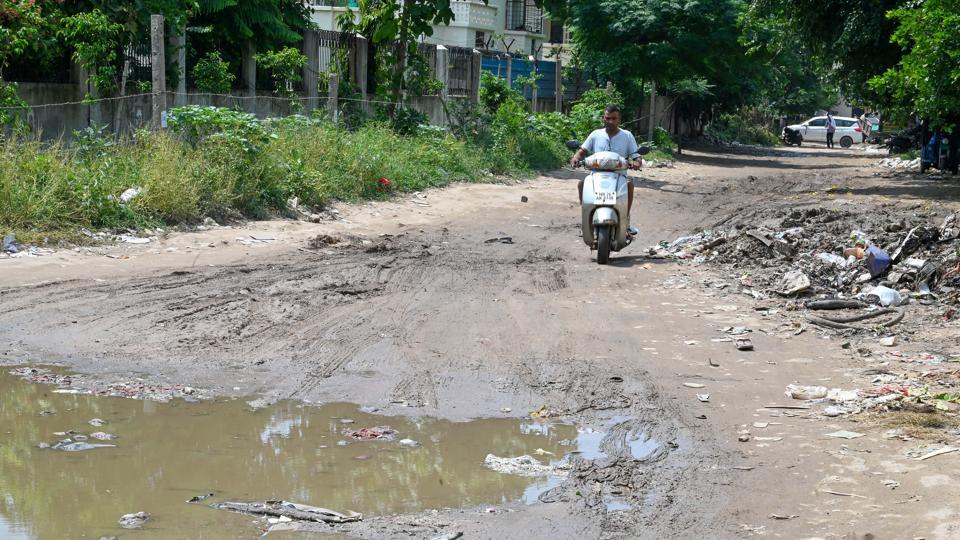
But the biggest problem, say residents, is large-scale encroachment on roads and market areas in most of these areas, which results in massive traffic jams and parking issues.
The Gurugram district administration said it is making continuous efforts to remove encroachments and will soon identify areas that require immediate attention, and direct their removal.
Roadside and market area encroachment
A spot check by HT on Saturday found widespread encroachment on main roads, internal roads, and market complexes of Huda.
Lokesh Bhatnagar, a Sector 14 resident, said that more than 1,000 vendors, mostly eateries, have encroached the Old Delhi-Gurugram Road, internal residential areas of the sectors and the market complex. “The decision of authorities to create vending zones has actually resulted in a mess for the residents as instead of the expected 10, at least 100 vendors have mushroomed. It ends up attracting antisocial elements to the area. The waste generated from these stalls and eateries is either dumped on roadside by their owners or gets washed away in the sewer system, clogging the drains and attracting stray animals,” he said.
Arvind Singh, another resident, said, “One of the parking areas of the Old DLF Colony has been completely encroached with such small eateries and authorities could be seen nowhere even after multiple complaints to them.” He added that many of these vendors serve unhygienic food, spreading diseases among people.
The encroachments have also resulted in the extreme narrowing of sector roads, the Old Delhi-Gurugram road and MG Road.
Main roads, sector roads in poor shape
MG Road and the Old Delhi-Gurugram Road, which are the two main roads that connect most of the areas of this ward, have been in a poor condition for years and none of the civic agencies has repaired them. These roads, which connect the centre of the city directly to Delhi were repaired overnight last year when G20 events were being held but they again returned to a poor state soon, raising concerns about the quality of the original condition of the road and the repairs. An HT spot check found that there are bad patches and potholes on these two major roads, and hardly a lane is available for vehicular movement due to the encroachments.
Residents also said that there is no pavement on either road for pedestrians. Many residents questioned why MG Road was in a good shape and well maintained from the Gurugram-Delhi border uptill Iffco Chowk but is broken past that near Sector 17C and Sukhrali.
Large-scale commercial activities from residential areas
Residents say that large-scale illegal commercial activities are being carried out from residential premises in Sectors 12, 14, and 17. Several houses have been converted into paying guest (PG) accommodations or hostels in the last 10 years, which has increased the burden on road, sewer and power supply infrastructure. They alleged that officials are aware of the illegal activities and are taking no action.
“Most of these buildings are being used for running PGs. The owners, who mostly live outside the city, lease out their entire building to someone who gets them converted into PGs. What was originally a space for a few thousand residents now houses more than 300,000 to 400,000,” said Ankit Chauhan, a resident of Sector 12.
The area is also prone to criminal activities such as chain and mobile phone snatching, and eve teasing, say residents. Police said at least four vehicles are stolen from the area every week and more than three snatching cases have been reported per week, said police.
Clogged sewers, poor sanitation
The population growth in the ward in the last six to eight years has increased the pressure on the sewerage systems, roads and power supply infrastructure, resulting in waterlogging and frequent power outages.
The massive roadside encroachments add to the problem of clogged sewers, as the drains are unable to handle the waste generated by the eateries and vendors.
Ajay Kumar, a Sector 17C resident , said that there used to be a strength of at least 30 sanitation workers for each of the sectors in the ward but after recent changes in garbage lifting agencies, their count has dropped tremendously.
“Garbage is not picked daily which ends up getting littered everywhere as the bins start to overflow. Further, they are scattered by stray animals such as cows and dogs in search of food. Ragpickers do the rest of the work in scattering them to pick something useful for themselves,” he said, adding that it ends up causing severe hygiene problems for residents and making it difficult to move pedestrians who already face problems due to damaged roads.
Officials said that the ward lacks manpower for sanitation due to which the garbage lifting work doesn’t take place on time on most of the occasions from these sectors and they can be seen remaining littered roadside all the time.
Anup Singh, the former councillor of ward six, said that there used to be at least 30 sanitation workers for each sectors in the past. “However, with changes in the tenders and contractors of the Municipal Corporation of Gurugram, their numbers dwindled and now it is actually not known how many are deployed per ward. Their number is now small resulting in the sanitation problems,” he said.
He said that encroachment and bad roads are the biggest problems of the ward for which civic agencies need to act.
Nishant Kumar Yadav, the deputy commissioner, said, “We have already requested GMDA (Gurugram Metropolitan Development Authority) to take swift action in removing encroachments across the district. Continuous efforts are being made to tackle these issues, and we have identified the key areas that require immediate attention. The concerned teams will be directed to ensure that these problems are resolved at the earliest, with a focus on restoring order and accessibility in the affected areas.”
New community centres
Ward six will also become the first ward in Gurugram to get two community centres with clubs, libraries and indoor games of which one will be located in Sector 12 and the other in Sector 14. The latter is expected to start functioning from January next year while the other one in Sector 12 in the next three years.
“This ward is the first Gurugram which will soon have two community centres with clubs,” said Anup Singh, adding that it took him a lot of time to get these two projects sanctioned. “These two centres will have a stilt plus three floors of which the first floor will be used as a community centre and others as clubs especially for senior citizens with libraries and indoor game facilities.” The centres are being built at a cost of ₹40 crore.


