
 E-Paper



Shankar Chowk to get pedestrian subway, panel formed to conduct survey
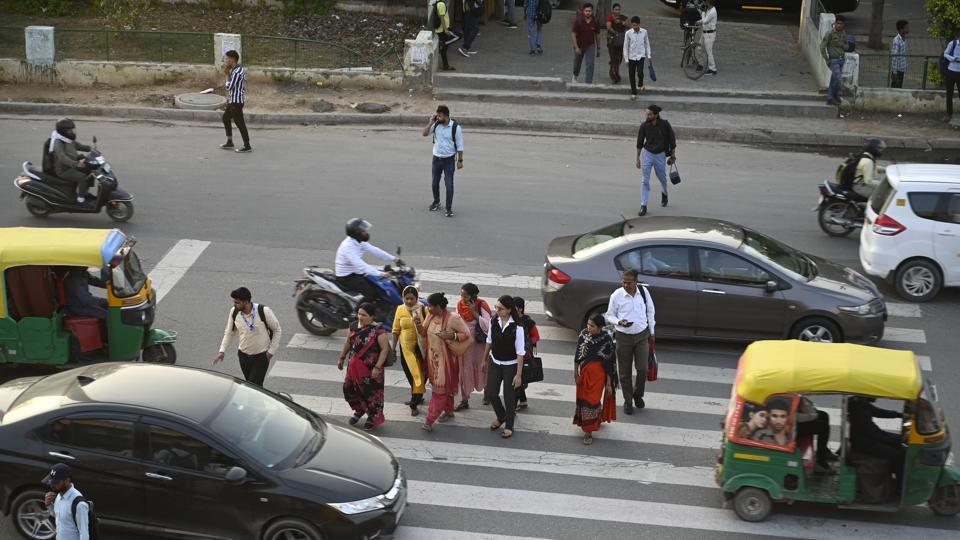
The Gurugram district administration on Tuesday formed a four-member committee to build a pedestrian subway between Cyber City Rapid Metro station and Udyog Vihar and directed the members to analyse the Shankar Chowk intersection, on the Delhi-Gurgaon Expressway, for pedestrian safety and accident fatalities and submit a report to the deputy commissioner suggesting measures to resolve pedestrian issues

 Prefer HTon Google


The Gurugram district administration on Tuesday formed a four-member committee to build a pedestrian subway between Cyber City Rapid Metro station and Udyog Vihar and directed the members to analyse the Shankar Chowk intersection, on the Delhi-Gurgaon Expressway, for pedestrian safety and accident fatalities and submit a report to the deputy commissioner suggesting measures to resolve pedestrian issues.
The committee comprises officials from the district administration, Gurugram traffic police, Gurugram Metropolitan Development Authority (GMDA) and a DLF official.
Shankar Chowk is among Gurugram’s most accident-prone spots owing to the high volume of traffic and pedestrians there and signal-free traffic movement. Sixteen people have died at the intersection since 2017 and four of them were pedestrians.
Gurugram deputy commissioner Nishant Kumar Yadav said they are revamping all major intersections in the city and want to ensure pedestrians can safely cross the stretch. “We have planned to provide a safe passage to the pedestrians who travel to work to Udyog Vihar, Cyber City and Golf Course Road. The volume of traffic is high on the entire stretch and speeding has been one of the main cause of accidents,” he said.
Yadav said the intersection will be designed with modern facilities.
Officials said during peak hours, hundreds of cyclists and pedestrians actively jaywalk between Udyog Vihar and Cyber City leading to vehicular congestion.
Amit Godara, executive engineer of Infrastructure 1, GMDA, said DLF is responsible for the constriction of the subway but the length of the subway is yet to be decided. “DLF has engaged Aecom as their infrastructure consultant and will share details shortly after which we will share our concerns and discuss the plan.Once finalised, the subway plan will take a year to execute,” he said.
Godara said currently the stretch is a high-speed corridor and working professionals do not have a safe way to cross from CyberHub to Udyog Vihar and vice versa. “At least 250,000 people travel both ways of the expressway for work and also cross the intersection. A subway at Shankar Chowk will not only benefit pedestrians but also reduce pressure on the main carriageway,” he said.
Officials said the plan is to reduce fatalities on the entire expressway and to ensure safety of both motorists and pedestrians.
Sarika Panda Bhatt, director, Nagarro, and co- founder, Raahgiri Foundation, said Shankar Chowk has a high rate of accidents involving pedestrians and vehicles. “The intersection is a major crossroad in the city, with heavy traffic flow from different directions, making it difficult for pedestrians to navigate safely. Pedestrian infrastructure is important because it provides safe and accessible routes for people to walk, run, and also cycle. Pedestrian infrastructure includes sidewalks, crosswalks, pedestrian crossings, pedestrian signals, street lighting, and other features that make roads safe for pedestrians,” she said.
Panda said in the case of Shankar Chowk, better pedestrian infrastructure such as dedicated pedestrian crossings, pedestrian signals, and wider sidewalks can help reduce the risk of accidents involving pedestrians. “These improvements can also encourage more people to walk, which can have numerous benefits for public health, the environment, and the economy,” she said.
Godara said already, a pedestrian underpass connecting Maulseri road and Shankar Chowk is being built. “The construction started on February 20 and will be ready by October this year. The project cost is nearly ₹25 crore and will be borne by DLF,” he said.
Last year in April, to reduce congestion at Shankar Chowk, the Haryana State Industrial and Infrastructure Corporation (HSIIDC) had opened a new U-turn on the leftmost service lane of the expressway, which leads commuters towards Cyber City and Udyog Vihar.
Gayatri Paul, CEO, DLF Foundation, said, “With increasing commercial development on both sides of the NH-48 , the project “Saving Lives Through Safer Roads” will ensure that there is safe pedestrian movement across the highway and a large number of pedestrians will be saved from crossing the road amid speeding traffic thereby exposing themselves to greater risk of accidents.”


