
 E-Paper



Waterlogging, traffic diversions bring key Gurugam stretches to standstill
To be sure, medium and heavy goods vehicles were banned from entering Delhi through the Gurugram borders from 5pm on Thursday to 1.30pm on Friday, in view of security arrangements.

 Prefer HTon Google


A short spell of light rainfall on Friday morning brought key Gurugram corridors to a standstill, as waterlogged roads and traffic diversions for Republic Day arrangements in Delhi put residents through a monsoon-like scare. However, traffic police said that the situation normalised by evening.
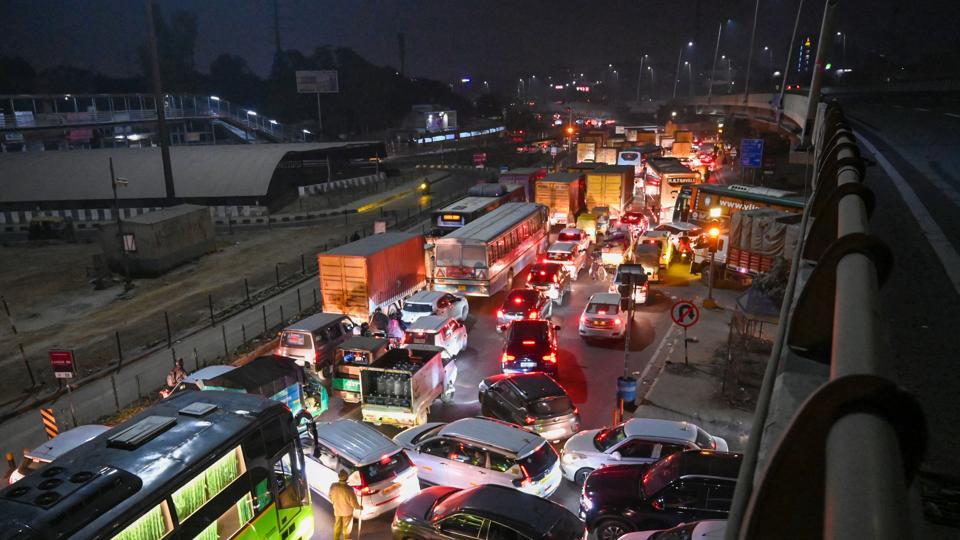
To be sure, medium and heavy goods vehicles were banned from entering Delhi through the Gurugram borders from 5pm on Thursday to 1.30pm on Friday, in view of security arrangements. They said a similar restriction will be in place from 5pm on January 25 to 1.30pm on January 26.
Vikash Kumar, public relations officer for Gurugram traffic police, said that vehicular movement was slow on the Delhi-Jaipur expressway near Narsinghpur and near Hero Honda Chowk due to waterlogging.
“Dewatering pumps were already installed there to remove excess water from roads. Traffic might have moved slow at some locations due to rain but there was no severe snarl,” he said.
Kumar said that only essential category or perishable item heavy vehicles are being allowed to move towards Delhi. “Zonal officers along with their teams had remained deployed across various key locations across the city Friday to continue to regulate traffic movement looking at the forecast of the rainfall,” he said.
Traffic police officials advised commuters to plan travel in advance, avoid peak hours where possible, and follow official diversion updates as restrictions remain in place for the Republic Day period.
On the day, commuters reported a two-hour traffic snarl during the morning peak hours on Sohna Road, Golf Course Extension Road, Golf Course Road and the Delhi-Jaipur Expressway (NH-48), affecting officegoers and schoolchildren.
Traffic police said congestion intensified as vehicles moved slowly amid wet road conditions and diversion-related rerouting, leading to long queues at multiple junctions, including Rajiv Chowk.
Commuters, however, said the combined impact of rain and diversions left them stranded. “I left early from Sohna Road, but it still took me more than two hours to cross the main stretch towards my office. Traffic was barely moving,” said Amit Kumar, a private sector employee.
A resident commuting via Golf Course Extension Road said delays were unavoidable. “The rain slowed everything down, and the diversion routes added to the chaos. It took me close to two hours to reach my workplace,” said Ritika Sharma, who works in Cyber City and is a resident of Emaar Palm Drive.
At Rajiv Chowk, one of the busiest junctions in the city, commuters reported bumper-to-bumper traffic through the morning. “I was stuck near Rajiv Chowk for a very long time. It took over two hours just to cross the stretch and merge onto NH-48,” said Sandeep Yadav, a commuter heading towards Delhi.
Many localities were also severely waterlogged in the morning hours, with affected localities including Jacobpura in Sector 12, Sheetla Mata Road, Basai Road, Sector 69, slip roads along Chinmaya Marg in Sector 49, Rajendra Park and New Palam Vihar in Sector 110.
Residents of Sector 69 said that the 60-metre-road that connects all the societies in the sector were waterlogged.
“Waterlogging in Sector 69 has become a critical issue during rainfall and has turned this residential and commercial hub into a high-risk flood zone. Though the area is considered to be among the newer localities, it faces acute water accumulation even after moderate rain, often crippling daily life,” said Sameer Bhat, a resident of Tulip Purple, Sector 69.
Commuters said there was severe waterlogging on the Sheetla Mata Road. “We were stuck there for a while. The city could not cope with the first rain of the year, which raises questions about the administration’s monsoon preparedness. It feels like this year may not be very different,” said Saksham Malik, a regular commuter on Sheetla Mata Road.
Residents of Rajendra Park also reported waterlogging in their locality, which frequently faces flooding during rains, with several lanes also remaining inundated with sewage. “Every lane in our area was flooded. All the promises made by civic officials and the government have failed. This shows what we can expect this year as well,” said Rajesh Patel, a resident.
The affected areas also included Narsinghpur, Iffco Chowk and Basai road.
A senior official of Gurugram Metropolitan Development Authority (GMDA) said, “Our teams are on ground to clean road gullies, remove debris from drain openings to facilitate quick discharge of stormwater.”
In a recent meeting on Wednesday, MCG officials shared that 70% of the desilting of the sewerage lines, and the remaining will be done by April-end. MCG commissioner Pradeep Dahiya, officials discussed 40 critical points of the city where such complaints were reported.
An official from MCG said that pumps have been installed at Narsinghpur, Iffco Chowk to remove the wayerlogging situation. “Our monsoon management cell (MMC) is working towards desilting of the drainage and sewage so the waterlogging situation does not persist further,” he said.
Yash Jaluka, additional commissioner of MCG, said that remedial work is underway at the 40 locations, including Jacobpura, Rajendra Park, Begumpur Khatola, Shivaji Nagar and Narsinghpur, and is expected to be completed soon.


Stay updated with all the Breaking News and Latest News from Mumbai. Click here for comprehensive coverage of top Cities including Bengaluru, Delhi, Hyderabad, and more across India along with Stay informed on the latest happenings in World News.


