
 E-Paper



Hotspots in Haryana, Punjab, HP and J&K down to 10, many districts in orange zone now
Haryana’s Sonepat and Faridabad, while Punjab’s Jalandhar, Patiala and Ludhiana besides J&K’s Bandipora, Shopian, Anantnag and Srinagar; and UT of Chandigarh are now hotspots or red zones


The number of hotspots or red zones from the four northern states of Haryana, Punjab, Jammu and Kashmir, Himachal Pradesh; and the union territories of Chandigarh and Ladakh were reduced to 10 from 29 on Thursday night by the Union ministry of health and family welfare (MoHFW).
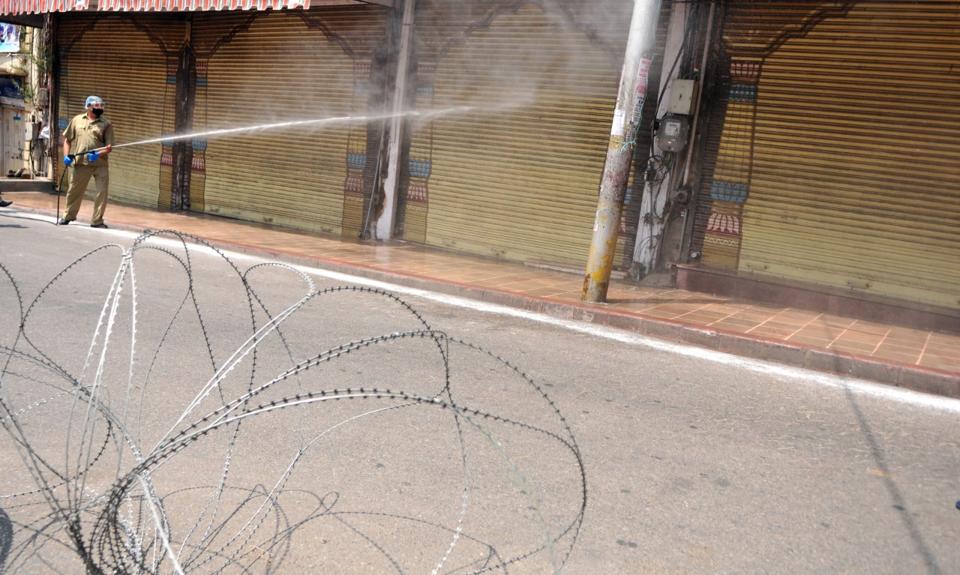
The new classification of districts, as per the Union health ministry, is multi-factorial and takes into consideration the incidence of cases, doubling rate, extent of testing and surveillance feedback.
A number of existing hotspot districts, consequently, have been dropped into the orange zones and may make it to the green zone subsequently, officials said.
“It is important to ensure that we identify pockets of critical interventions for a focused management of Covid-19 at the field level,’’ said Union health secretary Preeti Sudan in an April 30 communication to the chief secretaries of the states. The fresh list of hotspots came after cabinet secretary Rajiv Gauba held a video conference with chief secretaries of the states on Thursday.
Himachal, Ladakh have no hotspot now
Haryana’s Sonepat and Faridabad districts are now designated as hotspots or red zones in terms of Covid-19 spread. The state earlier had six hotspot districts in Nuh, Gurgaon, Faridabad, Palwal (hotspots with large outbreaks) and Ambala and Karnal (hotspots with clusters), as per the MoHFW classification of April 15.
Similarly, Punjab now has only three hotspot districts: Jalandhar, Patiala and Ludhiana as compared to the eight earlier, namely Mohali, Shaheed Bhagat Singh Nagar, Jalandhar, Pathankot (hotspots with large outbreaks) and Amritsar, Mansa, Ludhiana and Moga (hotspots with clusters).
Jammu and Kashmir now has four hotspots, namely Bandipora, Shopian, Anantnag and Srinagar as compared to the eight earlier – Srinagar, Bandipora, Baramulla, Jammu, Udhampur, Kupwara (hotspots with large outbreaks) and Shopian and Rajouri (hotspots with clusters).
No districts of Himachal Pradesh (HP) and Ladakh have been categorised as hotspots. HP earlier had five hotspots with clusters in Solan, Una, Kangra, Chamba and Sirmaur, while Ladakh had Kargil.
The Union Territory of Chandigarh, which was declared a hotspot on April 15, continues to remain so.
Classification criteria broad-based
Broad-basing its criteria for labelling districts as red, orange and green zones, the Union health ministry on Thursday night categorised 18 Haryana districts into orange zones, and the remaining two in green zones. The existing hotspot districts of Nuh, Gurugram and Palwal have made it to the orange zone.
The Union health secretary said that districts were earlier designated as hotspots or red zones, orange zones and green zones primarily based on the cumulative cases reported and the doubling rate. “Since the recovery rates have gone up, the districts are now being designated across various zones by broad-basing the criteria,’’ Sudan wrote.
A district will be considered under green zone if there are no confirmed cases so far or there is no reported case for the past 21 days, Sudan said.
“Some states have raised issues on the inclusion of certain districts in the red zone. I would like to highlight that this is a dynamic list. The list will be revised on a weekly basis or earlier and communicated to states for further follow-up action in consonance with the directions issued by Union home ministry under the Disaster Management Act,’’ the Union health secretary said.
States at liberty to classify red zones
The Central government though has also given the liberty to the state government to designate additional red or orange zones based on the field feedback and additional analysis at the state level. But they have been asked not to relax the zonal classification of districts classified as red or orange by the Union ministry. The Central government has emphasised that necessary action for containment be taken to break the chain of transmission of virus in both red and orange zone districts reporting confirmed cases.
New criteria for containment zones
Modifying the criteria for the demarcation of containment zones in districts, the MoHFW said that a residential colony/mohalla/municipal ward or police-station area/municipal zones/towns can be designated as containment zones in urban areas.
The containment zones in these districts have to be delineated based on mapping of cases and contacts, geographical dispersion of cases and contacts, area with well demarcated perimeter and enforceability. For rural areas, villages/clusters of villages or group of police stations/gram panchayats/blocks can be designated as containment zones.
“The area should be appropriately defined by the district administration/local urban body with technical inputs from the local level,” the communication said.


