
 E-Paper



Welfare schemes get lion’s share in Mamata govt’s Bengal budget
BJP legislator Ashok Lahiri, who was earlier the chief economic adviser to the Centre, said the budget was an advertisement minus the mandatory disclosure clause.


Welfare schemes, infrastructure, special rebate on stamp duty and amendments in road tax were the highlights of the ₹3,08,727 crore budget for 2021-22 that the Trinamool Congress (TMC) government placed before the West Bengal assembly on Wednesday, around two months after being sworn in for the third time since 2011.
The government said it was optimistic about creating 15 million new job opportunities in five years as committed in the interim budget presented on February 5 this year.
The total revenue receipt for 2021-22, including grants in aid from the Centre, would be ₹1,86,681.26 crore and total revenue expenditure for the period would be ₹2,13,346.51 crore, the budget papers said. The expenditure on social welfare schemes would be ₹1,07,494.74 crore.
Since finance minister Amit Mitra is unwell, the budget was placed before the House by industry and commerce minister Partha Chatterjee.
“Our State’s economy has grown steadily in the last ten years. Gross state domestic product (GSDP), which was ₹4,60,959 crore in 2010-2011, has increased to Rs. 13, 54,518 crore in 2019-20, an increase by 2.94 times…. Expenditure in the social sector increased 10.11 times between 2010-11 and 2020-21. Similarly in the agriculture and allied service sector the increase was 10.50 times and in physical infrastructure sector it was 5.58 times,” Chatterjee said in the budget speech.
Giving credit to chief minister Mamata Banerjee, who was also present in the House, Chatterjee said, “While India’s GDP growth dipped to minus 7.7% in 2020-21, Bengal’s GDP clocked a positive 1.2% growth from 11.3 %.”
“The state has also successfully controlled all fiscal parameters like fiscal deficit, in spite of severe financial hardships in the last one year caused by the Covid-19 pandemic and cyclones Amphan and Yaas,” he said.
Chatterjee focused on several social welfare schemes such as Duare Sarkar (government at the doorstep), the Swasthya Sathi medical insurance scheme and the recently launched student credit card.
Offering financial relief, Chatterjee said that in view of the economic hardship faced by people the government will extend the one-time exemption on motor vehicle tax and additional tax from July 1, 2021 to December 31.
Also, in view of the crisis in the real estate sector, the government reduced the rate of stamp duty by 2% from 4 to 8% depending on location, character and price of property. Also, the circle rate or market value for registration of deeds for land, house and flat etc. has been reduced by 10% . Both facilities can be availed only if the registration process is completed by October 30.
Virtually addressing the media from his home after the budget was placed, the finance minister said, “We have always focused on giving more money to common people so that demand is stimulated. This will boost industries. The whole world is focusing on macro economics. The Centre’s policy, on the other hand, is to offer loans and reduce corporate tax. What has this achieved?
Without elaborating on the large borrowings by the state to meet the shortfall in income, Mitra said, “processing of loans has been provisioned in the budget.”
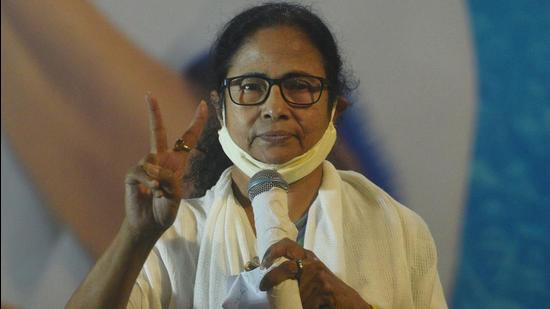
“The budget shows that we have done what we promised in the election manifesto,” said the chief minister.
The opposition Bharatiya Janata Party (BJP) criticised the budget saying it was an advertisement minus the mandatory disclosure clause.
“The states follow various methodologies while calculating GSDP. The rate of increase announced by the Bengal government is not correct. The actual increase is by 2.4 %. It is true that in 2020-21 Bengal’s GDP growth was higher than the national rate. But it is also true that in recent years Bengal’s economy has shrunk in comparison to the national average. Had there been so much development people from Bengal would not have migrated to other states for work. This proves Bengal has fallen back,” said economist and BJP legislator Ashok Lahiri who was earlier the chief economic adviser to the Centre.
“The budget talks about welfare schemes but the government has not said how many of these are assisted and sponsored by the Centre. For example, the Pradhan Mantri Awas Yojana is called by a different name in Bengal while the bulk of funds for the scheme come from the Centre. The budget speech did not disclose this,” said Lahiri.
“The implementation of these schemes should be evaluated. We need to find out who and how many benefitted from these. There should be transparency. This government only provides relief, whether by giving food to the poor or pumping out water from flooded areas. But where is the infrastructure that provides permanent relief from these problems,” said Lahiri.
“The finance minister has said that the state government has given 23 million Covid-19 vaccines to people but the budget document does not say how many of these were purchased by it and how many were given by the Centre,” he added.
“The budget is also silent on north Bengal and people from the scheduled caste and scheduled tribe communities,” said Suvendu Adhikari, leader of the opposition in the state assembly.


