E-Paper



Bada Mangal: Forgotten lies Begum Alia, encroached and in ruins her Maqbara
The one who is said to have started Bada Mangal, lies forgotten, with her tomb, Maqbara Alia, decaying rapidly, crying for attention

 Prefer HTon Google


Hidden from the casual onlooker’s glance and tucked away in a narrow lane of the Old City’s Wazirganj area, the tomb of Begum Alia, the Hindu wife of Nawab Shuja-ud-Daula stands tall but in ruins.
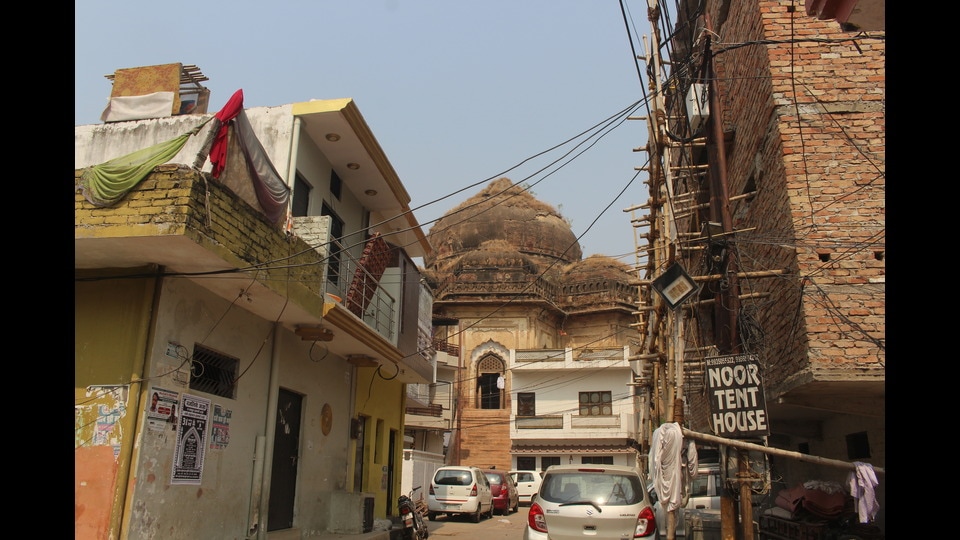
As Lucknow gears up to celebrate Bada Mangal from this Tuesday onwards, the one who is said to have started or popularised the festival, lies forgotten, with her tomb, Maqbara Alia, decaying rapidly, crying for attention.
The 18th Century edifice despite being a protected site under Archaeological Survey of India (ASI) is not only in bad shape but is also falling prey to encroachments from all sides, with dwellings being built such that they share a wall with the monument.
As one enters the mausoleum, trash is seen piled in almost every corner of the multiple partitions inside it. Plaster from the walls and the structure’s dome is falling, and some of the beautiful stone-filigree-work windows have broken, granting easy access to all and sundry. The roof is being used by the locals to fly kites with weeds bursting through all corners of it.
“We have written to officials and efforts are on to begin its preservation from this financial year,” said the ASI’s superintending archaeologist of Lucknow circle, Aftab Hussain.
Begum Alia and Bada Mangal
According to historian Ravi Bhatt, Bada Mangal celebrations in Lucknow have many theories.
One popular folklore is that Janab-e-Alia was a devotee of Lord Hanuman. She saw Lord Hanuman in her dream and she ordered to dig a place near Hewett Polytechnic (previously called Islam Bari) near Rahimnagar.
A statue of Lord Hanuman was recovered in the dig. When an elephant was carrying the Lord’s statue, it sat at a place in Aliganj and refused to move forward.
It was here that a temple dedicated to Lord Hanuman was built by her son, Nawab Saadat Ali Khan, and since then, Bada Mangal has been celebrated.
“Alia was born into a Hindu Raikwar Thakur family but was married to Shuja-ud-Daula, the third nawab. She was also known as Chattar Kunwar,” said Bhatt adding that another folklore says her son Saadat Ali Khan was born on a Tuesday and that’s why he was named ‘Mirza Mangali’ and lovingly, Manglu.
There are other interesting stories regarding how Bada Mangal began.
Centuries back during the Nawabi period, a pandemic-like disease spread in Lucknow and an exodus of citizens began from the city. During this time, many people took refuge in the city’s Aliganj temple in the belief that God would save them. The Nawabi administration and general public contributed to their food. Later, this tradition of contributing to feed the needy continued in the month of Jyestha and took the shape of Bada Mangal.
It is also said that Tulsi Das had come to Lucknow somewhere during 1584 in the month of Jyestha staying at Chachi Kuan temple in Old Lucknow. He saw Lord Hanuman in his dream on Tuesday and since then Bada Mangal is being celebrated.
Once, an attar merchant arrived in Lucknow after hearing about its riches. As he could not sell much, he was disappointed. When Wajid Ali Shah got to know about this, he bought all his attar. He then ordered it to be mixed in the plaster to build Qaiserbagh. Overwhelmed by the sale, the merchant also contributed to renovating the temple in Aliganj.