
 E-Paper



Badaun CBG plant overcomes stubble challenge
The plant procures more than 38K metric tonnes of Parali after agreements between the CBG plant and aggregators, who are willing to buy stubble from farmers and then supply it to the plant. This way, the problem of stubble burning has been checked while ensuring raw material for the plant


Lucknow: A compressed biogas (CBG) plant set up by the Hindustan Petroleum Corporation Ltd (HPCL) in Badaun district of Uttar Pradesh, ready for operation by November 2022, hit a snag as it was not able to arrange raw material ‘parali’ (paddy stubble) to start production. This was despite a staggering 34% of the total land in Bareilly division being under paddy cultivation.
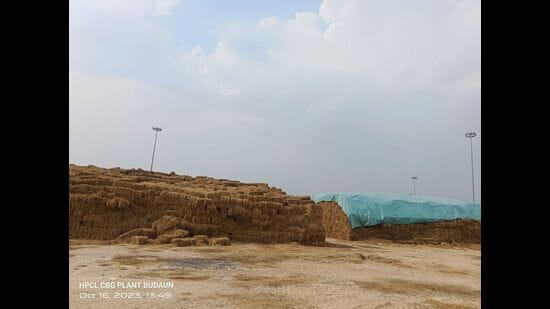
The plant tried to procure stubble from Punjab and Haryana to meet its requirement partially, but the practice did not prove to be sustainable and viable due to the high cost involved in transporting the stuff from outside the state.
“Our plant has the capacity to produce b14.25 tonnes of CBG from 100 tonnes of parali per day. Its annual parali requirement is 35,000 tonnes. But despite all efforts, we were not able to arrange parali to start commercial operation ,” Suvendu Gupta of the HPCL disclosed.
“Today, the plant has already purchased 50% of its annual requirement of 35,000 metric tonnes (MT) of parali from farmers within the region during the current season to start production of CBG from paddy stubble,” he added.
This, it is claimed, has also resulted in an additional source of income for farmers and significant reduction in stubble burning in the division this year.
BEHIND THE SUCCESS STORY
Bareilly divisional commissioner Saumya Agarwal presented this success story as a case study in a video conference led by chief secretary Durga Shankar Mishra here recently and he lauded the efforts.
“When the matter of the HPCL’s Badaun CBG plant lying inoperative due to lack of stubble was brought to my notice, I decided to find a way out. I held a meeting with the departments concerned, Farmer Producer organisations (FPOs) and representatives of the CBG plant,” Agarwal told HT on phone.
“We found that balers, rotary slashers and gyro rakers were not available in enough numbers to cater to the need of cutting, raking and compressing paddy stubble into compact transportable bales or bundles. Besides, a market linkage for selling the crop residue to the CBG plant was also not available,” she added.
With the help of the marketing and the agriculture departments, agreements were made between CBG plant and aggregators who were willing to buy stubble from farmers and then supply it to the plant for ₹3,400 per quintal.
THE IMPACT
As a result, a total of 73 aggregators have already committed to supplying 38,291 MT of ‘parali’ to the Badaun plant. Additionally, efforts to increase the number of highly subsidised balers in the division bore fruit, doubling from 18 in June 2022 to 36 in 2023.
“The impact was swift and profound. Incidents of parali burning, a significant environmental concern, plummeted from 735 in 2021 to a mere 187 in the current year. Besides, the move helped aggregators and farmers enhance their income,” Agarwal, a 2008 IAS officer, claimed.
Jitendra Singh and Gurlad Singh, two aggregators who collect parali from farmers to supply it to the CBG plant in Badaun, said if more CBG plants were set up in the division with the same parali procurement arrangements, stubble burning would automatically be wiped out.
“Though farmers supply parali to us free of cost, it indirectly saves them at least ₹2,000 per acre they have to spend on ploughing their fields to get rid of paddy stubbles,” they pointed out.
THE WAY FORWARD
“An application called Parali Markerplace has been developed which is a directory of all paddy farmers with their contact numbers, details of when they will harvest and amount of parali available, storage places etc,” Agrawal said, adding, “As of now it is in self-registration mode: data of 1,000 farmers with 10085 MT of parali.” The app, according to her, establishes a free, open, transparent parali market, keeps prices in check and any person can directly get in touch with an individual farmer or aggregator and place the order and take supply.
Bareilly division with four districts under it is the highest paddy producing division in Uttar Pradesh. Paddy in the division is cultivated on an area of 5,55,793 hectares which is 34% of the division’s total cultivable land, the highest being in Shahjahanpur district (45%) followed by Pilibhit (39%).
“Bareilly division is now an ideal investment destination for CBG plants due to availability of abundant raw material (parali) that now has a well-established network and market linkages,” she claimed.


