
 E-Paper



Border dispute with China India’s biggest security challenge: CDS
Future wars will not be confined to land, air and water. It will include space, cyber and electromagnetic domains; keep ourselves ready for such a scenario will be a challenge, he says

 Prefer HTon Google


GORAKHPUR Chief of Defence Staff (CDS) General Anil Chauhan on Friday highlighted the unresolved boundary dispute with China as the biggest national security challenge, followed by Pakistan’s proxy war and its strategy of “bleeding India by a thousand cuts”.
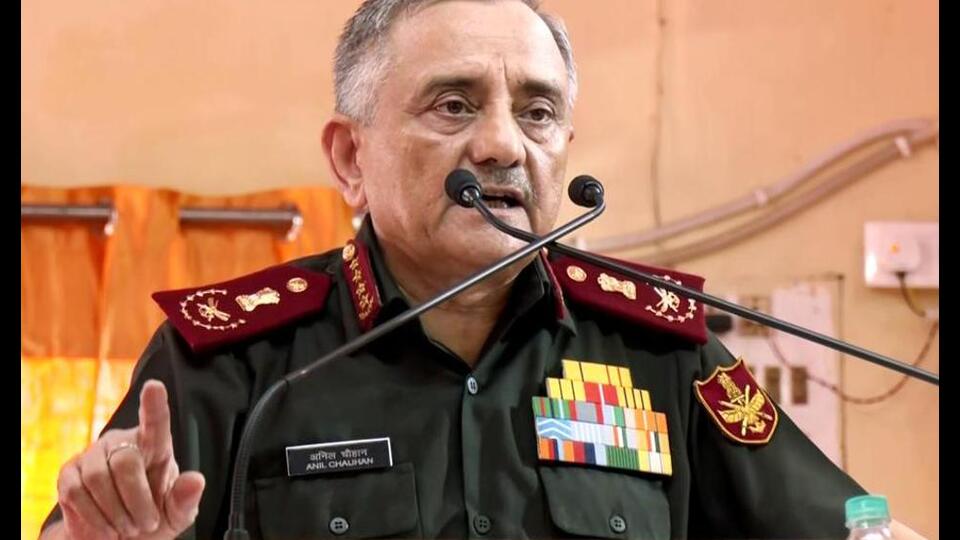
The CDS said dealing with threats emanating from two adversaries with nuclear weapons is another major challenge facing India as it will have to be prepared for any kind of conventional warfare. Chauhan was speaking as the chief guest at a symposium on ‘National Security Challenges Before India’ held at the Gorakhnath temple.
He emphasised that border disputes have historically been at the core of India’s wars and continue to pose formidable security threats.
“I consider the unresolved border dispute with China as the biggest challenge. The second major challenge is the proxy war being run by Pakistan against India. Pakistan’s strategy has been to ‘bleed India by a thousand cuts. It means keep hurting India slowly at a regular interval,” said Gen Chauhan.
The military official said the third biggest security challenge is emanating from the regional instability, especially the way India’s neighbouring countries are facing social, political, and economic unrest.
“The fourth challenge would be what kind of warfare we will have in future. Wars are changing rapidly. Future wars will not be confined to land, air and water. It will include space, cyber and electromagnetic domains. It will be a challenge for us to make adjustments and keep ourselves ready for such a scenario,” he said.
Underlining the importance of ideology, he said it serves as the lifeblood of a nation. “Just as blood is indispensable to the human body, so is ideology for a nation,” he remarked, adding that while a nation’s physical identity lies in its territory, its ideological strength is equally crucial for survival and direction.
The CDS said the armed forces were given full operational freedom to conduct Operation Sindoor and its aim was not only to avenge the Pahalgam terror attack, but also to draw a “red line” on cross-border terrorism.
The National Security Advisor (NSA) played a significant role in planning and implementation of Operation Sindoor in terms of providing guidance to the military that included target selection, deployment of troops, framework for de-escalation and use of diplomacy, added Chauhan. with PTI input


