
 E-Paper



Congress truncating Vande Mataram fuelled separatism, says Yogi
Respect for Vande Mataram not merely an emotional expression, it also instils in all of us a sense of our national duties towards constitutional values, says Yogi Adityanath in Uttar Pradesh assembly


The decision of the Congress to truncate Vande Mataram under its appeasement policy led to cultural division and the Partition of the country, chief minister Yogi Adityanath said in a discussion in the legislative assembly on Monday to commemorate the 150th anniversary of the national song.
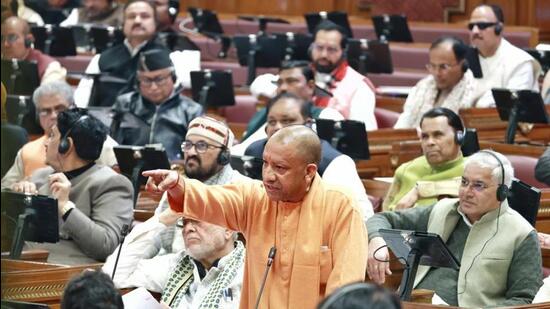
Urging members to read Anandmath authored by Bankim Chandra Chattopadhyay, Adityanath said the respect for Vande Mataram is not merely an emotional expression.
“It also instils in all of us a sense of our national duties towards constitutional values,” he said.
The compromise on Vande Mataram by the Congress was not out of respect for religious sentiments, but the first and most dangerous experiment in the party’s appeasement politics, which fuelled separatism, he said.
“Till Muhammad Ali Jinnah was in the Congress, Vande Mataram faced no opposition. After leaving the Congress, he used the national song as a political tool for the Muslim League, deliberately giving it a communal angle; the song remained the same, only the agenda changed,” the chief minister said.
“In the Congress session held in Lucknow in 1935, Jinnah opposed Vande Mataram. In October 1937 , Jawaharlal Nehru wrote a letter to Subhas Chandra Bose stating that some stanzas of the song needed to be removed. It was a move to “appease” Muslim community. On October 26, 1937, Congress truncated parts of the song under the guise of harmony, sacrificing national consciousness,” he said.
Despite protests by patriots, Congress prioritised vote-bank politics over the nation, he added.
On March 17, 1938, Jinnah demanded the song’s complete alteration, and the Congress did not resist, Adityanath said, adding that this set the stage for growing separatism and the first compromise on cultural symbols, ultimately contributing to India’s Partition.
The chief minister emphasised that opposition to Vande Mataram was political, not religious.
The song featured in all the sessions of the Congress from 1896 to 1922, he said. Leaders like the Maulana Abul Kalam Azad and other senior Congress leaders belonging to the Muslim community said that Vande Mataram was not against Islam, he said.
“Mohammad Ali Jauhar first opposed the song in a Congress session held in 1923. When Vishnu Digambar Paluskar sang Vande Matram, as Jauhar left the dais. Congress bowed to pressure and by 1937 only two verses of the song were allowed in Congress sessions,” he said.
“The truncated version recognised by the Constituent Assembly in 1950 reflected this legacy of appeasement. Vande Mataram is more than a song; it is the soul of India. From the 1905 Bengal Partition movement to the freedom struggle, it inspired the freedom fighters.”
“Rabindranath Tagore called it the soul of India, Aurobindo Ghosh called it a mantra, it featured on the first tricolour hoisted abroad by Madam Bhikaji Cama. Madan Lal Dhingra’s last words were also Vande Mataram,” Adityanath said.
“When ‘Vande Mataram’ was celebrating its silver jubilee, the country was under British rule. After the failure of the First War of Independence in 1857, British rule was at its peak of repression and tyranny. The voice of the people was being suppressed through draconian laws, and torture was being inflicted, but ‘Vande Mataram’ kept the dormant consciousness of the country alive. Even when the country was celebrating its (the song’s) silver and golden jubilees, British rule was still in place. At that time, the platform for advancing the spirit of freedom was the Congress sessions, where Rabindranath Tagore first gave voice to it in 1896. It became a mantra for the entire country,” he said.
“When the centenary of Vande Mataram arrived, the same Congress party that had once given this song, which awakened the soul of the nation, a place on its platform, was in power. However, it then imposed a state of Emergency on the country and stifled the Constitution,” he said.
‘As Vande Mataram completes 150 years, India, under the leadership of Prime Minister Modi, is moving towards a ‘Viksit Bharat’ with confidence. The dream of Bankim Chandra Chattopadhyay, the immortal creator of the national song, is being realised by the new India,” he said.
SP POLITICS LIMITED TO APPEASEMENT, SAYS PATHAK
Freedom fighters sang Vande Matram when they were sent to the gallows by the British government, deputy chief minister Brajesh Pathak said in the state assembly on Monday during a discussion on 150 years of the national song.
Pathak also strongly criticised the Samajwadi Party, accusing it of practising appeasement politics and distancing itself from national values.
“They have nothing to do with Vande Mataram. Their politics is limited to appeasement,” he said.
“Samajwadi Party leaders should read the history and ideals of socialism and introspect. Socialist leaders like Ram Manohar Lohia led a humble life while today the SP leaders live in opulence. When SP is in power they do not raise slogans in support of Vande Matram, but their slogan is that all the vacant plots are theirs,” he said.
Pathak said after becoming Prime Minister in 2014, Narendra Modi said all poor people should have a house, this is the spirit of Vande Matram, they should have drinking water facility, get free ration and medical treatment.
“The SP leaders have nothing to do with the socialist ideology. They take the name of Amedkar, but opposed reservation in promotion for scheduled castes as well as women’s reservation in the Lok Sabha,” he added.


