E-Paper



‘Dard, data, daulat’: Rahul Gandhi voices youth concerns in Prayagraj
Out of every 1000 young people, only 12 land a permanent job, says Rahul Gandhi at ‘Chhatron Ki Goonj’ event in Prayagraj

 Prefer HTon Google


Describing India’s youth population as the country’s greatest strength, Rahul Gandhi, leader of Opposition in the Lok Sabha, on Saturday said educational qualifications are losing their value because degrees no longer guarantee employment despite the significant financial burden borne by students and their families.
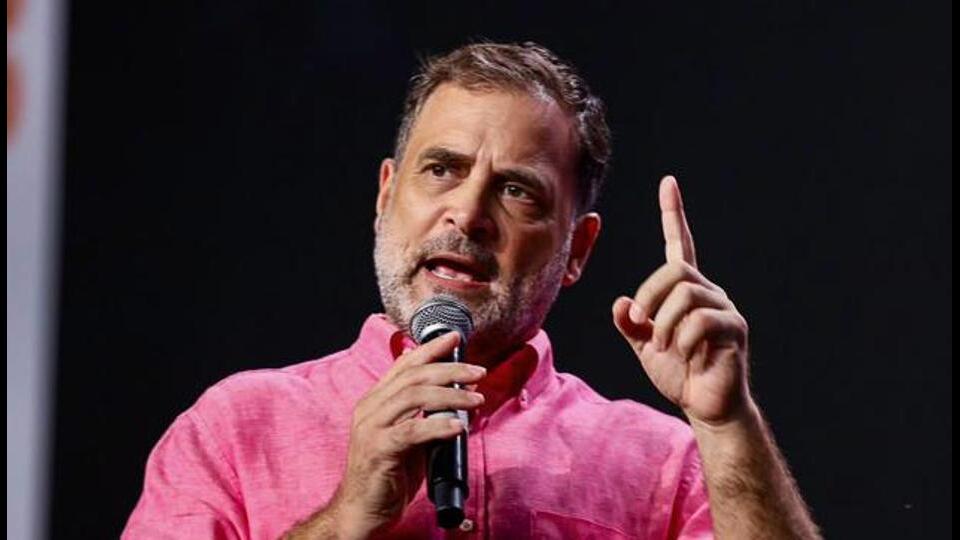
Connecting with youth at the ‘Chhatron Ki Goonj’ event held at KP Ground in Prayagraj, the Congress MP from Rae Bareli said, “You are the power and pride of India. When I say this, I am talking about every Indian citizen. This evening I want to speak to you about dard (pain), data, and daulat (wealth).”
Addressing a large gathering, Gandhi said students pursue education with the hope of securing jobs, but “all the doors” leading to employment have been closed.
He noted no other nation possesses such a large pool of young talent.
Referring to recent student-led protests across the country, Gandhi praised young people for raising their voices against issues affecting them.
“Youths have lit a torch in the darkness by overcoming their fears and speaking up. They have helped bring about change in the country,” he said.
Urging young people to reject hatred and violence, he said, “We will change the system with love and affection.”
Talking about employment, Gandhi stated, “Let me give you the figures: out of every 1000 young people, only 12 land a permanent job.”
The Congress leader warned that the youth are being manipulated by digital platforms to get them “addicted” to social media.
“You are told to watch as many reels as you like, send as many WhatsApp messages as you wish, and browse or create content on Instagram. This is the addiction of the 21st century. You can indulge in this 21st-century addiction, but you cannot get a job; you cannot find employment in this country,” he said.
Gandhi stated that there are 40 crore “energetic young people” in the country who represent the nation’s true strength.
He said that while people talk about China, America, and Russia, all of them pale in comparison to the youth of India and their potential in the 21st century.
Highlighting the importance of data, he said, “In the 21st century, a country’s progress relies on two things: the youth potential that you possess and the data that you generate. India has the youth, and it also possesses the largest volume of data in the world. Every Indian consumes one gigabyte of data daily; future progress will be driven by this data and your potential. Youth plus data equals the 21st-century economy.”
However, Gandhi argued that the primary avenues for employment have been destroyed.
Discussing the manufacturing sector, he said, “The first door is manufacturing. Today, in the world, you’ll see ‘Made in China’, ‘Made in Vietnam’, ‘Made in Bangladesh’, but you won’t see ‘Made in India’. The reason is that demonetisation and the wrong GST have destroyed our manufacturing system. Small businessmen who used to provide employment, and industries like leather, textile, and automobile that used to manufacture in India... all that has been finished. The first door is closed.”
Moving to the second avenue, he criticised the failure of ‘Startup India’ to support the common student.
He stated, “The second door is entrepreneurship, which was called ‘Startup India’. The most important thing in Startup India is bank loans for students like you, and financial support for small businesses. Brothers and sisters, India’s banks will never give even one rupee to students like you. 90% of small and medium industries do not get bank loans. The door to entrepreneurship is closed.”
On the issue of government recruitment, Gandhi pointed to the prevalence of corruption and systemic failure.
He said, “The third door is what we call government jobs, where you face paper leaks. In that door, brothers and sisters, only one out of 150 youths makes it. If 150 youths take an exam and look for a government job, only one youth gets through.”
He further lamented the decline of the public sector, noting that it used to provide employment to 1.4 million youths 10 years ago. “Brothers and sisters, the public sector has been privatised. Public schools were closed, public hospitals were closed... Navratnas were picked up and sold, companies like BSNL were sold,” he added.
Gandhi even expressed concern over the corporate sector, which he claimed is now under threat from technological displacement. “And the last... your last hope, corporate jobs. IT, back-office, transcription, software... where Indian youth used to get employment earlier. That door too, brothers and sisters, is being closed using your data through AI.”
During an interactive session, Rahul Gandhi invited seven students from different universities and colleges to the stage. The students shared their experiences and challenges, highlighting issues ranging from unemployment to shortcomings in the education system.
STUDENTS HIGHLIGHT GAPS IN EDUCATION, RECRUITMENT SYSTEMS
Students and job aspirants highlighted what they described as major shortcomings in the country’s education and recruitment systems.
Participants alleged that repeated paper leaks have undermined the credibility of competitive examinations, while delays in recruitment processes have left thousands of candidates waiting years for appointments. Several speakers also expressed concern over rising higher education costs and increasing fees charged for recruitment applications.
Among those who addressed the gathering was Ajay Raghav, an aspirant for the Uttar Pradesh Sub-Inspector (UP-SI) examination. He claimed that recruitment for the post is conducted infrequently and cited concerns regarding the examination process.
Another participant, Avinash, said he had been preparing for a teaching position since 2018 but had yet to see fresh recruitment notifications despite the existence of vacant posts.
“The government has adopted an arbitrary stand on the issue. A proper vacancy calendar should be released so that aspirants can plan their preparation and careers accordingly,” he said.
Tushar, a student from Patna University, recounted his experience during a student protest held in Patna on July 22. He alleged that police personnel in plain clothes lathi-charged protesters.
“I fell during the protest and was taken on a two-wheeler to a police station, where I was detained for around 15 hours. I was threatened with a false case. Even today, I am facing harassment. My fault is that I was demanding employment opportunities,” he claimed.
Shifath Faiz, vice-president of the Patna University Students’ Union, also referred to the July 22 protest and alleged that students were subjected to police action. She compared the incident with previous crackdowns on student demonstrations in Delhi.
Meanwhile, Allahabad University student leader Kunal Pandey alleged that the university administration had arbitrarily increased fees. He said students were continuing their agitation and demanding a rollback of fee hikes across various courses.
“We are not scared anymore. Students will continue their struggle,” Pandey said.