
 E-Paper



In specialised dist level healthcare, Civil Hospital performs first neurosurgery
In a significant boost to specialised healthcare at the district level, doctors at the Syama Prasad Mukherjee (Civil) Hospital performed their first neurosurgery on Thursday, barely a month after the department became functional

 Prefer HTon Google


In a significant boost to specialised healthcare at the district level, doctors at the Syama Prasad Mukherjee (Civil) Hospital performed their first neurosurgery on Thursday, barely a month after the department became functional.
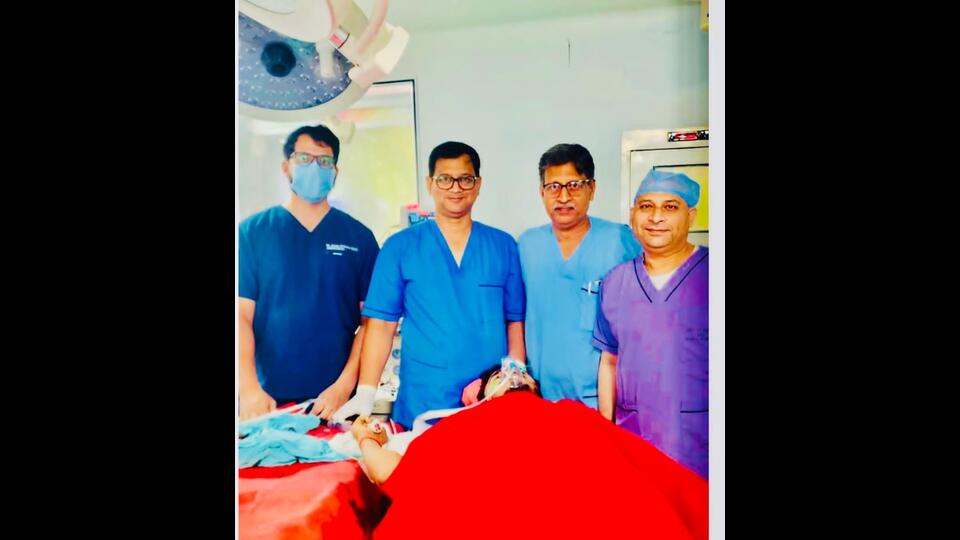
The 10-bed department, which started functioning in the first half of July, performed the complex spinal procedure on a 37-year-old man suffering from spinal tuberculosis and severe neurological compression.
The development is expected to strengthen the capacity of district hospitals to handle complex cases and gradually reduce the load on superspeciality centres such as King George’s Medical University (KGMU), Ram Manohar Lohia Institute of Medical Sciences (RMLIMS) and Sanjay Gandhi Postgraduate Institute of Medical Sciences (SGPGIMS).
The surgery was performed on Vinay Tiwari, a resident of Siddharthnagar, who had been suffering from severe back pain for around 1.5 years. An MRI revealed tuberculosis infection in his L3 vertebra, causing severe compression of neural structures and weakening of the muscles in his left leg. Doctors said delayed treatment could have resulted in permanent weakness or paralysis of both legs.
Neurosurgeon Dr Vinod Kumar Tiwari performed the nearly two-hour procedure, involving L2-L4 spinal fixation using titanium screws and rods. The anaesthesia team was led by Dr Sunil Kumar Singh and included Dr Rajesh and Dr Qasim. Sisters Pooja and Kiran were also part of the surgical team.
The patient’s condition is stable and the strength in his left leg has started improving following the surgery, doctors said.
Civil Hospital director Dr GP Gupta said the first spinal surgery marked the beginning of a larger expansion of neurosurgical services at the hospital.
“It is just the beginning. We will gradually take up brain tumour operations, head injury surgeries and other procedures that require opening of the skull. Our hospital is equipped with an ICU and ventilators, and these facilities are functioning well,” Gupta said.
He said the hospital was also working with RMLIMS to develop a system for superspeciality support.
“We are in discussions with RMLIMS so that patients can be shifted there after surgery whenever superspeciality care is required and receive treatment within the golden period. If necessary, neurosurgery specialists from RMLIMS can also come to Civil Hospital to provide assistance,” he said.
The hospital has procured a microscope, image intensifier and other equipment required for complex neurosurgical procedures, Gupta said.
“With these facilities, we will be able to provide advanced neurosurgical treatment closer to patients and reduce the pressure on KGMU, RMLIMS and SGPGI,” he added.
A shift for district hospitals
Lucknow has four major district-level government hospitals including Civil Hospital, Balrampur Hospital, Lok Bandhu Raj Narain Hospital and Rani Laxmi Bai Memorial Hospital. While Balrampur Hospital already had a neurosurgery department, its services were largely limited to basic procedures.
Civil Hospital’s first complex spinal surgery marks an important expansion of neurosurgical capacity at the district level.
Health officials said strengthening such departments could eventually help patients access specialised treatment closer to home instead of being referred directly to tertiary centres.
Dr Tiwari said a similar procedure in a private hospital could cost around ₹3 lakh. Its availability at a government hospital, he said, would make advanced neurosurgical treatment more accessible to patients who may otherwise struggle to afford it.
Despite several attempts over the phone to get the chief medical officer, Dr NB Singh, on record, he remained unreachable.


